

Carnival of Monsters

Carnival of Monsters is one of the clearest demonstrations of why the Jon Pertwee era is so fondly remembered: an ambitious, idea-driven story that balances spectacle, satire and character with remarkable confidence.
The serial opens by resetting the Doctor’s status quo. Freed from exile on Earth by the Time Lords (see The Three Doctors), the Doctor and Jo Grant finally depart in a fully functioning TARDIS, aiming for Metebelis III. That sense of liberation is immediately undercut when everything goes wrong, and the TARDIS apparently materialises in the hold of a cargo ship crossing the Indian Ocean. The Doctor’s instinct that something is amiss proves correct. Although the setting looks like Earth in 1926, aboard the SS Bernice — a ship that famously vanished on 4 June of that year — time behaves oddly, the passengers repeat themselves without memory, and alien phenomena intrude, most memorably in the form of a plesiosaurus rising from the sea. When the Doctor and Jo discover an invisible hatch made of alien alloy and see the TARDIS seized by a giant hand, the story’s true nature begins to reveal itself.
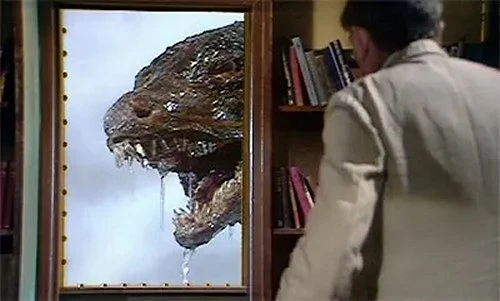
Running parallel to this is the arrival of travelling showman Vorg and his assistant Shirna on the planet Inter Minor. Vorg’s miniscope — a machine capable of containing entire worlds in miniature — is intended as entertainment, not conquest, yet it immediately brings him into conflict with the planet’s ruling elite. The Minorian tribunal, comprising Kalik, Orum and their superior Pletrac, embodies a rigid, class-bound bureaucracy deeply suspicious of anything “alien” or unnecessary. Their cultural paranoia, dependence on the pronoun “one”, fear of contamination and uneasy relationship with their own Functionaries elevate them beyond simple caricature, making Inter Minor feel like a fully realised society rather than a joke at bureaucracy’s expense.

The miniscope itself is the story’s central triumph. Within it, whole ecosystems exist in compressed form, their inhabitants — humans, Ogrons, Cybermen, Tellurians (Humans) and the deadly Drashigs — completely unaware that they are being observed for amusement. The Doctor and Jo, trapped inside the Bernice circuit, struggle to escape repeating loops of behaviour and eventually find themselves navigating the machine’s internal circuitry. Their flight takes them through marshlands inhabited by the Drashigs, huge carnivores who hunt by sense of smell, and leads the Doctor to realise they are inside a compression field — a technology so dangerous it has been banned by the High Council of the Time Lords.
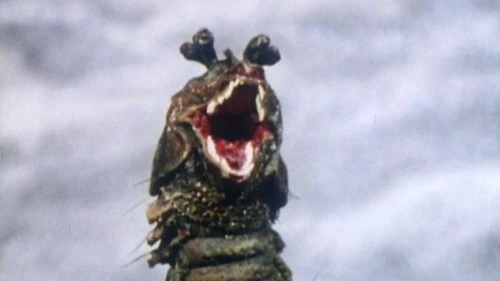
Robert Holmes’ script continually layers ideas. The miniscope allows him to parody 1920s adventure fiction, comment on the entertainment industry’s voyeurism, and introduce political intrigue on Inter Minor. Kalik and Orum’s attempt to engineer a coup by unleashing the Drashigs, undermining President Zarb’s authority, adds genuine stakes beyond a simple breach of import regulations — a subplot Holmes added after script editor Terrance Dicks quite rightly worried the original structure lacked sufficient threat. The resulting chaos, with Drashigs breaking free, repelled by gunfire aboard the Bernice and eventually growing to full size on Inter Minor, provides a thrilling climax. That Kalik and Orum are ultimately devoured by the very creatures they sought to weaponise is both darkly comic and thematically apt.
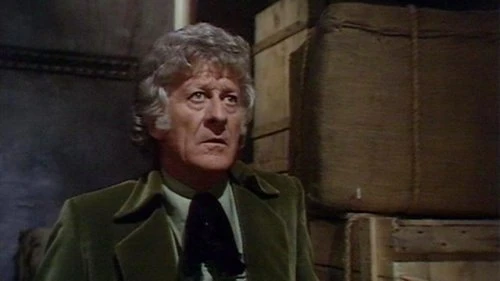
Production-wise, Carnival of Monsters is a minor miracle. Despite obvious budget constraints, it consistently looks inventive and confident. The miniscope sequences cleverly subvert Doctor Who’s own format by turning the Doctor and Jo into performers watched by an in-story audience. Specially recorded footage of Ogrons and a Cyberman — played uncredited by Rick Lester and Terence Denville — avoids reliance on stock clips and reinforces the idea that these are living exhibits, not flashbacks. Even the narrative’s rough edges, caused by post-production trimming of overlong episodes, rarely damage its momentum, though the heavily rearranged cliffhanger between episodes three and four hints at what was lost. Holmes’ inclusion of authentic Polari dialogue for Vorg (a form of slang historically used primarily in the United Kingdom among circus and fairground performers), enthusiastically embraced by Leslie Dwyer and Jon Pertwee, adds texture and charm.
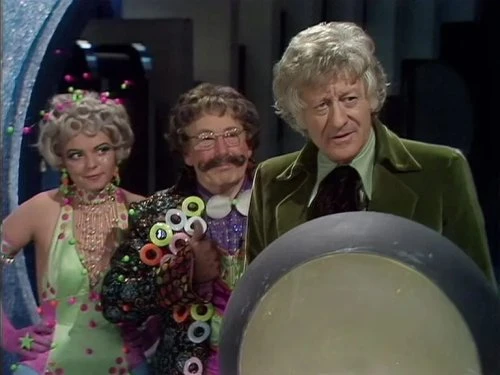
The guest cast is uniformly excellent, and the script gives every character a distinct voice. Leslie Dwyer’s Vorg is warm, wheedling and morally slippery, while Cheryl Hall’s Shirna balances Vorg’s opportunism — his concern for insurance claims over the lives in the miniscope chillingly underlines the story’s ethical core. Michael Wisher, Terence Lodge and Peter Halliday bring real weight to the Minorian officials, avoiding pantomime villainy. Ian Marter makes a strong impression as Lieutenant Andrews, long before he would return as Harry Sullivan, and Tenniel Evans’ Major Daly benefits from the actor’s long-standing rapport with Pertwee, dating back to The Navy Lark.
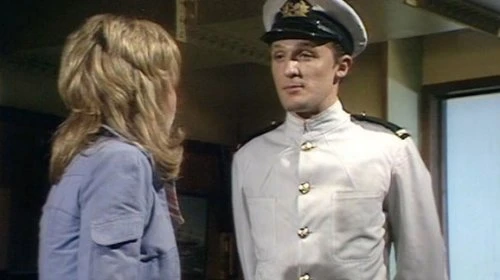
Behind the scenes, the serial has its own rich history. Working titles such as The Labyrinth and Peepshow hint at Holmes’ intentions, though the latter was dropped due to its lewd connotations, much to the writer’s displeasure. Both Cheryl Hall and Jenny McCracken had previously been shortlisted to play Jo Grant, with producer Barry Letts later fulfilling his promise to cast them in other roles after Katy Manning secured the role. Several cast members carried notable Doctor Who pedigrees: Michael Wisher would go on to create Davros, while Peter Halliday had appeared in The Invasion.

Ultimately, Carnival of Monsters stands as a mini-masterpiece. Its premise alone — worlds stored and observed for amusement — is clever, but Holmes pushes further, weaving satire, politics and adventure into a tightly structured narrative that understands exactly what makes Doctor Who work. It is entertaining, unsettling and intellectually playful, a story that turns chaos and order into two sides of the same coin. For newcomers, it serves as an excellent introduction to the classic series; for long-time viewers, it remains one of the most memorable and rewarding adventures of the Pertwee era.
Share on...
Published on January 16th, 2026. Written by Laurence Marcus for Television Heaven.