

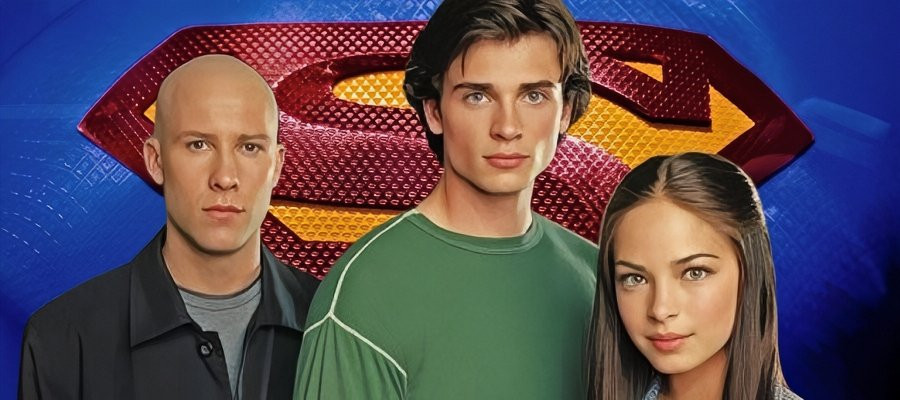
Smallville
2001 United StatesSmallville was developed by writer-producers Alfred Gough and Miles Millar, based on the DC Comics character Superman created by Jerry Siegel and Joe Shuster. Over ten seasons, it transformed one of popular culture’s most familiar icons into a long-form coming-of-age drama, exploring not the finished hero but the uncertain young man he once was. By focusing on Clark Kent before he becomes Superman, the series carved out a distinctive identity, balancing mythology, teenage angst and moral dilemmas, and ultimately redefining what a superhero television series could achieve.
The show’s origins lie in an idea that never came to fruition. Tollin/Robbins Productions initially wanted to develop a series about a young Bruce Wayne, charting the formative years of Batman. However, Warner Bros.’ feature-film division decided to pursue a Batman origin story for the cinema and did not want to dilute that property by competing with a television series. In 2000, the producers instead approached Peter Roth, president of Warner Bros. Television, with a different proposal: a drama centred on a young Superman. That same year, Alfred Gough and Miles Millar developed a pilot inspired by the tone and structure of the film Eraser. After watching it, Roth encouraged them to rework the concept into a Superman origin story. From the outset, Gough and Millar imposed a guiding principle that would shape the entire series: “no tights, no flights”. Clark Kent would not wear the Superman costume or learn to fly during the show, keeping the focus firmly on character rather than iconography.
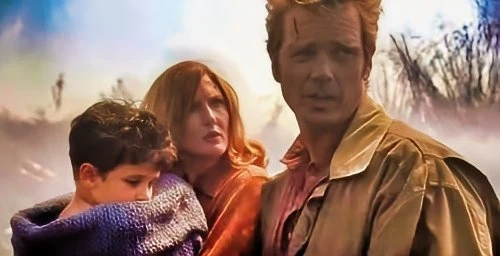
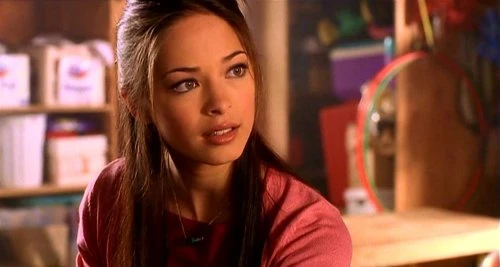
The pilot episode premiered on The WB on 16 October 2001. Written by Gough and Millar and directed by David Nutter, it immediately signalled the show’s ambitions. The episode opens in 1989 with a spectacular meteor shower crashing into the small Kansas town of Smallville. At the same time, Jonathan and Martha Kent, played by John Schneider and Annette O’Toole, discover a small spacecraft containing an alien boy. They adopt the child and name him Clark. This opening sequence does more than provide an origin story; it establishes a thematic foundation for the series. Gough and Millar use the meteor shower to create a shared bond between the three central characters of Clark (Tom Welling), the lone survivor of his destroyed homeworld, Lana Lang (Kristin Kreuk), whose parents are killed in the disaster, and Lex Luthor (Michael Rosenbaum) who is permanently alienated from his father, Lionel, after being rendered bald by the meteor blast. Loss, displacement and fractured families are thus embedded in the narrative from the very first minutes.
The story then jumps forward twelve years to a teenage Clark Kent struggling to understand who he is and where he belongs. When he learns the truth about his alien origins, he is unable to cope and briefly runs away from home, a decision that underlines how overwhelming his discovery is. Although he is deeply attracted to Lana, he cannot even get close to her without collapsing in pain. She wears a necklace made of meteor rock, later identified as kryptonite, a radioactive fragment of Clark’s homeworld. This adaptation of Superman’s main weakness by Gough and Millar was designed to provide a concrete reason for Clark’s awkwardness and clumsiness around Lana, while also introducing a key element of Superman mythology in an emotionally grounded way.
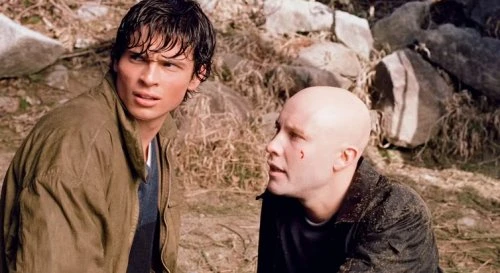
The pilot follows Clark as he begins to understand his powers and attempts to stop a vengeful fellow student from killing classmates at Smallville High School. In doing so, it introduces themes intended to run throughout the season and indeed the entire series: the moral responsibility that comes with power, the triangular relationships between Clark, Lana and Lex, and the idea that Clark’s arrival on Earth, while a blessing, also caused immense suffering. Peter Roth particularly appreciated this central conflict, noting that Clark must live with the knowledge that his presence was the source of so much pain, including the deaths of Lana’s parents and the chain of events that would eventually lead Lex down a darker path.
The parental relationships in Smallville are just as important as the teenage drama. Gough and Millar wanted a younger, more actively involved Kent couple than previous incarnations, allowing Jonathan and Martha to guide Clark closely as he navigates adolescence and his extraordinary abilities. In contrast, Lionel Luthor, played with chilling authority by John Glover, was conceived as a parallel figure, representing what the producers described as an “experiment in extreme parenting”. Lionel’s cold manipulation of Lex provides a powerful counterpoint to the warmth and morality of the Kents. Another key addition was Chloe Sullivan, played by Allison Mack. Created specifically for the series, Chloe was intended to be the perceptive outsider, someone who would notice the strange occurrences in Smallville rather than serving simply as a precursor to Lois Lane.
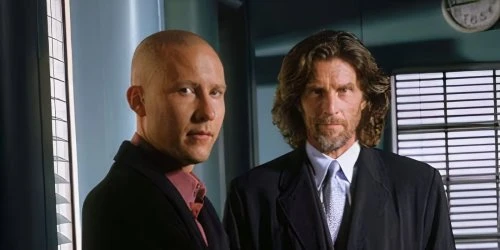
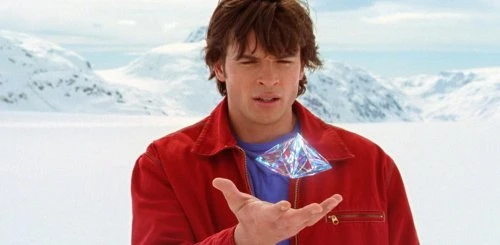
Casting proved crucial to the success of the show. Tom Welling was chosen as Clark Kent after months of scouting. David Nutter had to persuade Welling’s manager that taking a television role would not damage his film prospects before the actor even agreed to read the script. Once he did, Welling was convinced. He later recalled the moment he learned he had been cast, describing how he stopped at a petrol station to phone his manager, only to be greeted by seven voices simultaneously telling him, “Tom, you got it!” His performance quickly attracted attention, earning him a place among People magazine’s “Breakthrough Stars of 2001” and the Teen Choice Award for Choice Breakout Star (Male) in 2002.
The series was an immediate commercial success. Smallville set a WB record as the network’s highest-rated series debut, with 8.4 million viewers tuning in for the pilot. It also broke records among adults aged 18–34, with Warner Bros. president Jordan Levin crediting the show with reinvigorating the network’s Tuesday-night schedule. Over its ten-season run, Smallville amassed numerous accolades, ranging from Teen Choice Awards to Emmys. In 2002, it won the Emmy Award for Outstanding Sound Editing for a Series for its pilot episode, a testament to the technical polish that supported its storytelling.
Beyond ratings and awards, Smallville generated a substantial cultural footprint. It spawned young-adult novels, comic books and internet-based mini-episodes featuring characters from the show, and it influenced later television fantasy dramas, including the British series Merlin. By the time it concluded in 2011, Smallville had surpassed Stargate SG-1 to become the longest-running North American science fiction series by episode count. All ten seasons are available on DVD ensuring its continued accessibility to new audiences. The story did not end with the television finale; it resumed in comic book form as Smallville Season 11, which ran from April 2012 to November 2014.
The cast’s later careers add further layers of interest in retrospect. Tom Welling made a much-anticipated return to television in 2017 when he co-starred in the third season of the Fox fantasy comedy-drama Lucifer. Kristin Kreuk went on to headline Murder in a Small Town, which began airing in 2024 on Global in Canada and Fox in the United States, and was renewed for a second season in 2025. Michael Rosenbaum later portrayed Martinex in Guardians of the Galaxy Vol. 2 and Vol. 3, and in 2024 starred in the audio series TRUE NOIR: The Assassination of Anton Cermak. Allison Mack’s legacy is far more troubling; in 2018 she was arrested and pleaded guilty to racketeering offences, and in 2021 was sentenced to three years in prison. John Schneider remains widely recognised for his role as Bo Duke in The Dukes of Hazzard and has also maintained a long career as a country singer, releasing nine studio albums. Annette O’Toole, whose first television appearance dates back to The Danny Kaye Show in 1967, had previously appeared in Superman III as Lana Lang and has since found renewed success playing Hope McCrea in the Netflix series Virgin River from 2019 onwards.
In retrospect, Smallville stands as a landmark series. By stripping away the costume and focusing on the formative years of its hero, it explored identity, responsibility and the cost of power with an emotional depth rarely seen in the genre at the time. Its blend of myth, melodrama and moral inquiry ensured that, long after its final episode, and with talk of a future animated series, Smallville continues to occupy a significant place in television history.
Verdict ★★★★☆
Seen this show? How do you rate it?
Seen this show? How do you rate it?
Share on...
Published on January 20th, 2026. Written by Laurence Marcus for Television Heaven.