

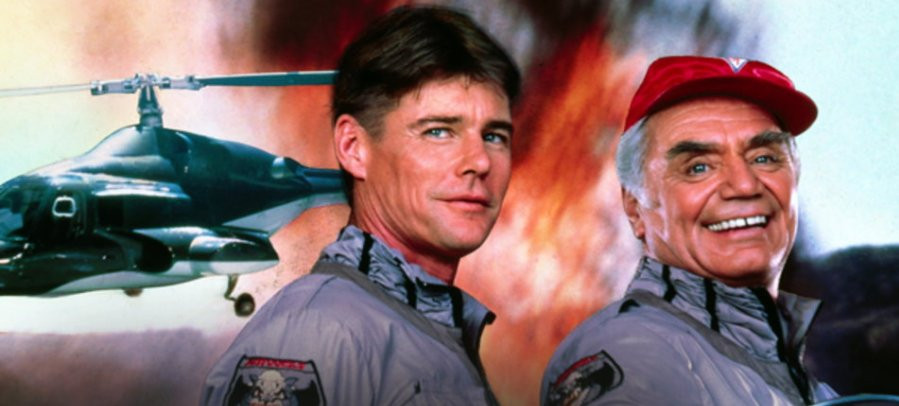
Airwolf
1984 United StatesAirwolf remains one of the most intriguing and ambitious action-adventure series to emerge from 1980s American television. Conceived by Donald P. Bellisario—who first flirted with the idea of an ace pilot drama in a Magnum, P.I. backdoor pilot—the show took flight in 1984 at the height of a mini-boom in helicopter-themed entertainment. The success of the film Blue Thunder spurred the US networks to commission three such series in quick succession, yet it was Airwolf, with its blend of espionage, science fiction and Cold War paranoia, that struck the strongest chord with audiences.
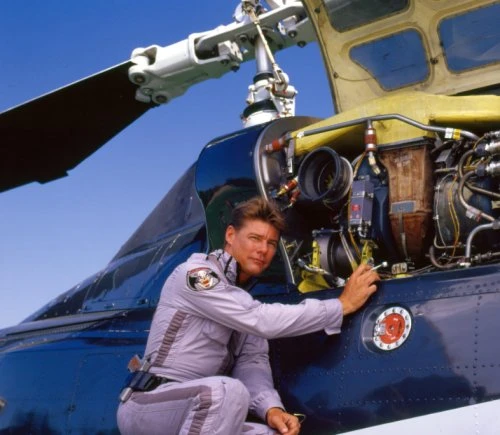
At the heart of the story is Stringfellow Hawke (Jan-Michael Vincent), a brilliant but reclusive pilot recruited by a covert CIA-adjacent agency known only as “The Firm”. Their aim is to recover Airwolf, a supersonic, heavily armed stealth helicopter stolen by its creator, Dr Charles Henry Moffet (David Hemmings), a genius with a vicious streak who absconds to Libya and promptly demonstrates the machine’s lethality. Hawke succeeds in reclaiming the gunship—at great personal cost—but refuses to return it until the government finds his brother, St John, missing in action since Vietnam.
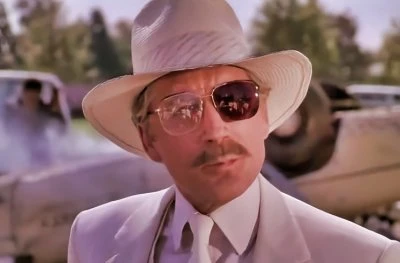
Hawke hides the aircraft in a desert cavern known as “the Lair”, flying missions for The Firm as leverage while maintaining a wary détente with his handler, the enigmatic Michael Coldsmith Briggs III (aka 'Archangel' played by Alex Cord), instantly recognisable in his white suit, eye patch and cane. Vincent’s moody intensity is well balanced by Ernest Borgnine as Dominic Santini, Hawke’s loyal mentor and co-pilot, while Deborah Pratt’s Marella and, from season two, Jean Bruce Scott’s Caitlin O’Shannessy, round out the team.
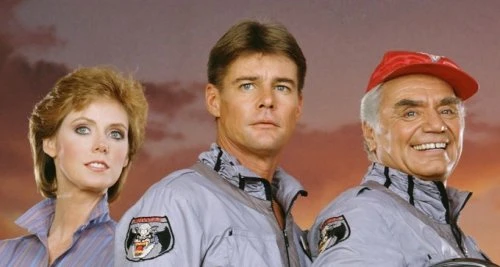
The show’s first season is its most striking: a darker, serialised thriller reflecting Cold War tensions and the moral ambiguity of clandestine operations. The Firm itself, despite its spotless white wardrobe, is as likely to exploit Hawke as to support him. CBS later pushed for a more family-friendly tone, and the second season duly lightened the mood, softening some of the series’ harder edges.
As Airwolf thrived on CBS, Blue Thunder—its police-procedural counterpart on ABC—floundered. Though both descended from the same early-’80s fascination with surveillance technology, Blue Thunder shed the paranoia that had defined its film predecessor and settled into routine crime-fighting, ultimately lasting only 11 episodes. Airwolf, meanwhile, retained a sense of high-stakes intrigue that gave it a distinctive identity.
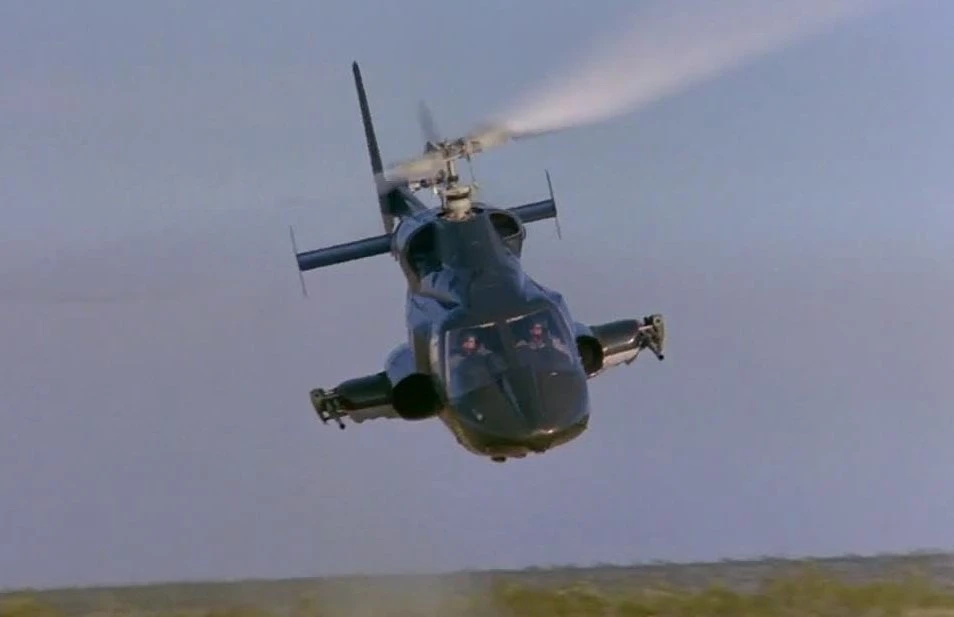
The production itself was as ambitious as the storytelling. The titular helicopter was a modified Bell 222 (tail number N3176S), its sleek lines transformed into an on-screen icon. Large amounts of aerial footage from the pilot were repurposed throughout the series to manage costs—a practice that became central by the time a retooled fourth season, with a new cast, was produced for the USA Cable Network after location filming moved to Canada.
The original two-part pilot was later condensed into a home-video release, Airwolf: The Movie, with updated music and tightened scenes. For fans, these early episodes remain the purest expression of Bellisario’s vision: a brooding, stylish adventure that blended pulpy thrills with just enough moral complexity to stand apart from its contemporaries.
Viewed today, Airwolf is unmistakably a product of its era—full of sleek machines, covert missions, and Cold War anxieties—but its blend of character drama, memorable performances, and airborne spectacle ensures it continues to command affection. Like the sleek black helicopter at its centre, it moves with a purpose and mystique that imitators never quite matched.
Seen this show? How do you rate it?
Seen this show? How do you rate it?
Share on...
Published on December 11th, 2025. Written by Laurence Marcus for Television Heaven.