
Star Maidens
1976 United Kingdom, GermanyStar Maidens is one of those 1970s science-fiction curios that feels oddly familiar yet faintly out of step with its era. An Anglo-German co-production for ITV, first broadcast in 1976, it is remembered today less as a lost classic than as a camp, visually striking experiment whose ambitions were ultimately undermined by conflicting creative intentions and erratic scheduling.
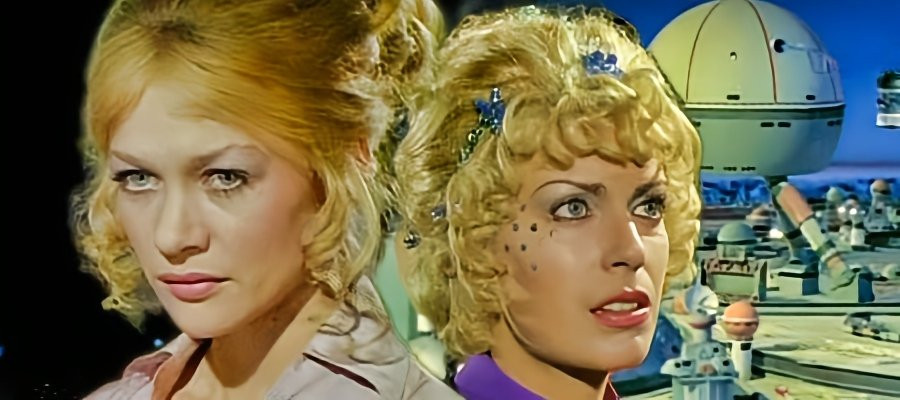
At a glance, the series looks uncannily like Space: 1999, and not by accident. Production designer Keith Wilson worked on Star Maidens between seasons of the Anderson series, and many of his design ideas – along with adapted props and recycled sound effects – lend the show a sleek, Moonbase Alpha aesthetic on a noticeably smaller budget. Shot at Bray Studios and on location around Southern England, the production values were impressive for a thirty-minute drama costing around £50,000 per episode, even if the seams occasionally show.
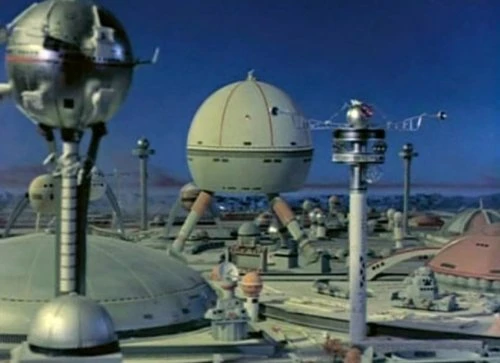
The premise is an immediate hook. On the planet Medusa, men are second-class citizens in a rigidly female-dominated society. After their world is knocked from its orbit and rendered uninhabitable on the surface, Medusans survive in vast underground cities governed by a matriarchal elite. When Medusa drifts into Earth’s solar system, its rulers are astonished – and alarmed – to discover a planet run by men. Two Medusan males, Adam (Pierre Brice) and Shem (Gareth Thomas), seize the opportunity to escape to what they see as a male “paradise” and demand asylum on Earth.
Their flight sets up the series’ central conflict. The pair are relentlessly pursued by Supreme Councillor Fulvia (Judy Geeson) and Chief Security Controller Octavia (Christiane Krüger), whose cool authority and ideological certainty embody Medusa’s fear of male autonomy. When the Medusans fail to retrieve their fugitives, they abduct two humans – scientist Dr Rudi Schmidt (Christian Quadflieg) and his assistant Liz Becker (Lisa Harrow) – forcing negotiations that form the backbone of the series.

The opening four episodes function as a serialised chase, but thereafter Star Maidens settles into largely self-contained stories split between Earth and Medusa. These explore culture shock, reversed gender roles and uneasy political compromise, with Derek Farr’s Professor Evans acting as a voice of cautious diplomacy. The final episode introduces an external threat – the mysterious “Enemy” that once hunted Medusans – and brings the series to a surprisingly earnest conclusion, implying that Medusa’s rulers may finally have reassessed their view of men.
In performance terms, Gareth Thomas stands out, bringing warmth and quiet intelligence to Shem, a role that arguably helped pave the way for his later casting as Blake in Blake's 7. Judy Geeson clearly relishes Fulvia’s icy superiority, while Lisa Harrow gives Liz Becker a grounded humanity that offsets some of the show’s more theatrical excesses. Elsewhere, the acting is variable, occasionally tipping into the heightened style that reinforces the programme’s reputation as a camp novelty.

That reputation is not entirely unfair. Star Maidens flirts with sexual politics but rarely probes them deeply. According to later production notes, the German backers envisaged the series as a light sex comedy, while the British team aimed for thoughtful, intelligent science fiction. The tension between those two aims is visible on screen: moments of genuine social commentary sit alongside scenes that feel faintly arch or undercut by tone. This lack of a unified vision, combined with ongoing production difficulties and the need to bring in additional writers such as John Lucarotti and Ian Stuart Black, likely contributed to the series’ unevenness and its failure to secure a second season.
In the UK, Star Maidens was further hampered by chaotic scheduling. Broadcast sporadically across the ITV network in a bewildering range of time slots – from early evenings to Sunday mornings – it never had the chance to build a loyal audience. While it enjoyed reasonable international sales and a modest merchandising afterlife, including an annual and novelisation, it never became a mainstream hit.
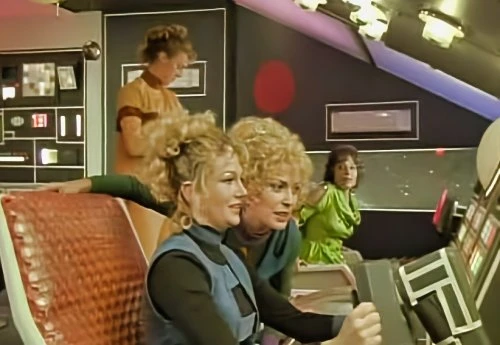
Seen today, Star Maidens is best appreciated as a fascinating footnote in British television science fiction: visually appealing, conceptually intriguing and occasionally thoughtful, but ultimately caught between tones, cultures and expectations. Its recent reappearance on a British streaming channel has allowed it to be reassessed not as a failure, but as an ambitious, flawed experiment that dared to imagine a battle of the sexes among the stars – even if it never quite decided how seriously to take the fight.
Seen this show? How do you rate it?
Seen this show? How do you rate it?
Share on...
Published on January 13th, 2026. Written by Laurence Marcus for Television Heaven.