

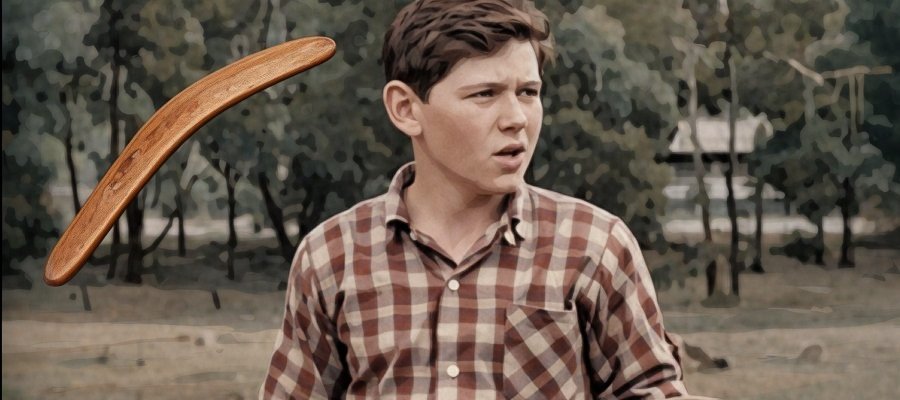
The Magic Boomerang
1964 AustraliaRoger Mirams is deservedly recognised as the pioneer of children’s television drama in Australia. Through his company Pacific Films, Mirams helped shape a generation of locally made adventure stories that captured both domestic and international audiences. His early success with The Terrific Adventures of the Terrible Ten laid the groundwork for something even more imaginative and ambitious: The Magic Boomerang.
The Terrible Ten, produced in 1959, consisted of 15-minute black-and-white episodes shot on film. The series enjoyed notable success at home and abroad, evolving by 1963 into The Ten Again and screening on the Australian Broadcasting Commission (ABC). The experience gained during these formative productions would directly inform the more polished and expansive Magic Boomerang.
The Magic Boomerang blended outdoor adventure with fantasy. Its premise was irresistibly simple: 13-year-old Tom Thumbleton, played by David Morgan, discovers a boomerang among Aboriginal relics left by his great-great-grandfather. When thrown, time freezes for everyone except the thrower; when caught, time resumes. Set near the fictional town of Gunnaganoo, the series follows Tom and his mischievous younger friend Wombat (Rodney Pearlman) as they thwart criminals and outwit wrongdoers. Tom’s parents, Dan and Gwen, were portrayed by Telford Jackson and Penny Shelton.
Much of the creative team carried over from The Terrible Ten. Mirams produced the series, with David Baker and Joe McCormick directing most episodes. Susan Haworth played Philip’s sister Penny, a character notable for her competence and resourcefulness—refreshingly progressive at a time when many overseas series relegated girls to helpless roles. Young Aboriginal actor Bindi Williams also appeared in early episodes, marking an important, if modest, step toward broader representation in Australian children’s television.
By the time The Magic Boomerang entered production in January 1964, Pacific Films had relocated from Macedon to Woodend, transforming the Mechanics Institute into a studio and later converting a disused cinema across the road into a second facility. What began years earlier as a two-person crew had expanded to two film units and up to 14 staff. The cast and crew affectionately dubbed the town “Hollywoodend,” reflecting both pride and ambition. Local residents cooperated enthusiastically, offering homes, shops, the railway station, and even the local bank as filming locations.
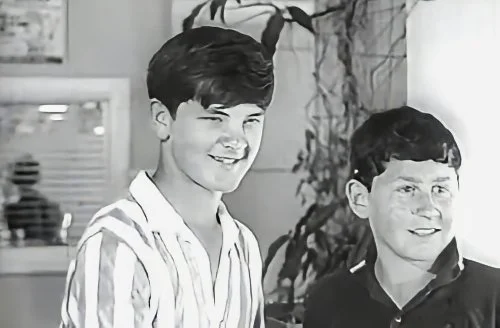
Thirty-nine half-hour black-and-white episodes were produced between 1964 and mid-1965. Although the series debuted in Britain and Canada before Australia, it finally aired locally on 2 May 1965 in a Sunday afternoon timeslot on the ABC. Mirams proved a savvy international marketer, promoting the Australiana appeal of wide-open spaces, horses, and resourceful country children.
Technically, the show relied on simple but effective methods. The time-freeze effect was achieved through freeze-frames or by having actors remain perfectly still while Tom or Wombat moved through the scene. The opening titles featured Tom riding into frame, throwing the boomerang, and segueing into an animated graphic with the title announcement. The simplicity worked; the storytelling carried the show.
In 1966, while Pacific Films was busy with The Adventures of Seaspray, the decision was made to revive The Magic Boomerang in colour. With David Morgan now too old for the lead, 15-year-old Robert Brockman stepped in as Nugget Morris, the new custodian of the boomerang. Gavan Ellis played his older friend, while William Hodge portrayed the eccentric Honourable Charles Swinbourne, whose ramshackle property, Rainbows End, served as a comedic focal point. Despite cast and tonal changes—leaning more toward light comedy than adventure—the central formula remained intact: villains concoct schemes, and the magic boomerang saves the day.
Only six colour episodes were produced before the revival was discontinued, the new instalments later folded into ABC repeat runs of the original series. Yet even with its brief second life, The Magic Boomerang stands as a landmark in Australian children’s television. It demonstrated how ingenuity, community spirit, and a belief in young audiences could create enduring entertainment. Built on modest budgets but expansive imagination, it remains a testament to Roger Mirams’ pioneering vision and Pacific Films’ formative role in shaping Australia’s television heritage.
Seen this show? How do you rate it?
Seen this show? How do you rate it?
Share on...
Published on March 1st, 2026. Written by Marc Saul for Television Heaven.