

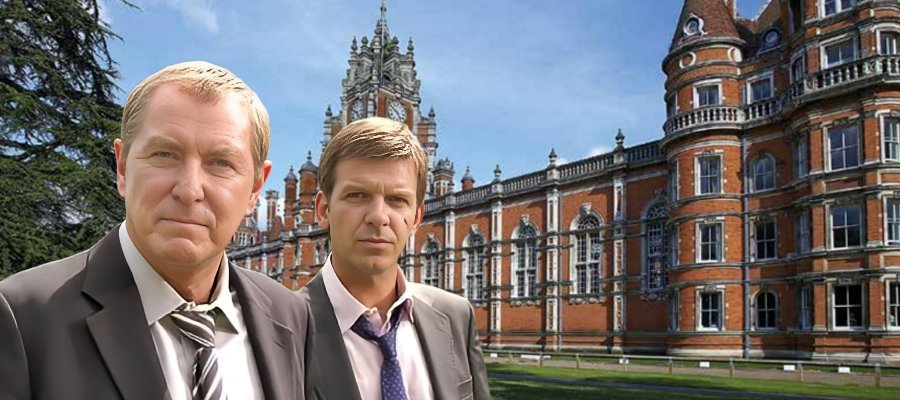
Media Arts at Royal Holloway: Real and fictional places in Midsomer Murders
The Midsomer Murders episode ‘Murder on St. Malley’s Day’ (2002) belongs to a string of television programmes and films, filmed at Royal Holloway, University of London in Egham, Surrey. There is a Media Arts Department at the college but this article will examine a professional media production - at how the exteriors and interiors of the college are used narratively, what they tell us about the aesthetics of television, and also at how a fictional place, Midsomer Parva, is created which differs significantly from the real space of Egham.
In Midsomer Murders, settings are sutured together so that separately shot sequences are narratively connected. In the episode ‘Murder on St. Malley’s Day’, Royal Holloway College partly stands in for Devington School (see Tabarelli) while some establishing shots of the school were filmed at Bearwood College in Wokingham, Berkshire (see IMDb). Meanwhile, the Natural History Museum in Tring, Hertfordshire served for the girls’ annex (see Tabarelli). Scenes for the St. Malley’s Day race were filmed at Black Park (see Tabarelli), while the village scenes were shot in Turville (see Tabarelli): the boys are seen running through Turville during the St. Malley’s Day race as they pass through Midsomer Parva; a house in Turville serves as Dudley Carew’s house; and The Bull and Butcher pub features as The Chalk and Gown. Hall Barn in Beaconsfield, Buckinghamshire, meanwhile, served as the Talbot family home (see IMDb).
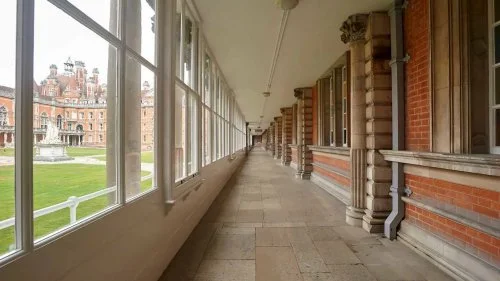
Royal Holloway was chosen for the episode which concerns the tradition upheld at Devington School. Founder’s is a Grade 1 listed red-brick building (see Cutter, ‘In the beginning’). It was designed by William Henry Crossland and modelled on the Chateau de Chambord of the Loire Valley, France and opened in 1886 by Queen Victoria (see Cutter, ‘The Founder’s Building’).
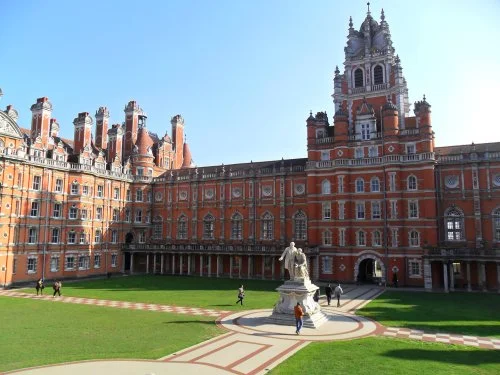
The setting of Royal Holloway is apt as Devington School is in every respect the type of old-fashioned public boarding school common to Britain, the most famous example being Eton. In this respect, it differs from Royal Holloway which is part of the University of London. Devington School follows an elitist system where prestigious families such as the Talbots gain a place and the Pudding Club is even further closed-off to many pupils and provides scholarships based on prestige rather than merit. The image of the public-school boy is conveyed, as was the headmaster in traditional garb and quoting a Latin motto, and in this case the girls.
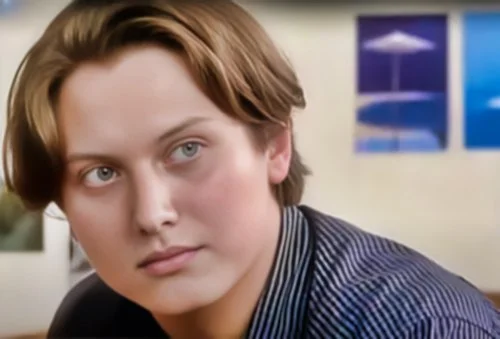
The male students of Devington School, such as Marcus Heywood, speak in a posh accent and wear traditional uniforms: white shirts with ties and distinctive dark-coloured blazers and trousers and for attending the Pudding Club even more formal attire. The girls of the school, indeed, wear white shirts, ties, grey blazers and dresses. Royal Holloway differs as it does not have a dress code. Devington School is, furthermore, like the boys boarding school since the main building houses only boys while the girls reside in an annex. Some public schools in Britain remain boys’ schools whereas others, like Stowe school, have come to admit girls (‘Stowe School – Buckingham’). Royal Holloway was quite the opposite: it was actually founded specifically as a women’s college as was Bedford College which merged with it, before it came to admit boys (‘Pioneering Women’). Conversely to Devington School, the Founder’s Building at Royal Holloway now has accommodation for both sexes in the main building but specific corridors for the different sexes.
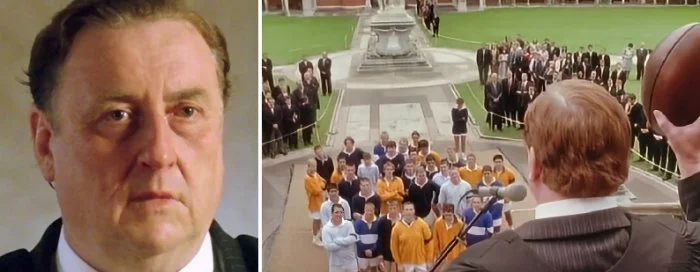
The exterior of Founder’s Building is further important narratively. There is a wide shot of the South quad taken from behind the balcony and it is on this balcony that the headmaster, Eckersley-Hyde, addresses the students and begins the St. Malley Day race, with Eton College itself having an annual winter Steeplechase race where students run over muddy, challenging terrain (‘Boys Run in Annual School Steeplechase’). Eckersley-Hyde looks at the clock on the tower striking 3pm which is significant as a bell rings from another tower. At this point, Eckersley-Hyde throws the ball down to the pupils and the race begins as Daniel Talbot reluctantly sets off ball in hand. The setting of the clock is key to the narrative since the sounding of the bell is delayed after the clock chimes. This is because the porter Ludlow is not there to ring it but that it has been set to ring automatically since Ludlow is in the woods waiting to murder Daniel.
It is further important to consider the type of college that Royal Holloway is. Significantly, although Royal Holloway is a college of the University of London, it is not located in London, but its setting is far more rural than urban. Universities and university colleges in the United Kingdom are generally divided into city-based and campus-based institutions (Lawson, 2023), apart from the work-from-home Open University. Other colleges of the University of London, such as the prestigious University College, London (UCL) and King’s College, London (KCL) differ from Royal Holloway as they are situated in the centre of the extremely busy metropolis, though these are just a couple of examples of the many city institutions to be found in the nation’s capital and indeed in the country as a whole. City based colleges often have buildings which are scattered throughout the city rather than being in a single, closed-off area and have a blend of students and city residents, whereas accommodation in campus-based institutions is often concentrated more in one place (Lawson, 2023). Although, as we shall soon see, Royal Holloway is in close proximity to the small town of Egham and its transport network, Royal Holloway is situated on one campus, separated from Egham by a hill, and its Founder’s Building and quads made it ideal in this instance to stand for the more rural Devington School, although it should be pointed out that campus-based institutions do have more modern buildings (see Lancaster University, for instance) and it must be stated that some television productions make use of a city-institution like Oxford which is appropriate for their narratives.
It is, however, important to note that the Royal Holloway campus is not solely composed of the Founder’s Building with its distinct architecture. Rather there were many other buildings for different subject departments (Media Arts was, for example, situated in a small hut), and the campus has become even more modernised in the period following the making of the Midsomer Murders episode. There is therefore a difference between the Devington School campus and the Royal Holloway one and the whole Royal Holloway campus is not used in the Midsomer Murders episode under consideration.
Furthermore, there was no single Midsomer Murders studio and the interiors were often filmed in temporary studios or on real world sets, around a 30-mile radius of Pinewood Studios. This tells us about how some television productions are filmed. The interiors of Royal Holloway’s Founder’s Building created the atmosphere of a prestigious old-fashioned school. The inside of Devington School with its red walled corridors was clearly filmed in Founder’s and the room used for the Pudding Club was of the old-fashioned type found in Founder’s, as is the porter’s lodge. As noted above, both the Founder’s Building and Devington School contained accommodation; it is impossible to ascertain whether the scenes set in accommodation in Devington School were filmed in Royal Holloway but the accommodation appears modernised by contrast with the other interiors.
But the physical space of production, on location as opposed to in a TV studio, and the fact that the interiors were largely shot on film rather than videotape, gave the episode a sense of Realism. There was a move from studio to location work in programmes stretching back to, for instance, the 1960s but a couple of examples of series from the same genre as Midsomer Murders, also set in part in university colleges, will suffice here for comparison. The interiors of the episode ‘Murder on St. Malley’s Day’ can be contrasted with many of those of the BBC mystery series Lord Peter Wimsey episode ‘Gaudy Night’ (1987) which was set in an Oxford college. While, in some cases, authentic Oxford college settings were employed and shot on film, many of the interiors were studio sets shot on videotape, creating a jarring effect. Rather the Midsomer Murders episode can be seen as closer in style to ITV’s Inspector Morse (1987-2000) which was filmed using 16mm film stock and while certain studios were used, a large portion of the series was filmed in Oxford, including the interiors.
Moreover, in the Midsomer Murders episode, Midsomer Parva is not Egham and is cut-off to a greater degree than Royal Holloway, despite the point noted earlier that this college is a campus-based institution. While there is the village Englefield Green in close-proximity (about 10 minutes walk) to Royal Holloway, unlike Midsomer Parva, Egham is a town in the Borough of Runnymede in Surrey located within short walking distance (about 25 minutes) from the college. While Egham is famous for its history – for example, in 1215 the Magna Carta was sealed by King John nearby as Egham was in close proximity to the King’s then residence at Windsor (‘Egham – Visit Surrey’) – when the Midsomer Murders episode was filmed, Egham had been increasingly modernised, had a High Street with many shops (‘High Street Timeline’) and in 2001 had a population of approximately 25,840 (‘Egham’). Such modernisation continues today.
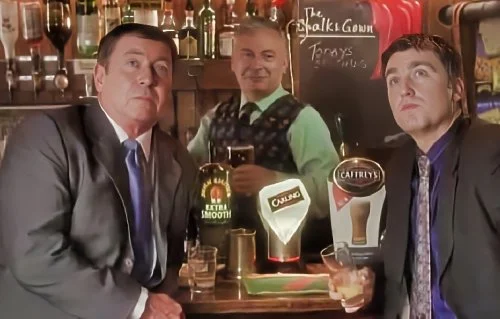
It is also established in the Midsomer Murders episode that there is not much else to do in the area apart from attending the Pudding Club and going to The Chalk and Gown: the boys were taken to a private room there from the school in an old banger. Conversely, following the merger of Royal Holloway and Bedford New College, there is a Student Union which serves as the main social hub on campus (‘Student Union’). There is a purpose-built Union building, established in 1965 (‘Student Union’), and in 2002 there was entertainment in the form of popular musical themed nights, meetings at The Packhorse (‘The Packhorse’), along with many clubs and societies, run by the SU (‘Student Union’).
Furthermore, there are not main bus or railway stations in Midsomer Parva. In the Midsomer Murders episode, it is established that one has to take a local bus to Couston where there is a central bus station: Julia arranged to meet her boyfriend Daniel Talbot there. Conversely, there are excellent rail links between Egham and Reading and between Egham and London, Waterloo, with the Egham station being a short walk (about 20-25 minutes) from Royal Holloway. The Reading to Waterloo line was owned by National Rail and managed by South Western Railway (‘Cheap trains: from Egham to London Waterloo’) and takes approximately 46 minutes from Egham to Reading (which is approximately 18 miles away) (‘Egham to Reading: Cheap trains from £9.80’) and 39 to 52 minutes from Egham to Waterloo (which is 19 miles away) (‘Cheap trains: from Egham to London Waterloo’). Furthermore, in 2002, there were buses, dominated by First Berkshire and First Bus, from Egham to Staines and to Heathrow Terminal 5, running regularly (‘AI Overview’).
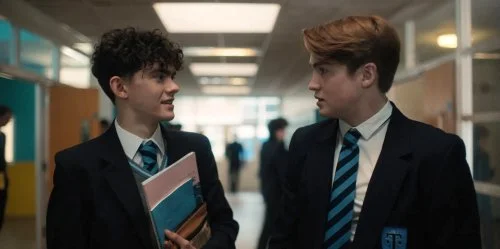
At one point in the episode, Detective Chief Inspector Barnaby studies a map as he puts together the case geographically but it is a map of the fictional Midsomer Parva which has been filmed in a variety of places. A key one of these is Royal Holloway chosen for Devington School for its old-fashioned quality. Numerous films and programmes used Royal Holloway as a setting, either for other real-world universities such as in The Crown (2023) and in Heartstopper (2024), for fictional educational establishments as in Trinity (2009), Judwaa 2 (2017), Astral (2018), Cheat (2018), The Split (2019-21), You (2022), and Silent Witness (2024), or as other period buildings as in Howards End (1992), Basic Instinct 2 (2006), Pantham (2018), Born a King (2019), Downton Abbey (2013) and Call the Midwife (2021). Short films like The Silent War (2023) were filmed at Royal Holloway as was the earlier Hollywood blockbuster Avengers: Age of Union (2015). Furthermore, it was mentioned in the Introduction that Royal Holloway has a Media Arts Department and a variety of student films were produced filmed at the college like Miss Emma (2011), Hallelujah (2016), Imagineer (2017), Kill Me Now (2017) and Dreambound (2024), while a film like Delirium (2017) saw staff and students taking on the roles of crew and supporting parts. Various documentaries and examples of Reality TV were also filmed set at Royal Holloway like Antiques Roadshow (2001), Celebrity Masterchef (2012), Stargazing Live (2014), Gareth Malone’s The Choir Best in Britain (2016), Sir David Attenborough’s Natural Curiosities (2016), and Great British Railway Journeys (2016) which specified that Royal Holloway was served by Egham station. Furthermore, this article has drawn attention to the aesthetic of a programme Midsomer Murders through its filming in the interiors of Royal Holloway and has also highlighted the episode’s difference from Egham. Finally, it is worth mentioning that other avenues can be explored than those here. For example, Midsomer Murders often represents ‘traditional Englishness’ and the public-school traditions and Founder’s old architecture support that here (the area of Midsomer is very much not in the North, Scotland or Wales). Furthermore, Royal Holloway ex-students’ may have an attachment to seeing their alma mater on screen and so qualitative interviews could be conducted. Additionally, other Midsomer Murders locations have strong resonances: Turville, for instance, is where Caractacus Potts lived in Chitty Chitty Bang Bang (‘Chitty Chitty Bang Bang – Film Locations’), and is also the village where The Vicar of Dibley supposedly lived (‘Where was The Vicar of Dibley filmed?’).
References and further reading
The History of Royal Holloway College 1886-1986 by Caroline Bingham (London: Constable, 1987); ‘In the beginning’ edited by Jon Cutter (www.rhc70s.org, accessed February 1 2026); ‘The Founders Building’ edited by Jon Cutter (www.rhc70s.org, accessed February 1 2026); Midsomer Murders Location Guide by Frank Hopkinson (London: Pitkin Publishing, 2022); ‘Study in the UK: City Uni or Campus Uni?’ by Jenna Lawson (www.topuniversities.com, January 14 2023; accessed February 1 2026); Midsomer Murders On Location by Sabine Schreiner and Joan Street (Sawston: Irregular Special Press, 2015); ‘Midsomer Murders & History’ by Petra Tabarelli (www.midsomermurdershistory.org, accessed February 1 2026); ‘AI Overview’ (search terms: bus Egham 2002, accessed February 1 2026); ‘Boys Run in Annual School Steeplechase’ (www.etoncollege.com, accessed February 1 2026); ‘Cheap trains from Egham to London Waterloo’ (Trainline, www.thetrainline.com, accessed February 1 2026); ‘Chitty Chitty Bang Bang – Film Locations’ (www.movie-locations.com, accessed February 1 2026); ‘Egham’ (www.citypopulation.de/en/uk/southeastengland/surrey/E63005100_egham accessed February 1 2026); ‘Egham to Reading: Cheap Trains From £9.80’ (Trainline, www.thetrainline.com, accessed February 1, 2026); ‘Egham – Visit Surrey’ (www.visitsurrey.com, accessed February 1 2026); ‘High Street Timeline’ (www.eghammuseum.org, accessed February 1 2026); ‘IMDb: Midsomer Murders Murder on St. Malley’s Day’ (www.m.imdb.com, accessed February 1 2026); ‘The Packhorse’ (www.su.rhul.ac.uk, accessed February 1 2026) ‘Pioneering Women’ (www.royalholloway.ac.uk, accessed February 1 2026); ‘Stowe School – Buckingham’ (www.best-schools.co.uk, accessed February 1 2026); ‘Student Union’ (www.intranet.royalholloway.ac.uk, accessed February 1 2026); ‘Where was The Vicar of Dibley filmed?’ (www.beautifulenglandphotos.uk, accessed February 1 2026)
This article is dedicated to Professor Jonathan Bignell who took me on as a PhD student in the Department of Media Arts at Royal Holloway College in 2000, and mention must also be made of my mother, Rosemary Englander: together we watch Midsomer Murders during my stays at her house in Milton Keynes. With thanks also to Egham Museum and Petra Tabarelli for assistance.
Share on...
Published on February 28th, 2026. Written by Dr. Andrew O'Day for Television Heaven.