

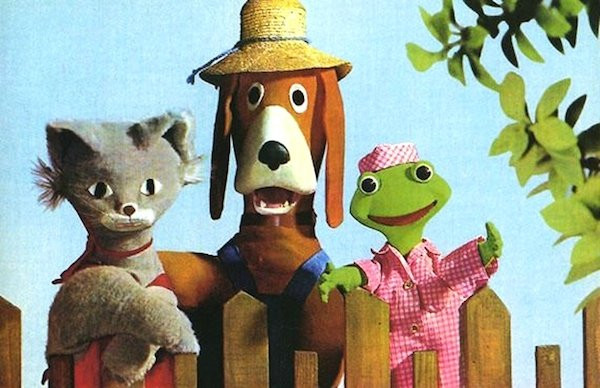
Hector's House
1965 FranceFirst broadcast in 1965 and running until the early 1970s, Hector’s House remains one of the more curious yet charming fixtures of classic children’s television. A French production originally titled La Maison de Toutou, the series was dubbed into English and quickly found a home on BBC1 filling the spot just before the evening news (like The Magic Roundabout), where its gentle humour and whimsical tone made it a firm favourite among younger viewers.
Set entirely in the garden of the eponymous Hector – a slightly pompous, well-meaning dog ("I'm a great silly Hector.") – the show followed his day-to-day interactions with his two neighbours: Kiki the frog and Zaza the cat. Each episode unfolded with a quiet rhythm, marked by Hector’s habitual insistence on “everything being in order,” often disrupted by the well-meaning meddling of his friends. There was no fast-paced action, no garish visuals, and certainly no laugh track. Instead, Hector’s House delivered a form of storytelling that was endearingly understated and oddly comforting.
Hector, clad in a housecoat and voiced with genteel exasperation, often broke the fourth wall to speak directly to the audience, a technique that further enhanced the show’s intimate feel. There was a gentle absurdity to the entire affair – from the stop-motion puppetry to the oddly human traits assigned to the animal characters – but it worked, in part because the performances were so delightfully earnest.
The animation, though rudimentary by modern standards, possessed a certain rustic charm. The characters were essentially glove puppets with limited articulation, yet they conveyed remarkable personality. Much of this came down to the vocal performances, which imbued the trio with warmth, wit, and just the right dose of whimsy.
Hector’s House may lack the manic energy of more modern children's programming, but that’s precisely where its appeal lies. In an age saturated with noise and visual overload, Hector’s world – bounded by a garden gate, a modest shed, and a few loyal friends – feels like a wonderfully serene retreat. Its quiet humour and earnest simplicity continue to evoke fond nostalgia among those who grew up with it.
Another show that has generated an urban myth, this time that myth being that actress Joanna Lumley voiced Zaza the cat. The story became so widely known that it was accepted as fact. But the truth is, that the lovely Ms Lumley had nothing to do with the show whatsoever as she confirmed herself when the question was put to her. "It would have been lovely wouldn't it?" she said. "But no, it's not true."
Seen this show? How do you rate it?
Seen this show? How do you rate it?
Share on...
Published on December 21st, 2018. Written by Laurence Marcus for Television Heaven.