

Martin Chuzzlewit
1964 United KingdomThe 1964 BBC serialisation of Martin Chuzzlewit arrived with the weight of a novel that had never been regarded as one of the easiest of Charles Dickens’ works. It is sprawling, digressive, and its plot is remarkably convoluted even by Dickensian standards. Yet, as this adaptation quickly made clear, its enduring appeal lies not in narrative simplicity but in the vividness of its characters. Figures like the sanctimonious Pecksniff, the irrepressible Sarah Gamp, and the ever-optimistic Mark Tapley give the story a richness that translates well to the screen, even within the limitations of early 1960s television.
At its core, the drama is a study of greed, tracing the moral failings of the Chuzzlewit family and the painful journey of young Martin, the one member who attempts to rise above it. His path is predictably arduous, filled with betrayals and reversals before he earns both prosperity and love. The adaptation preserves this arc faithfully, though the inherent density of the narrative means that, at times, the pacing feels hurried—particularly as it moves through its later developments.
The story’s temporary shift to America, reflecting Dickens’ own disillusionment with the country after visiting it, remains one of its more awkward elements. The depiction of the frontier as a crude and deceitful wasteland supporting a rabble of deceitful and grasping boors comes across as extremely exaggerated and has been called by some commentators as gross and unfair a caricature as he ever produced, even by the standards of Victorian satire. Still, this imbalance is overshadowed by the far more compelling and authentic portrait of English lower- and middle-class life, which the serial captures and provides for the rest of the novel.
Much of the production’s success can be credited to its experienced creative team. Constance Cox’s adaptation demonstrates a clear familiarity with Dickens’ rhythms, having been previously responsible for bringing to the screen Bleak House, Oliver Twist, and The Old Curiosity Shop, while Joan Craft’s direction keeps the sprawling narrative coherent across its thirteen episodes. The production values, though constrained by the era’s technology, are used effectively to evoke a sense of period detail. Campbell Logan, whose long career in television had embraced the first-ever classical serial transmitted from Alexandra Palace, and the first television productions of Jane Eyre, Vanity Fair, and Persuasion, was the producer.
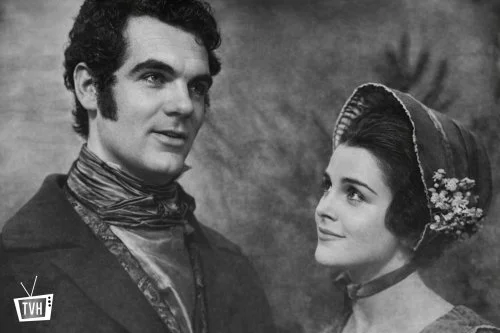
The cast, too, rises admirably to the challenge. Gary Raymond, an actor who had recently devoted himself largely to films and had just returned from Hollywood where he had been working on the religious epic The Greatest Story Ever Told, brings a fitting earnestness to young Martin, while Barry Jones lends gravitas to the elder Chuzzlewit (the hero’s miserly grandfather). Richard Pearson’s Pecksniff stands out in particular, embodying the character’s oily hypocrisy with precision, while the hero’s sweetheart Mary Graham—a sweet-souled orphan girl conceived in the best Dickens tradition—is played by Ilona Rodgers who later went on to appear in New Zealand and Australian productions and also worked in American productions including Hercules: The Legendary Journeys and Power Rangers. The rest of the supporting cast contributes solidly, ensuring that even the more episodic stretches remain engaging.
Contemporary reception reflected this strength. Reviewing the opening episode for The Stage, critic Brian de Salvo observed: "The prospect of playing Dickensian characters must appeal to most actors. Constance Cox and Joan Craft, the writer-director partnership, which was responsible for The Old Curiosity Shop, obviously intend to provide their cast with every opportunity to excel in Martin Chuzzlewit. That opportunity was not missed in Sunday's first episode. Richard Pearson does not waste a raised eyebrow or miss an inflexion in his brilliant portrayal of Pecksniff. Anna Middleton and Rosalind Knight are admirable foils as his daughters Mercy and Charity. Barry Jones has established himself well as old Martin and though we have scarcely met young Martin yet it is pleasant to think that we have as talented an artist as Gary Raymond in store. On this first showing there is not a single weakness in the company, who are admirably supported by Joyce Hammond's costumes, Susan Spence's sets and Joan Hotchkis' music.
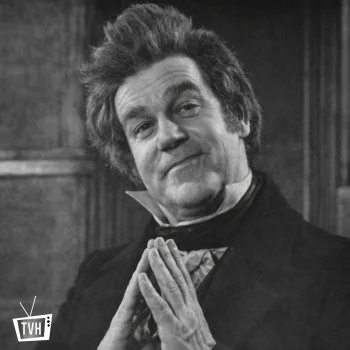
"Of the remainder, I must, however, single out Peter Bayliss who surely delighted Dickens-lovers with the ingratiating Mr. Tigg. So far, we have only been setting scenes and meeting people, a preliminary which is far from dull thanks to the beautiful economy of Miss Cox's script. I look forward, however, to getting to know young Martin, Mary Graham, Mark Tapley and the others in the weeks to come."
By the time the final episode aired, the serial had maintained enough of its momentum to impress even the typically exacting Dennis Potter. Writing in the Daily Herald, he noted: "Clinking champagne glasses and hearty kisses appropriately brought to a happy ending the 13-week-long serialisation of Martin Chuzzlewit on BBC.
"Yesterday's giddy episode sliced through so much of the Dickens novel so quickly that some of the period details and mannered eccentricities were lost. But enough remained to please the eye. The distant clop of horses and the chime of city bells. Dusty offices and candle-lit gloom. A villainous face with lank, greasy hair, or an old, bonnet-topped hag with broken teeth and a sly cackle. The final unravelling of Dickensian complexity had a suicide from a fat bottle of poison, a wedding where the groom absconded and justice and romance shared out with triumphant partiality.
"Pon my word! How pleasant it is to see people happy, " grinned poor old Tom Pinch, excellently played by a simpering John Quentin. Constance Cox made her usual accomplished job of adaptation. The design department revelled in an orgy of toppers and tapestries. The actors rolled their tongues in unfeigned pleasure at such ripe dialogue. And we, the viewers, were left to applaud a splendid tale splendidly told."
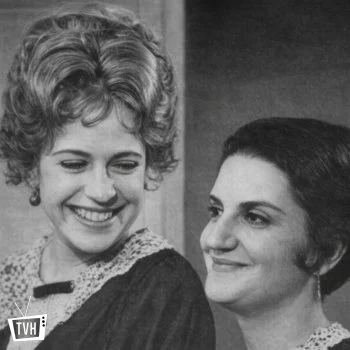
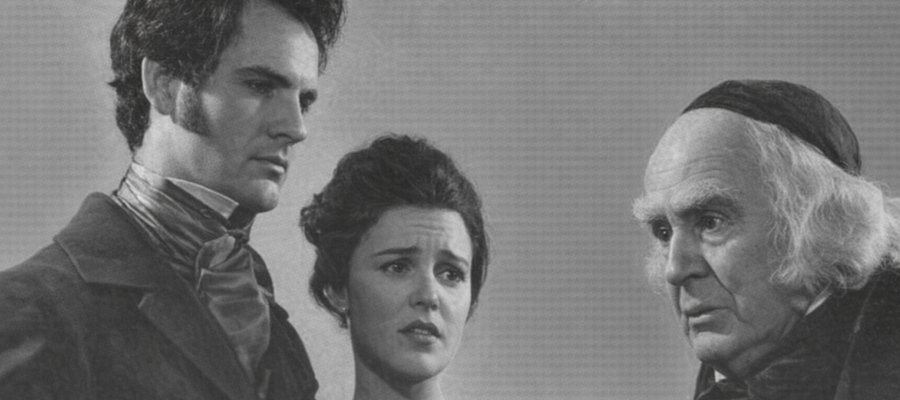
If there is a lingering frustration surrounding this production, it lies in its fate. Like so many television programmes of its era, all thirteen episodes were recorded on 405-line black and white videotape and subsequently wiped. Even the telerecordings were later discarded, leaving the serial largely lost. What remains are only a handful of publicity images, faint echoes of what was clearly a thoughtful and well-executed adaptation.
In the end, this Martin Chuzzlewit stands as a reminder of both the strengths and the ephemerality of early television drama: a complex Dickens novel brought to life with care, skill, and strong performances, only to vanish almost entirely from the archive.
The pictures on this page are 4 of only 5 pictures known to exist of this production. They are sourced from a faded copy of the Radio Times magazine dated 16 January 1964, and have been enhanced to return them as near to their original quality as possible.
Seen this show? How do you rate it?
Seen this show? How do you rate it?
Share on...
Published on March 29th, 2026. Written by Laurence Marcus for Television Heaven.