

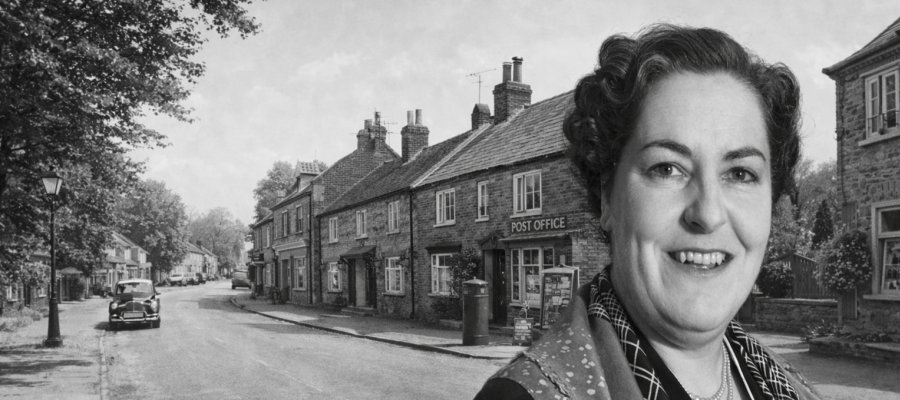
Our Miss Pemberton
1957 United KingdomThere’s something deeply charming about the idea of Our Miss Pemberton, even before you get to the frustrating fact that not a single episode is known to survive. Like so many early BBC productions, it has slipped quietly into television history, surviving only through listings, newspaper snippets and the memories of those who happened to catch it during the afternoon schedules of the late 1950s.
At first glance, the premise sounds comfortingly simple: a kindly shopkeeper in a small country town, at the centre of everybody’s lives and everybody’s business. But that simplicity was precisely the point. At the time the BBC were looking for a series to replace the goings on of the Grove Family, searching for another cosy slice of everyday British life, and Our Miss Pemberton clearly struck a chord with viewers. Broadcast in a 15-minute afternoon slot within Mainly for Women between 3pm and 3.45pm it became something of a quiet daytime success. The Daily News reported in October 1957 that the series had attracted peak afternoon audiences and “shoals of letters of appreciation,” which paints a wonderful picture of viewers writing in to praise this gentle serial about village life.
At the heart of it all was veteran actress Margot Boyd, appearing in all 56 episodes as the titular Miss Pemberton. Boyd seems perfectly cast from what little survives in print — warm, observant, quietly reassuring. You can easily imagine her behind the counter of a little village shop, dispensing advice alongside groceries and knowing far more about the townsfolk than she ever let on. Alongside her throughout the run was prolific character actor Terence Soall as Geof Patterson, while the second series brought in Lennard Pearce for six episodes, years before he became immortalised as Grandad in Only Fools and Horses. There’s a lovely period detail in the Radio Times noting that Pearce was simultaneously appearing in The Lovebirds at London’s Adelphi Theatre — exactly the sort of small archival footnote that makes lost television history feel alive again.
Another intriguing name in the cast was Edith Stevenson, who the Western Mail claimed was “making quite a name for herself in the serial.” Yet despite that praise, her television career barely continued beyond it. She was married to Bill Owen, later beloved for Last of the Summer Wine, which gives Our Miss Pemberton another unexpected link to future British television royalty.
The programme itself ran from January to June 1957 before returning for a second and final run from October 1957 to May 1958.
Behind the scenes, the series has some equally fascinating pedigree. It originated from an idea by Doreen Stephens, who had overseen women’s television programming since 1954 and clearly understood the appeal of intimate, domestic storytelling. Several episodes were written by Sheila Hodgson, long before she became one of the great dependable voices of BBC radio drama. Hodgson would go on to write for radio for decades, from Night Without Sleep in 1959 to The Boat Hook in 1992, adapted from ideas left behind by M. R. James. Looking back, it’s remarkable how many significant creative figures passed through these supposedly “small” afternoon dramas.
And then there’s Margot Boyd herself, whose career gives Our Miss Pemberton an extra layer of poignancy. Years later she returned to serial drama in Swizzlewick, a series about the day-to-day events of a local council in a fictional Midlands town, but she became best known to generations of listeners as Mrs Marjorie Antrobus in The Archers, a role she played from 1984 until 2004 after originally expecting it to be a one-off appearance. Boyd once explained that she based the character on women she remembered from her childhood on a Somerset estate managed by her father, saying: “Every other woman was a Mrs Antrobus.” It’s easy to imagine she brought that same lived-in authenticity to Miss Pemberton decades earlier.
Today, Our Miss Pemberton survives only as a ghost of early BBC television: no recordings, no clips, scarcely even photographs. Yet the fragments left behind suggest a series full of warmth and quiet humanity, the kind of programme built not around dramatic cliffhangers but around companionship and familiarity. In many ways, that may explain why audiences loved it so much in 1957 — and why television historians still find it so fascinating now.
Seen this show? How do you rate it?
Seen this show? How do you rate it?
Share on...
Published on May 16th, 2026. Written by Laurence Marcus for Television Heaven.