

Colony in Space
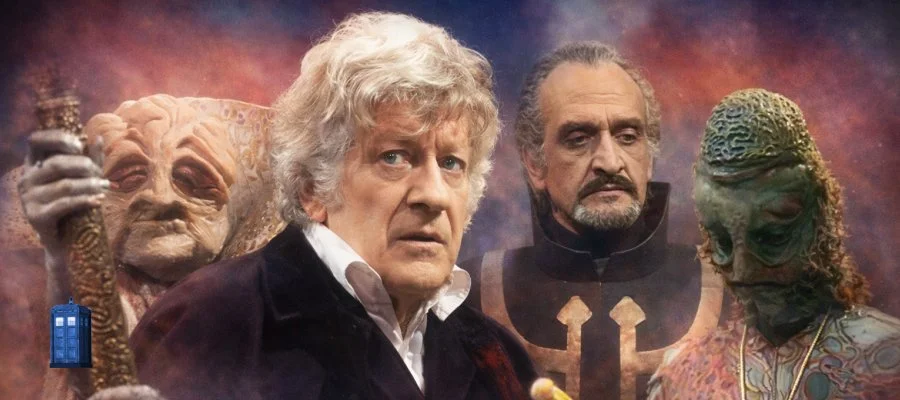
Like several stories from Jon Pertwee's era, Colony in Space is a serial that would almost certainly have benefited from being shorter. At six episodes, it often feels as though it is marking time, with chases, captures and escapes stretching the narrative beyond what its central ideas require. A four-part version would almost certainly have delivered a tighter and more consistently engaging adventure. Modern viewers watching the story in one sitting may find their attention wandering, whereas the original weekly broadcast format allows each cliffhanger and revelation more room to breathe.
The story begins with a rare glimpse behind the scenes of Time Lord politics. The High Council has become concerned about the legendary Doomsday Weapon, a secret known only to themselves and the Master. With the Doctor still officially exiled to Earth, they temporarily restore his freedom—not out of generosity, but because they need him to solve a problem they cannot ignore. It's a neat reminder that, despite his punishment, the Doctor remains someone the Time Lords reluctantly rely upon when events become too dangerous.
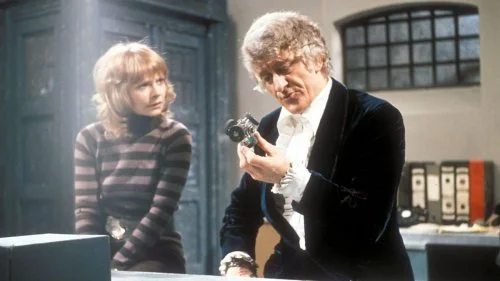
Before the adventure properly begins, the serial provides one of its most memorable moments. At UNIT headquarters, the Doctor experiments with a modified dematerialisation circuit, convinced he can finally outwit the Time Lords' remote control over the TARDIS. Jo remains unconvinced, but in the process the Doctor invites her inside the ship for the first time. Her famous observation that it is "bigger on the inside" prompts the equally famous explanation that the TARDIS is "dimensionally transcendental." It is a charming scene that underlines Jo's growing trust in the Doctor while also giving new viewers one of the series' classic concepts.
Their plans are interrupted when the Time Lords seize control of the TARDIS remotely, transporting them to the distant world of Uxarieus. Jo's initial excitement quickly gives way to genuine fear as she realises that the Doctor's tales of alien worlds have all been true. It's a nicely played character moment for Katy Manning, whose performance captures both Jo's vulnerability and determination.
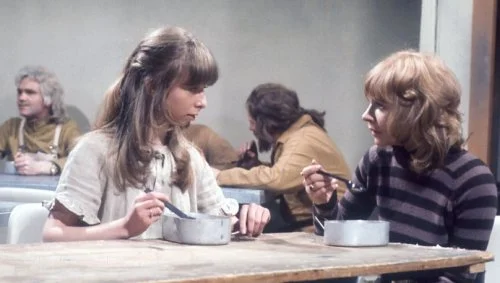
On Uxarieus they encounter a struggling colony whose inhabitants have endured failing crops, mysterious attacks and growing suspicion that someone wants them gone. The Doctor initially finds himself viewed as an unwelcome outsider, mistaken for someone connected to mineral exploration. The uneasy atmosphere works well, creating the sense of an isolated frontier settlement where trust is in short supply and survival is never guaranteed.
Writer Malcolm Hulke’s story gradually reveals that the greatest danger is not the planet's wildlife but human greed. The reptilian attacks that appear responsible for several deaths are actually part of a campaign of intimidation orchestrated by the Interplanetary Mining Corporation. Having discovered enormous deposits of valuable duralinium beneath the colony, the corporation is prepared to drive away settlers to exploit the planet's resources. Hulke's political interests are never subtle, but they are effectively woven into the narrative. The conflict between pioneering colonists simply seeking a new home and a profit-driven corporation gives the story a social conscience that is ever relevant.
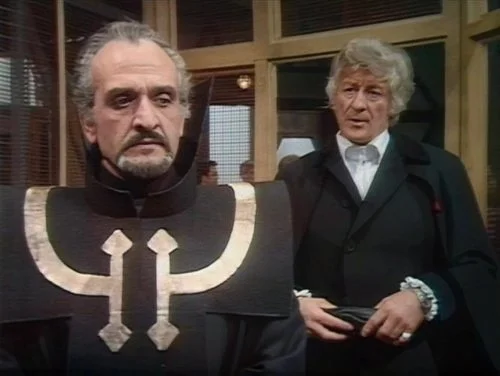
The arrival of an Adjudicator from Earth appears to promise an impartial resolution before the inevitable twist reveals that the official is actually the Master, having stolen the real Adjudicator's identity. Roger Delgado once again demonstrates why his Master remains such an enduring interpretation of the character. Rather than relying purely on flamboyance, Delgado plays the role with quiet authority and effortless charm, making it entirely believable that everyone accepts his credentials without question.
The Master's true objective has little to do with corporate interests. He reveals that the native civilisation of Uxarieus had once achieved remarkable technological advancement before collapsing, leaving behind the mythical Doomsday Weapon. He invites the Doctor to join him in claiming it, offering an opportunity to rule the galaxy together. The Doctor's refusal is one of those wonderfully concise statements that perfectly defines his character: he would rather explore the universe than rule it.
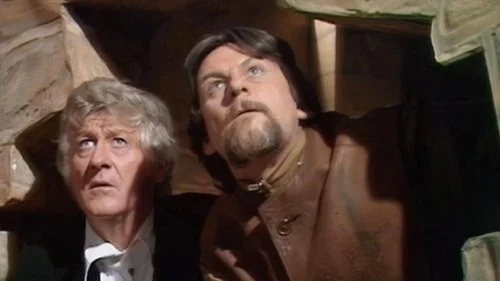
The climax resolves several plot threads at once. Guided by one of the surviving native elders, the Doctor activates the device's self-destruct mechanism, ensuring that the weapon can never be misused. At the same time, the colonists finally rise against the mining company, overcoming its hired forces while the Master escapes to fight another day. The Doctor also discovers that radiation from the buried weapon had been poisoning the colony's crops all along, neatly explaining the agricultural failures that helped fuel the dispute. With the promise of a genuine Earth Adjudicator arriving to settle ownership fairly, the Doctor and Jo return to UNIT headquarters only moments after they originally departed.
Beyond the story itself, Colony in Space occupies an interesting place in the programme's history. Script editor Terrance Dicks openly admitted that he disliked the Doctor's Earth exile, believing it restricted stories to repetitive formulas involving alien invasions or rogue scientists. Working with Malcolm Hulke, he used this serial to break free from those limitations and return the Doctor to a fully science fiction setting, if only temporarily.
Hulke was particularly well suited to this kind of story. Long before Doctor Who, he had established himself writing science fiction television with Target Luna and the Pathfinders serials, all commissioned by Sydney Newman before Newman created Doctor Who. Hulke had attempted to join the programme during William Hartnell's first season with an unmade serial titled The Hidden Planet, later wrote an unbroadcast Dr. Who radio pilot for Peter Cushing, and, alongside Terrance Dicks, helped shape some of the programme's most enduring mythology. Together they introduced the Time Lords in The War Games, while Hulke himself went on to create both the Silurians and the Sea Devils, as well as the Draconians. His political beliefs also found their way into many of his scripts, with recurring themes of environmentalism, anti-authoritarianism and scepticism towards powerful institutions. Colony in Space is perhaps one of the clearest expressions of those ideas.
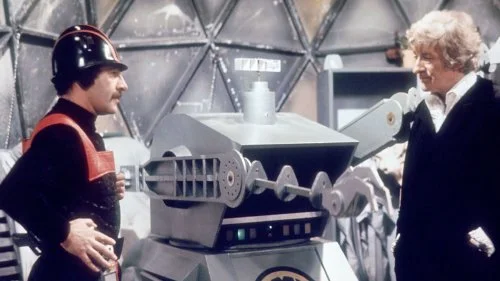
There are several intriguing production stories too. Director Michael E. Briant originally wanted Susan Jameson to play the IMC officer Morgan, but BBC management overruled the decision, arguing that casting a woman in the role might introduce unintended sexual undertones for a family audience. Briant later criticised the decision as both unenlightened and sexist. Elsewhere, fans may enjoy an in-joke in the opening scenes when the Brigadier states that he almost arrested the Spanish ambassador after mistaking him for the Master—a reference to Roger Delgado having previously portrayed the Spanish envoy Mendoza in Sir Francis Drake. The production also initially placed the story in the year 3000, marking an intentional return to adventures beyond contemporary Earth after an extended run of UNIT-based stories.
Critical opinion on Colony in Space has always been divided. Some have argued that the political themes are at their strongest before the Master's arrival, after which the story becomes a more conventional chase for a super-weapon. Others have found the production visually static and criticised the amount of padding spread across six episodes. Equally, there are those who appreciate its rich world-building, thoughtful ideas and the way the narrative gradually unfolds over six weeks. All of those viewpoints contain an element of truth.
While Colony in Space is unlikely to rank among Jon Pertwee's finest adventures, it remains an intelligent and ambitious serial. Beneath its occasionally leisurely pacing lies an engaging blend of political allegory, frontier adventure and classic science fiction. The performances are consistently strong, Roger Delgado is as compelling as ever, and Malcolm Hulke's script offers far more substance than a straightforward battle between good and evil. Viewed as it was originally intended—one episode at a time—it becomes much easier to appreciate its measured storytelling and thoughtful themes, making it a rewarding if slightly overlooked entry in the Pertwee era.
Share on...
Published on July 7th, 2026. Written by Laurence Marcus for Television Heaven.