

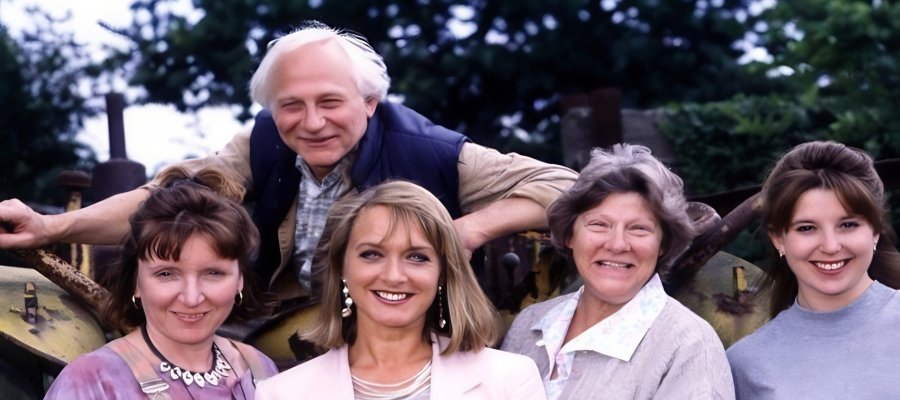
Sitting Pretty
1992 United KingdomSitting Pretty is a curious, often overlooked sitcom that feels like both a corrective and a companion piece to Only Fools and Horses. Where that earlier hit leaned heavily on male dynamics, creator John Sullivan consciously redresses the balance here by shifting focus to women—specifically, a pair of sisters whose lives could hardly be more different.
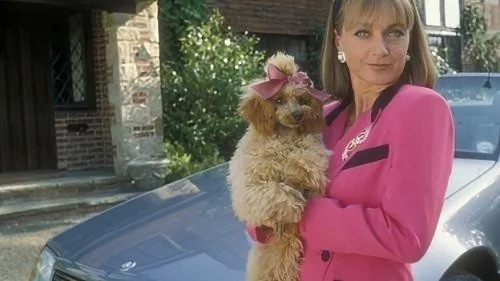
At the centre is Diane Bull’s Annie Briggs, a character as tragic as she is comic. Introduced as a “pampered good-time girl,” Annie is a relic of Swinging Sixties glamour—once dubbed “the Jackie Onassis of Bethnal Green”—who has coasted through life on charm, beauty, and a string of wealthy benefactors. The premise kicks in with ruthless efficiency: Annie’s latest husband, a millionaire named Boris, dies mid-affair less than a year into their marriage, leaving her not only widowed but financially ruined. The fall from luxury to destitution is swift and brutal, and it provides the show’s central comic engine.
Forced out of her opulent lifestyle; her elegant home, her cars, and even her dogs are all repossessed, she is left with no choice but to retreat to her final remaining asset—a cramped flat she had previously given to her daughter Tiffany (Alison Lomas), or “dumpling” as Annie fondly calls her, a trainee nurse born from an earlier affair with a photographer. Their relationship is strained, shaped by years of neglect while Annie globe-trotted and Tiffany was packed off to boarding school.
But the real heart of Sitting Pretty emerges when circumstances push both women back to the family’s ramshackle farm in Kent. There, Annie is reunited with her sweet but doting mother Kitty (Vilma Hollingbery), her hilariously hypochondriac father George (John Cater), and—most crucially—her (non-identical) twin sister Sylvie (Heather Tobias).
Sylvie is Annie’s perfect foil: dowdy, principled, and quietly resentful. While Annie lived a life of indulgence, Sylvie stayed behind, caring for their parents and clinging to her hippy ideals. As an unmarried mother to Andrew, (born Lone Star and played by David Rubin in a single episode), with the improbable claim that his father was Bob Marley, she embodies a very different kind of unconventional life. The tension between the sisters—envy, frustration, but also buried affection—drives much of the show’s best material.
What makes the series work is its fish-out-of-water dynamic. Annie, with her hybrid East End/Home Counties accent, pampered pooch, and theatrical airs, is wildly out of place on the modest farm. Her go-to expression—“phenomenal,” delivered with dripping sarcasm—becomes a running gag that neatly encapsulates her inability to process her new reality. Yet, despite her absurdities, she’s not entirely unsympathetic. The writing allows glimpses of vulnerability beneath the vanity.
Diane Bull’s performance is the show’s standout asset. Known for her stage work, particularly with Alan Ayckbourn, Bull brings a theatrical precision to Annie without tipping into caricature. Her timing is sharp, and she manages to make Annie both exasperating and oddly endearing. There’s an added poignancy in watching her here, given her untimely death from cancer in 1998 at just 46—a loss that lends the series an unintended bittersweet quality in retrospect.
If Sitting Pretty never quite achieved the cultural impact of Sullivan’s earlier work, it’s not for lack of ambition. Its blend of social commentary, character-driven humour, and female-centric storytelling was ahead of its time in some respects. At moments, the tone wobbles between broad sitcom and more reflective family drama, but that inconsistency is also part of its charm.
Seen this show? How do you rate it?
Seen this show? How do you rate it?
Share on...
Published on April 22nd, 2026. Written by Laurence Marcus for Television Heaven.