

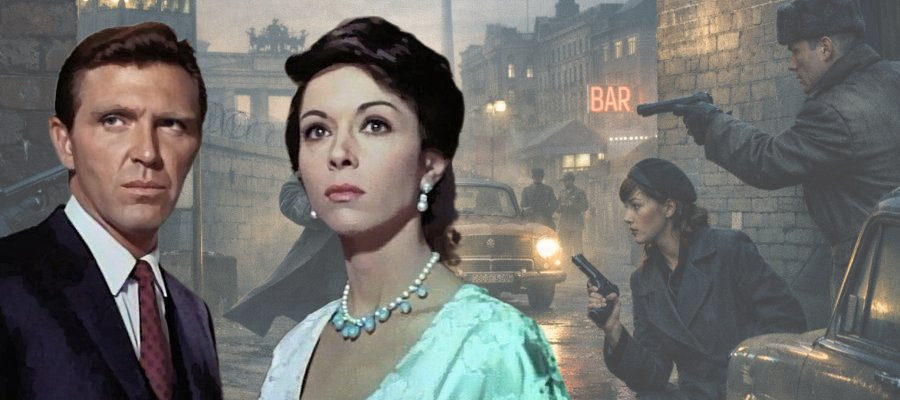
The Man Who Never Was
1966 United StatesThe Man Who Never Was occupies an intriguing niche in 1960s television history: an improbable spy thriller built around identity, chance, and deception, with a premise bold enough to sustain a single, self-contained season. Produced by ABC and 20th Century Fox Television, the series ran between September 1966 and January 1967 and, despite its evocative title, bears no relation to the better-known book and film of the same name.
The series opens with American intelligence agent Peter Murphy presented as a man in flight. Resourceful and ruthless when necessary, Murphy has just disposed of an enemy on a riverboat in Berlin and is attempting to evade pursuing agents when fate intervenes. Seeking refuge in a pub, he is startled to see his exact double seated across the room. Before Murphy can act, the double leaves the bar and is gunned down in the street. Leaving by the back door, Murphy is greeted by the dead man’s chauffeur, who mistakes him for his employer and offers him a lift home. Exhausted and injured, the spy blacks out.
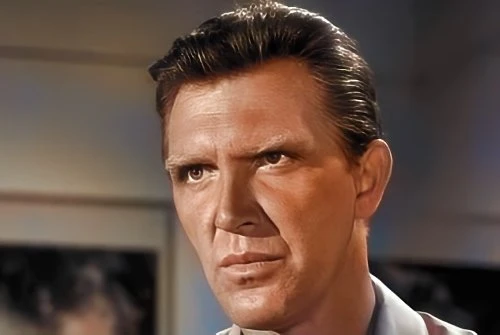
Murphy awakens the next morning in a stranger’s bed. A woman enters the room—clearly his wife—and asks if he is all right. “I ought to know better than to be concerned,” she remarks dryly. “Another bar-room brawl?” It soon becomes clear that Murphy has inadvertently stepped into the dead man’s life.
Back at intelligence headquarters, Murphy’s spymaster, Colonel Forbes (Murray Hamilton), makes a startling discovery: what was thought to be Murphy’s body is carrying Mark Wainwright’s passport. To prevent an international incident, Forbes places a blanket of secrecy over the murder and tracks Murphy to Wainwright’s home. There, he proposes an audacious solution. Since Murphy is officially dead and Wainwright unofficially so, Murphy could assume Wainwright’s identity permanently. The irony is profound. Wainwright, it turns out, was one of the richest men in the world, controlling a dozen companies, travelling freely across borders, and moving easily among the powerful and influential. As a cover, the identity is unbeatable.

Murphy is unconvinced he can sustain the deception, particularly with Wainwright’s friends, business associates, and—most dangerously—his wife. It takes considerable pressure from Forbes before he agrees to the ruse, and his fears soon prove well founded. Eva Murphy is sharp, observant, and emotionally distant. She quickly tests him, asking about Peter’s sister. When Murphy answers, she calmly reveals that her husband had no sister. He tells her the truth: that Mark is dead. Rather than exposing Murphy, Eva chooses to protect the masquerade in order to prevent her husband’s fortune from falling into the hands of his grasping half-brother. She offers a startling bargain—stay, maintain the identity, and become her husband.
Murphy accepts, binding both of them to a dangerous and intimate lie. Their uneasy alliance forms the emotional core of the series.
From this point on, the series settles into the form for which it is best remembered. Robert Lansing stars as Murphy-as-Wainwright, navigating a world of wealth, intrigue, and constant peril. Lansing, who had been replaced as the lead on Twelve O’Clock High after the 1965 season, is perfectly cast as a spy suffering from a uniquely layered identity crisis, bringing both intensity and vulnerability to the role. Dana Wynter’s Eva is equally essential to the show’s success. Elegant, controlled, and quietly resilient, she provides the ideal counterbalance to Lansing’s driven performance. Rather than a passive accessory, Eva actively sustains the masquerade, coaching Murphy in her late husband’s habits and mannerisms, and emerging as one of the era’s more compelling female protagonists.
Each episode sends the pair into a fresh international crisis: smuggling dissidents past secret police, rescuing refugees from communist agents, fleeing an exiled general aboard a schooner, matching wits with an East German intelligence officer, or surviving the whims of a deposed Latin American dictator who treats Eva herself as part of a gambling stake. The plots are often implausible, but they move quickly and stylishly, aided by extensive location filming in Berlin, Munich, London, and other European cities.
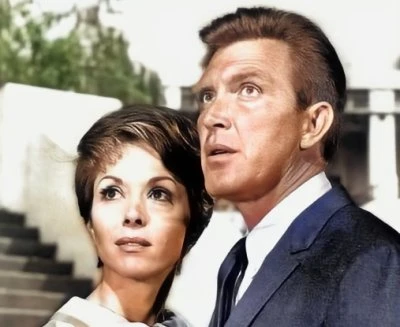
As the series progresses, the focus shifts from espionage mechanics to personal stakes. Eva, having endured an abusive marriage, responds to Murphy’s restraint and decency, and the two gradually fall in love. This emotional evolution gives the show momentum but also exposes the limits of its central conceit. Once fully explored, the deception can only be stretched so far, and the series wisely opts for resolution rather than repetition.
That resolution arrives in the final episode, “I Take This Woman,” broadcast on 4 January 1967. Murphy abandons his life as a secret agent and proposes marriage to Eva, who accepts. The series ends decisively, making it a rarity for its era: a show that concludes by design rather than default.
Produced and largely directed by John Newland, The Man Who Never Was also boasts a strong supporting cast, including Alexander Davion, Derek Francis, Allan Cuthbertson, Eric Pohlmann, George Pravda, Barry Letts, and Alexandra Bastedo. An early pilot starred Don Harron, but a sponsor change led to Robert Lansing assuming the lead—a decision that ultimately gave the series its authoritative centre.
Despite its strengths, The Man Who Never Was was cancelled after 20 episodes. The half-hour format may have been part of the problem, as it left little room to fully develop its often complex plots. The series also faced formidable competition in its time slot: its CBS rival, Green Acres, finished the 1966–67 season as the sixth most-watched programme on American television.
Though some episodes circulate online, the series has never received a commercial DVD release, a scarcity that only enhances its reputation. Seen today, The Man Who Never Was feels less like a prematurely cancelled show than a concept that reached its natural conclusion: a stylish, romantic Cold War adventure that told its story—and knew when to stop.
Seen this show? How do you rate it?
Seen this show? How do you rate it?
Share on...
Published on January 21st, 2026. Written by Laurence Marcus for Television Heaven.