

The Skin Game
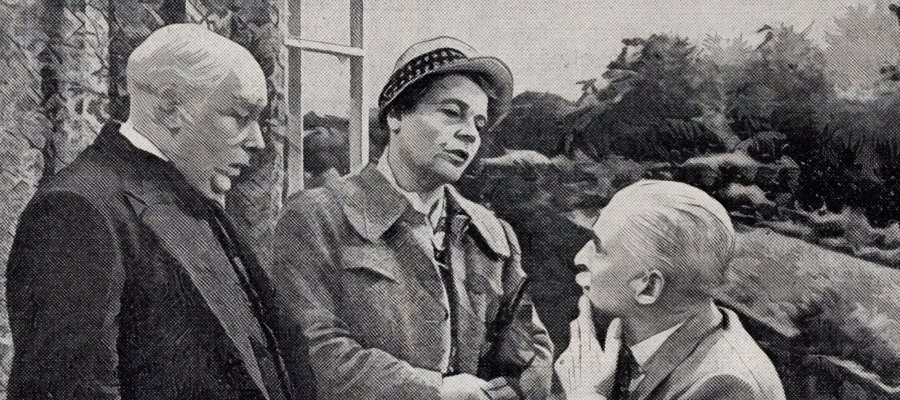
1951 United KingdomJohn Galsworthy, best known for his trilogy of novels collectively titled The Forsyte Saga, also proved himself a formidable dramatist, and this 1951 television adaptation of his 1920 stage play The Skin Game was hailed by Radio Times as “as powerful a piece” as he ever wrote. The play famously states its theme in its closing moments, when Hillcrist asks: “What is it that gets loose when you begin a fight, and makes you think you’re not?” It is Hillcrist (Arthur Wontner ) — a thoroughly decent, middle-aged, well-bred Englishman — who poses the question, having fought for what he believed to be right, only to wonder whether the struggle was worth it if it has cost him his own self-respect.
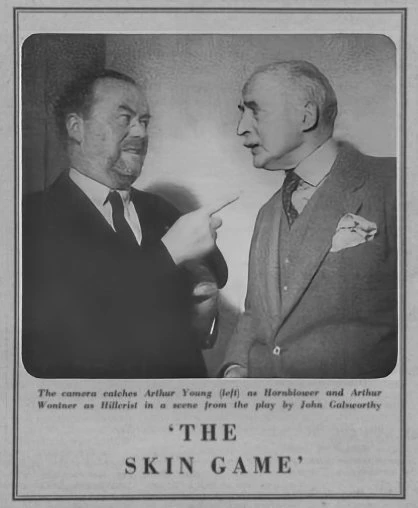
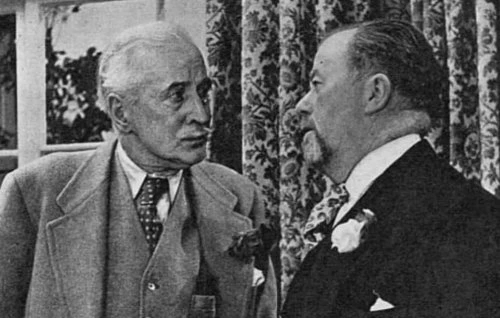
Set just after the end of the First World War, The Skin Game presents a clash of deadly opposites. The Hillcrists have lived for generations in their beautiful country house. Hillcrist (Arthur Young) lives there with his wife Amy (Barbara Couper), his late-teenage daughter Jill (Diane Watts), and their servants and retainers. He represents “old money”, though his finances are now precarious. Opposing him are the Hornblowers, rich newcomers from the North whose expanding potteries threaten to engulf the surrounding countryside. Hillcrist is a gentleman — a little weak perhaps, but fundamentally honourable. Hornblower, by contrast, is a self-made, “strong” man, unashamed to break his word if it suits his purposes.
The conflict begins early. Hornblower has ruthlessly dispossessed an elderly married couple from the village to make room for one of his own workmen, in flat contradiction of a promise he had given to Hillcrist. Worse still, he is now threatening to buy ‘the Centry’, a particularly beautiful part of the village, where his new chimneys would replace the trees that define the view. With this, war is declared.
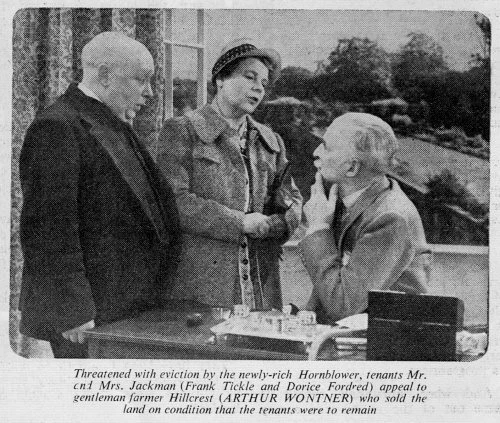
Determined to strike back, the Hillcrists fortuitously uncover a dark secret about Hornblower’s daughter-in-law, Chloe (Helen Shingler), who had once supported herself as the “other party” in divorce cases. When confronted with this information, Hornblower agrees to sell the disputed property to the Hillcrists for less than half the auction price, on the strict condition that the family swears to keep the secret. However, the truth leaks out through the unprincipled Dawker (Philip Dale), Hillcrist’s agent and Hornblower’s personal enemy.
In one of the play’s most powerful sequences, Chloe Hornblower comes to the Hillcrists’ house, desperately begging them to help keep the secret from her husband, who already senses that something is amiss. She hides behind a curtain when her husband, Rolf Hornblower (played by a young Patrick Macnee - The Avengers), storms into the house demanding answers. True to his promise to Chloe, Hillcrist invents a story to protect her, but Rolf is unconvinced and declares his intention to end the marriage — even though Chloe is pregnant. Overcome, Chloe runs to the lily pond outside the house and attempts to drown herself. She is brought back inside, and it becomes clear that she will survive. In the final moments, the decent English gentleman, bewildered and bitterly ashamed, sits down to reflect on the battle he has waged. “Begin as you may,” he concludes, “it ends in this — skin game!”
The play’s enduring power is reflected in the fact that The Skin Game was adapted for the cinema twice, first in 1921 and again in 1931, the latter version directed by Alfred Hitchcock. This 1951 television production also boasted a strong supporting cast, including Erik Chitty (Please Sir!) and Leonard Sachs (The Good Old Days).
Reviewing the broadcast in Television Weekly on 16 February 1951, critic Austin Welland praised the production highly, writing: “Royston Morley’s production was notable for ingenious camera work, particularly in the second act. But the chatter of crowd background was distracting during the bidding; however, this is a minor quibble. The producer deserves full credit for assembling a well-cast team who held the interest every moment they were on the screen.”
The Skin Game was broadcast live on Sunday 11 February 1951 at 8.30 pm, with a second performance transmitted the following Thursday. As was normally the case in the early 1950s, no telerecordings were made, and consequently the production no longer exists in the archives — leaving it as one of the many lost treasures of early British television drama.
Seen this show? How do you rate it?
Seen this show? How do you rate it?
Share on...
Published on December 16th, 2025. Written by Laurence Marcus for Television Heaven.