

Accident
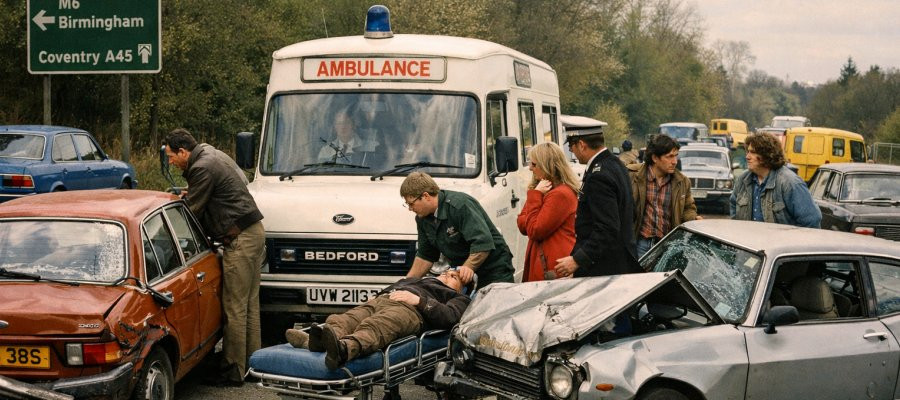
1979 United KingdomThe BBC’s Accident is one of those quietly ambitious dramas that slipped through the cracks of television history, yet deserves to be remembered alongside the Corporation’s more celebrated late-1970s experiments in serious, adult storytelling. Broadcast across eight episodes in 1979 and 1980, it takes a single, horrifying road traffic collision and turns it into a kaleidoscopic study of character, chance and consequence.
The premise is deceptively simple. On a wet March morning in the Home Counties, four students – Tom Baxter, his girlfriend Joanna, Tom’s pregnant sister Diana and her radical boyfriend Mitch – find themselves stranded at the roadside in a Citroën 2CV after running out of petrol. One of them heads off on foot to fetch fuel. Fate, however, has other plans. A minibus bound for the airport soon appears, driven by the enigmatic Jack Dutton, a man living a double life, and carrying with it a cross-section of ordinary lives: reconciled schoolteachers Frank and Dilys Martin, and Terri Lewis, a young woman heading for Africa in an attempt to escape a broken relationship.
Close behind the minibus, impatience and poor judgement take the wheel of a red Cortina driven by a prison officer, transporting a handcuffed long-term prisoner, Cyril Edmunds, to another jail. Adding still more momentum is a stockbroker, Andrew Buchan, cruising at 80mph in his Rover with his chauffeur in the back. At one precise moment, in one precise place, these journeys intersect. The result is violent, sudden and irrevocable: bodies “cut, creased, bent and broken”, interrupted lives reduced to a statistic.
What sets Accident apart is not the crash itself, but what the series chooses to do with it. Devised largely by Derek Ingrey, with three episodes by Ray Jenkins, the drama adopts a boldly non-linear structure. Using flashbacks, flashforwards and present-day hospital scenes, it shows events before, during and after the collision, constantly reshuffling perspective. Characters drift from foreground to background depending on the episode’s focus; someone central one week may barely speak the next. It is, as producer Joe Waters described, an attempt at a “television novel” – a jigsaw in which the audience assembles meaning from sharp-edged fragments.
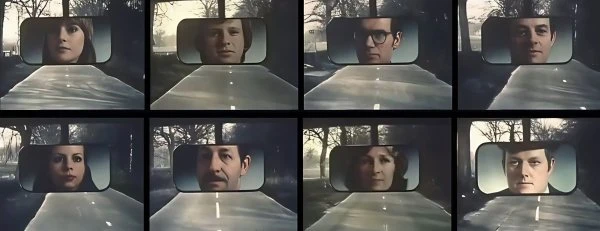
The opening titles alone signal this intent. A car hurtles down a quiet road from the driver’s point of view, the rear-view mirror flickering with the faces of those soon to be involved, before shattering into pieces. It is an elegant metaphor for what follows: ordinary reflections splintered by a single moment of impact.
For an obscure series, Accident boasts a remarkable cast. Many faces will be instantly recognisable to fans of British television, often years before their most famous roles. Gwyneth Powell appears long before Grange Hill; Geoffrey Hinsliff predates his Coronation Street notoriety as Don Brennan; Sylvester Williams turns up decades before EastEnders. There are early or unexpected appearances from Anthony Head, Marc Zuber and Sharman Macdonald, while Michelle Newell (The Cleopatras) – the only actor to appear in all eight episodes – provides a consistent emotional thread as Terri Lewis. The performances are uniformly strong, grounded and believable, helping the audience invest in characters even when the narrative leaps backwards or sideways in time.
Despite moments of warmth and even camaraderie among the crash victims – a touching “we’re all in it together” spirit that gradually develops – Accident never flinches from difficult material. Storylines involving child abuse, neglect and the possibility of miscarriages of justice are handled with a gritty seriousness that may still unsettle viewers. There is also an unmistakable undercurrent of social responsibility. Without becoming overt propaganda, the series repeatedly underlines how small acts of stupidity – impatience, inattention, running a car on empty, refusing to wear a seatbelt – can have fatal consequences. In that respect, it feels very much of its time, aligning with contemporary debates and campaigns about road safety.
Not everything is neatly resolved. By the final episode, several threads remain tantalisingly loose: unanswered questions about Jack Dutton’s true personal life, unresolved mysteries around abused child Mona, and relationships that seem poised to develop further. These dangling storylines give the impression that a second series may once have been contemplated. It is frustrating, but also strangely fitting; real accidents rarely provide tidy endings.
There are occasional pacing issues – a couple of episodes drift more slowly than others – yet Accident remains compelling throughout. Its blend of formal experimentation, strong writing and humane observation makes it far more than a hospital-bed drama about recovery. It is about fate, yes, but also about responsibility, coincidence and the fragile threads that hold everyday lives together.
That Accident is so little discussed today feels like a genuine loss. Entertaining, thought-provoking and often edge-of-the-seat tense, it stands as a reminder of a period when the BBC was willing to take risks with structure and subject matter. It is a series well worth rediscovering – and one that leaves you thinking long after the wreckage has been cleared away.
Seen this show? How do you rate it?
Seen this show? How do you rate it?
Share on...
Published on January 7th, 2026. Written by Laurence Marcus for Television Heaven.