

Fresh Fields
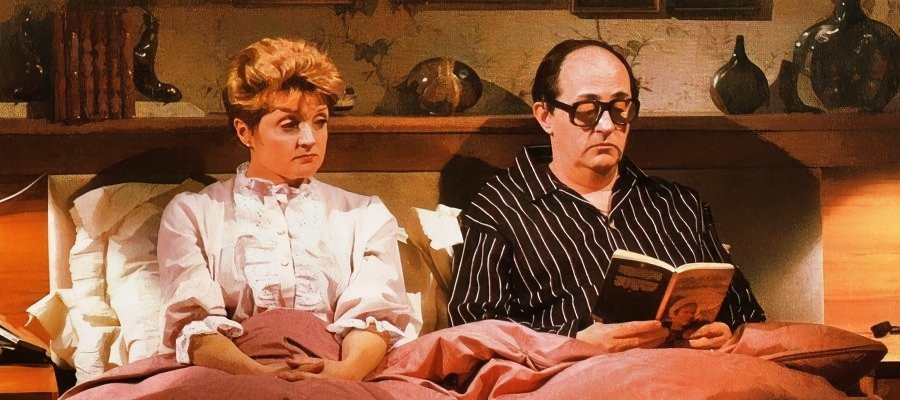
1984 United KingdomFresh Fields is one of those gently subversive British sitcoms that appears cosy on the surface but quietly brims with character-driven wit and observation. Set in the leafy calm of Barnes, London, the series centres on Hester and William Fields, a devoted, comfortably middle-class couple whose idea of marital harmony is constantly tested by very different responses to middle age and change.
William, played with beautifully restrained exasperation by Anton Rogers (May to December), is a diligent accountant whose ideal evening involves peace, predictability and a well-earned sit-down. His wife Hester, portrayed with infectious energy by Julia McKenzie (Cranford), is having none of it. With their children grown and gone, Hester refuses to fade quietly into suburban invisibility. Instead, she throws herself into new hobbies, causes and enthusiasms—working part-time at the local restaurant, Lucy’s Kitchen, experimenting with fitness fads, creative pursuits and anything else that promises a spark of novelty. The show’s title, and its emotional engine, lies in this tension: “fresh fields” are Hester’s antidote to empty-nest syndrome, while William clings to routine as a bulwark against chaos. The opening credits capture this dynamic perfectly, with silhouetted images of Hester pedalling an exercise bike or hammering a drum kit as William rocks contentedly in his chair.
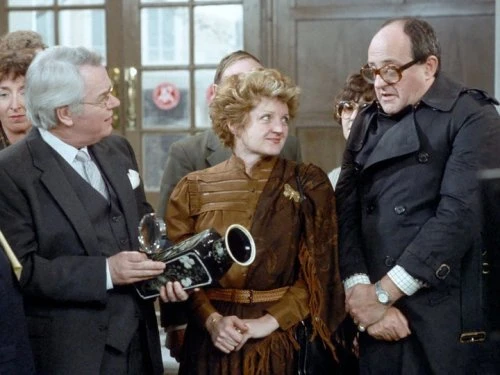
Around this central marriage is a neatly constructed ensemble that enriches the comedy without overwhelming it. The Fields’ home includes a granny flat occupied by Hester’s mother Nancy, memorably played by Fanny Rowe, whose prim disclaimers (“It’s not my place to say anything BUT…”) invariably precede pointed commentary. Nancy’s ex-husband Guy, a charming rogue portrayed by Ballard Berkeley (best remembered as the dotty Major in Fawlty Towers), drifts in and out attempting reconciliation, adding a generational echo to the show’s themes of marriage, independence and compromise.
The Fields’ children are mostly felt rather than seen. Their son Tom has emigrated to New Zealand and remains resolutely off-screen, while daughter Emma exists largely as a disembodied voice, phoning at the worst possible moments. Her husband Peter appears occasionally, and later the couple present Hester and William with their first grandchild, Guy, named after his great-grandfather—a neat comic loop that reinforces the show’s sense of family continuity. Emma herself eventually appears on-screen in the sequel series, played by Sally Baxter.
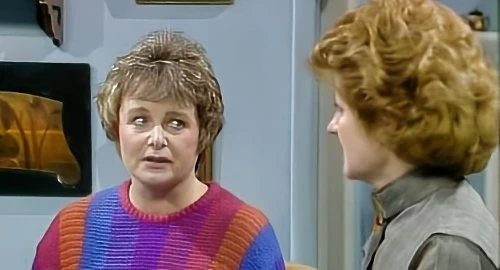
No discussion of Fresh Fields would be complete without mentioning Sonia Barrett, the Fields’ neighbour and a masterclass in sitcom irritation. Ann Beach’s Sonia pops round in every episode to borrow household items, breezily announcing “It’s only Sonia!” as she lets herself in. Her relentless cheerfulness and complete disregard for boundaries drive William to distraction, to predictably comic effect. Sonia’s husband John surfaces from time to time, as does William’s secretary, the efficiently sympathetic Miss Marigold Denham, played by Daphne Oxenford.
The original run concluded in 1986, but the characters proved durable enough to return in French Fields, which followed Hester and William to France after William accepts a job there. The change of setting injected fresh visual and cultural humour while preserving the couple’s essential dynamic: Hester embracing adventure, William bracing himself against it. Three series aired between 1989 and 1991, all written by John T. Chapman and Ian Davidson, with familiar faces reappearing—including a guest turn by Ann Beach as Sonia in the final episode, a fond nod to the show’s roots.
At the heart of the series’ success are its performances and writing pedigree. Julia McKenzie’s portrayal of Hester earned her a BAFTA for Best Light Entertainment Performance felt richly deserved for a character who is by turns frustrating, inspiring and deeply human. Anton Rogers provides the perfect counterbalance, grounding the comedy in dry realism and impeccable timing, and across the pond, the series won recognition with an International Emmy for Popular Arts in 1984.
Writer John T. Chapman brought to Fresh Fields the craft of a veteran whose career spanned half a century. From Whitehall farces like Dry Rot and Simple Spymen in the 1950s to an extraordinary television output of more than 200 comedies—including Hugh and I, an adaptation of Blandings Castle for Sir Ralph Richardson, and collaborations with Carla Lane on The Liver Birds—Chapman understood character comedy at a fundamental level. In Fresh Fields, that experience translates into scripts that mine humour from everyday marital negotiations rather than punchlines alone.
Made available in full on DVD, including French Fields in a comprehensive seven-disc set, the series stands as a quietly accomplished example of British sitcom at its most humane. Its laughs come not from cruelty or caricature, but from recognisable fears and desires: the need for purpose, the comfort of routine, and the delicate dance of staying connected as life moves on. In celebrating Hester’s restless curiosity and William’s stubborn contentment, Fresh Fields finds comedy in the ordinary—and makes it feel anything but.
Seen this show? How do you rate it?
Seen this show? How do you rate it?
Share on...
Published on January 30th, 2026. Written by Laurence Marcus for Television Heaven.