

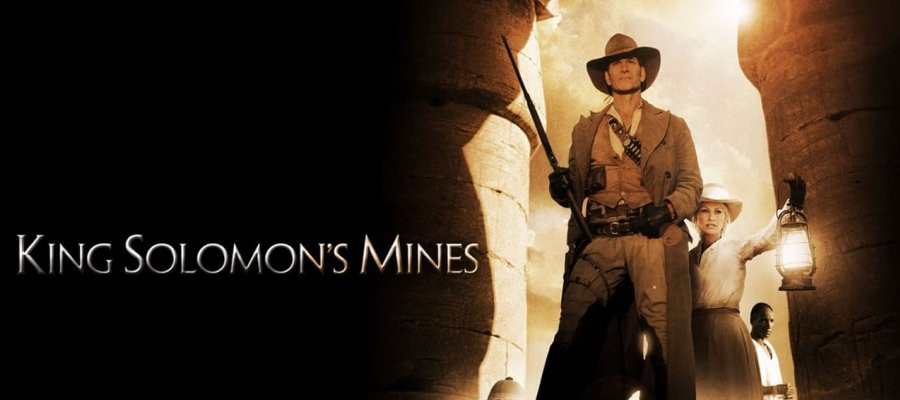
King Solomon's Mines
2004 United StatesReview: John Winterson Richards
The British, contrary to the "Little Englander" image, were from the Sixteenth to the Twentieth Centuries, probably more than any other nation, fascinated by what lay out there in the wide world beyond their shores. Many of the greatest Britons dedicated their lives to different aspects of that complex and uneasy alliance of trade, exploration, evangelisation, exploitation, colonisation, and imperialism that built The Greatest Empire the World Has Ever Seen, the existence and spread of which itself fed that fascination even more.
This is reflected in the literature and culture of the times. In fiction, what might be called the "Great White Hunter" subgenre built on the real life exploits of colonial outdoorsmen like Selous, Patterson, Corbett, and Adamson. At the same time Britons in the, initially, for the most part coastal colonies around the edge of Africa peered nervously into the dark, seemingly impenetrable interior and speculated on what wonders might be hidden there, waiting to be discovered, leading to what has been called a "Lost World" subgenre.
One such British colonial, an official named Henry Rider Haggard, later Sir Henry, is sometimes given credit for establishing both the "Great White Hunter" and "Lost World" subgenres with a single novel, King Solomon's Mines. Whether he deserves sole credit may be debated, but what cannot be denied is that he combined them both quite brilliantly and wrote an exciting adventure story, a classic "ripping yarn," the huge commercial success of which led to countless imitations. One can see its influence on Sir Arthur Conan Doyle, John Buchan, Edgar Rice Burroughs, and Wilbur Smith, among many others, and Haggard himself stuck close to its formula in several of his subsequent novels, most notably She and several other novels set in what we would today call the same universe as King Solomon's Mines.
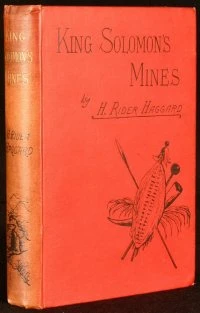
The premise of the original 1885 novel is based on some (previously) less well known verses of the Bible, referring to King Solomon sending ships Southward to collect gold. For many years serious scholars assumed that the ships went no further than the Red Sea, but more recent research suggests it is not entirely impossible that Middle Eastern civilisations may have had contact with Southern Africa.
Haggard's hero, Allan Quatermain, does not at first believe in that connection, or in a map in his own possession which purports to show the location of the mines from which King Solomon's gold was dug. Quatermain is the archetype of the "Great White Hunter." He is first and foremost a practical man, but he retains a sense of higher duty. He is motivated more by a humanitarian impulse than by greed when Sir Henry Curtis, a Herculean Baronet, and his friend Commander John Good, RN, ask for his help in rescuing Curtis' brother, who has gone missing on his own quest for the mythical mines. Adventures ensue.
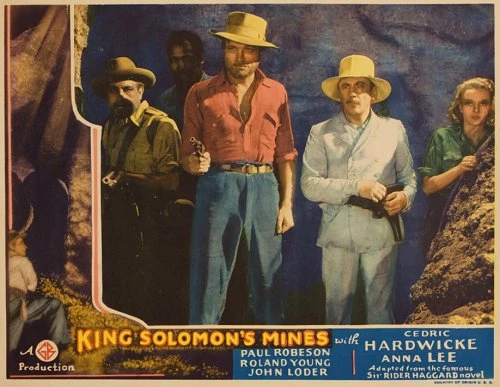
It is a spiffing tale that has been adapted many times in different media. A 1937 feature film with Sir Cedric Hardwicke as Quatermain is best remembered today for the participation of the great Paul Robeson. Another version in 1950 with Stewart Granger in the lead was hugely profitable. As late as 1985 Cannon Films produced a typically cheap and cheerful version with Richard Chamberlain, who was very good at this sort of thing, as a swashbuckling Quatermain.
However, it is in the nature of fashion that it changes. Some of the aspects of the "Great White Hunter" subgenre that most appealed to Haggard's Victorian readers are actually commercial weaknesses today when most are uncomfortable with the "white" aspect and many are increasingly uncomfortable with the "hunter" aspect - even if it should be noted that Haggard and all of the best writers in the subgenre often demonstrate greater interest in, knowledge of, and respect for both native peoples and wild animals on their own terms than their critics.
It was therefore perhaps a surprising decision to revive King Solomon's Mines in a two part television "miniseries" in the early 2000s as one of Hallmark's adaptations of literary classics, starring the distinctly All-American Patrick Swayze as Quatermain. It is interesting to note the changes, or at least changes of emphasis, thought necessary to make it palatable for modern sensibilities, especially since it was filmed in South Africa fairly soon after the end of apartheid.
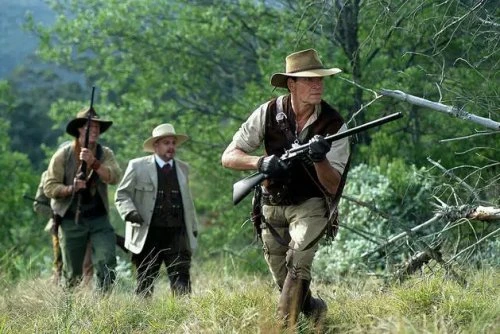
A renegade tour guide and some out of place Russians are introduced as villains, taking some of the emphasis off the native tyrant Twala, whose own people are given more agency in his overthrow rather than the crucial moments being left to the "white saviours" from beyond. The "witch doctor" Gagool, a wicked old hag in the novel, is here portrayed by an attractive young woman (Lesedi Mogoathle) and is therefore immediately more sympathetic. She shows at least hints of human kindness, even if it might be no more than pragmatism because it his suggested that not all of her "powers" are necessarily fraudulent and so she might be hedging her bets, knowing how everything will turn out. This ambiguity is interesting in itself.
Quartermain is shown as being on far friendlier terms with his black servants than in the novels, treating them as equals. This was, to say the least, not the norm in Victorian times. Neither was the degree of open emotion exhibited by Swayze, for example when he has to shoot a wounded elephant in an introductory sequence intended to emphasise that he is at least an ethical hunter.
The biggest change from the book is that it is a new female character not found in Haggard rather than Curtis who enlists Quatermain's help to search for a missing relative. A similar plot device was used in the Hardwicke, Granger, and Chamberlain versions to introduce a love interest (curiously the novel is more progressive than all the film versions in giving Good an interracial love affair). Here Curtis is reduced from the handsome, physically superior hero figure of the books to Quatermain's tough but slightly disreputable older drinking companion.
Swayze makes no attempt to hide or explain his Americanism, which is probably the right decision because it would only have been drawing attention to it. As it is, he has the virility to be a convincing Quartermain, even if he looks too young for the part as it is written in the book (he was in fact close to the correct age at the time but as a Hollywood star dare not show it).
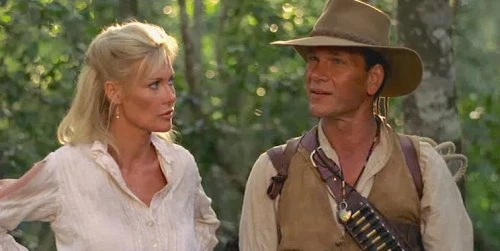
The lovely Alison Doody, who was so good in the similarly themed Indiana Jones and the Last Crusade, does well to make the poorly written female lead far more engaging than the script suggests. Doody is in general one of those actresses who deserves to be better appreciated. As her missing father, Sir John Standing, himself a real life Baronet, proves once again that there are no small parts for actors of his calibre with a moving portrait of a frightened man trying to keep his dignity.
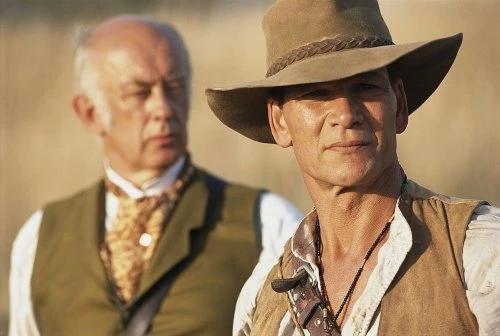
Roy Marsden is too old as Good but is another actor who always earns his pay. Ian Roberts does well with what the script requires him to do as the rewritten Curtis, and fellow South African Gavin Hood makes the new character of Quatermain's former business partner surprisingly intriguing - it is a wasted opportunity that hints of a possible redemption arc for the character which is eventually forgotten. Hakeem Kae-Kazim, a likeable leader figure in Black Sails, demonstrates his versatility by going to the other extreme as a frightening Twala.
Some of the South African locations are truly spectacular and nicely filmed, which may be the best reason to a well played but still rather pointless updating of the familiar adventure story.
Seen this show? How do you rate it?
Seen this show? How do you rate it?
Share on...
Published on December 3rd, 2025. Written by John Winterson Richards for Television Heaven.