


The Man From U.N.C.L.E.
1964 United StatesIn the 1960’s, with the Cold War at its height and the Cuban Missile crisis still firmly set in everyone’s minds, international intrigue and especially tales of secret agents and super spies were all the rage. When Ian Fleming’s creation of super spy James Bond took the movie world by storm, it was surely only a matter of time before the small screen turned to that same format in order to emulate Bond’s success.
With this in mind, producer Norman Felton, the director of MGM's television division and the guiding force behind Dr. Kildare, approached Fleming himself and began talks with him about possibly collaborating on a spy-oriented TV show for American TV. Fleming contributed some ideas (including the name of a main character; Napoleon Solo), but had to bow out when "Bond’s" producer, Albert Broccoli, felt that Fleming's involvement with the series would cheapen his upcoming movie franchise. It was at this stage that Felton brought in Sam Rolfe, one of television's top writer/directors.
Facing network bosses that were unhappy about Fleming's departure, Rolfe developed the ideas that Felton and Fleming had drummed out, being careful not to copy the James Bond format too closely, and emerged with The Man From U.N.C.L.E.; a series that became American television's most successful and fondly remembered spy series of the numerous types that attempted to board the 007 bandwagon.
A 70-minute pilot, originally titled Ian Fleming's Solo and later shortened to Solo in colour from late November to early December 1963, with locations at a Lever Brothers soap factory in California. In February 1964, a law firm representing Bond producers Harry Saltzman and Albert R. Broccoli demanded that the series cease using Ian Fleming’s name as well as the character name “Solo”—including “Napoleon Solo” and “Mr. Solo.” At the time, filming was underway on the Bond film Goldfinger, which featured Martin Benson as an American Mafia boss named “Mr. Solo,” who is ultimately killed by Auric Goldfinger. The producers argued that Fleming had already sold them exclusive rights to the name and therefore could not use it again. Although Fleming quickly signed an affidavit stating that nothing in the Solo pilot infringed on any Bond characters, the threat of legal action led to a compromise: the character could remain Napoleon Solo, but the series title had to be changed.
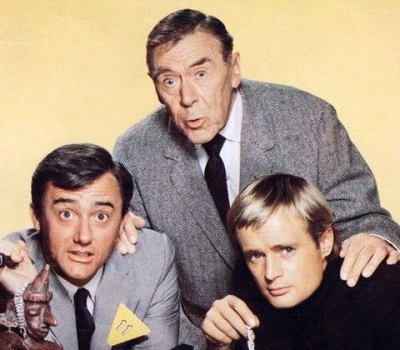
Now retitled, the series followed the exploits of U.N.C.L.E. (the United Network Command for Law and Enforcement) whose headquarters were located behind a secret doorway in Del Floria's tailor shop on New York's East Side. Its principal agents were Napoleon Solo -the Americanised Bond-alike, played with smooth, stylish, tongue-in-cheek charm by Robert Vaughn (Hustle), and IIllya Kuryakin (Sapphire & Steel) -British actor David McCallum as the dry-witted, calmly efficient Russian spy. Working under the direct orders of U.N.C.L.E. head Mr Alexander Waverly, -Hitchcock regular and widely respected British character actor Leo G. Carroll (Topper) - the duo battled a colourful collection of dastardly adversaries bent on the destruction of the 'American Way', through a series of 132 episodes (29 in black & white, 103 in colour).
In the original pilot, the head of U.N.C.L.E. was Mr. Allison, played by Will Kuluva, rather than Mr. Waverly. David McCallum’s Illya Kuryakin appeared only briefly. For the television broadcast, several scenes were reshot. The pilot was then re-edited to a 50-minute format to fit a one-hour time slot, converted to black-and-white, and ultimately aired as “The Vulcan Affair.”
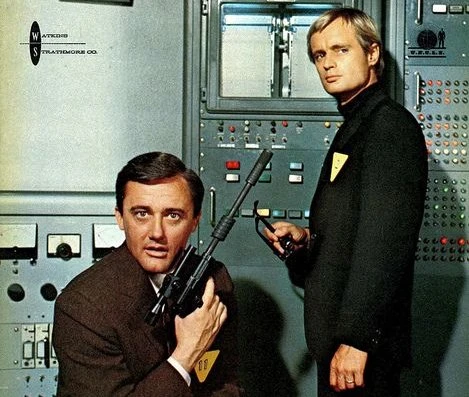
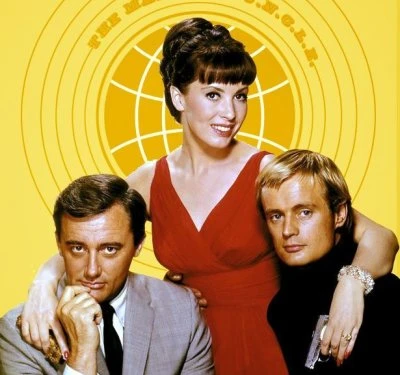
The U.N.C.L.E. duo's never ending fight again the minions of THRUSH (Technical Hierarchy for the Removal of Undesirables and the Subjugation of Humanity), was joined for a single season by Stefanie Powers as April Dancer (who first appeared in TMFU episode ‘The Moonglow Affair’ but played by the actress Mary Ann Mobley), and Noel Harrison (son of Rex Harrison), as side-kick Mark Slate, in the alternating weekly exploits of the (less than imaginatively titled), The Girl From U.N.C.L.E. (Actually, more a Modesty Blaze strip cartoon rip-off than an extension of the 'Bond' phenomena).
The Man From U.N.C.L.E. boasted a series of high profile guest stars eclipsed only by the dazzling array of talent to be found on display in the Batman TV series. Among them were such notables as Vincent Price, Angela Lansbury, Ricardo Montalban, Martin Landau, Joan Collins, Slim Pickens, Carroll O'Connor, Kurt Russell, Jack Palance, Janet Leigh, Sonny and Cher and Joan Crawford. One of the more intriguing pairings came in ‘The Project Strigas Affair’ which starred William Shatner and Leonard Nimoy, two years before they stood shoulder to shoulder on the bridge of Star Trek’s USS Enterprise.
A wide range of print and merchandise tie-ins grew out of the series’ popularity. In the United States, Gold Key Comics released a dedicated Man From U.N.C.L.E. title that ultimately ran for twenty-two issues. Across the Atlantic, two original comic strips were produced for the British market during the 1960s—some drawing on reprinted Gold Key material. The most prominent appeared in Century 21's Lady Penelope comic beginning in January 1966, and it remained until January 1967, when it was replaced by a Girl From U.N.C.L.E. strip.
The franchise also expanded into prose fiction, with roughly two dozen novels published between 1965 and 1968. Additionally, four U.K. TV Annuals were released by World Distributors from 1967 to 1970, combining new written stories with a reprinted Gold Key tale that had not previously appeared in Britain.
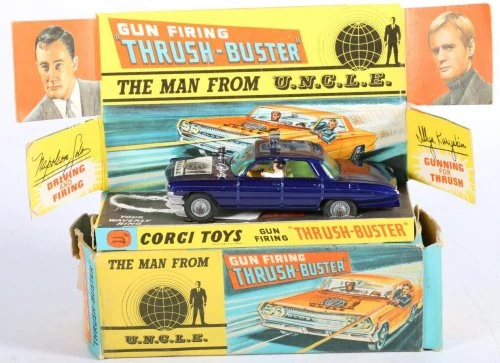
Licensed products were equally abundant. Fans could buy Gilbert action figures, Aurora model kits, lunch boxes, toy guns, and more. One of the best-remembered items was Corgi’s die-cast “Thrushbuster,” an Oldsmobile 88 that featured miniature Napoleon Solo and Illya Kuryakin figures which popped in and out of the windows to fire their weapons when a roof-mounted periscope was pressed. Overall, U.N.C.L.E. proved to be a merchandising powerhouse, with the show’s stars and distinctive logo adorning everything from bubble-gum cards to lines of adult clothing.
The series was yet another window into the mood of a bright breezy and optimistic decade now forever lost to us. It was simple fun, produced in a more colourful clear-cut time where right and wrong were still clearly defined, and heroes never so much as wrinkled their immaculately tailored attire. The result was a classic series of imagination and atmosphere.
It was basically Austin Powers...but with infinitely better dress sense.
Seen this show? How do you rate it?
Seen this show? How do you rate it?
Share on...
Published on December 9th, 2025. Written by Humar for Television Heaven.