

Stop, Look and Listen
1971 United KingdomA century after Britain introduced compulsory free education—and fourteen years after Independent Television began producing school programmes—ITV had already become a valuable resource for teachers. With series such as Rules, Rules, Rules, My World, and Seeing and Doing, it built a strong reputation for educational content. It was in this context that ITV launched its most successful and enduring series, Stop, Look and Listen, ungraciously, and certainly by today's standards, controversially labelled as, ‘for slow learners.'
From the 1970s through to the early 1990s, nearly 200 of these ten-minute films were produced by the Midlands ITV company ATV and its successor, Central Television. The series offered viewers a glimpse behind the scenes in a wide range of settings, including factories, shops, and safari parks, as well as the daily work of the police, hospitals, and fire service. It also highlighted essential trades such as bricklaying, road maintenance, and engineering.
The programme’s lively and accessible presentation helped it attract a much wider audience than first intended. Initially aimed at 7–9-year-olds—particularly those from disadvantaged backgrounds or who showed little curiosity about the world around them—it soon proved suitable for younger viewers as well. By the mid-1970s, it had been adapted to include children aged 5–7, and teachers observed that the films could also engage older children and adults.
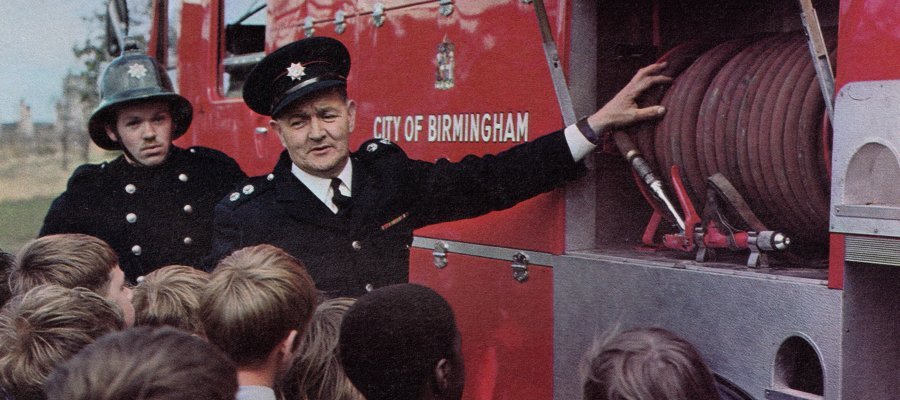
In autumn 1970, a year before Stop, Look and Listen appeared on ITV (it debuted on Tuesday 21 September at 1.45pm), its first episode—about a fire engine—was shown extensively on an educational television network run by the Plymouth Education Authority in Devon.
From the 1960s through to the 2000s, it was common practice for producers of new schools’ television programmes to show early episodes privately to selected schools or teacher training centres. These preview screenings were used to gather feedback from both pupils and staff, and to observe how audiences responded. In this case, the first episode was trialled through a local closed-circuit system run by the Plymouth College of Technology, reaching at least 1,500 children and their teachers. Responses to this pilot screening were generally favourable.
As a source of classroom stimulus, the series proved highly effective and was soon adopted far more widely than its creators had anticipated. After about four years, many of the films were either re-edited or replaced altogether, removing the on-screen teacher figure in favour of a narration-led format. This revised approach featured voices such as Chris Tarrant.
Further changes followed in 1990 with the introduction of the National Curriculum in England and Wales. From that point on, simply sparking interest or providing general stimulus was no longer considered sufficient justification for classroom use; programmes were expected to align more directly with defined learning objectives. In 1993, responsibility for schools broadcasting shifted from the ITV companies to Channel 4, and Stop, Look, Listen (the 'and' in the title had been dropped some time earlier) was reshaped into a broader, topic-based series for younger children—a format it maintained for roughly another decade.
Stop, Look, Listen was merged with Our World, Yorkshire Television's infants’ series which in its original form as My World had actually been running since the 1960s, but had become a similar topic-based series in the early 1990s. The last new episodes were shown in early 2002 then there were the usual repeats until 2006.
By the late 2000s, schools had largely moved to computers, interactive whiteboards, and online resources, making scheduled daytime broadcasts less useful. UK broadcasters do still support educational content (the BBC now produces most of its educational material through BBC Bitesize), but they no longer make the dedicated, curriculum‑timed schools programmes that were once a staple of daytime TV.
Seen this show? How do you rate it?
Seen this show? How do you rate it?
Share on...
Published on April 23rd, 2026. Written by Laurence Marcus for Television Heaven.