

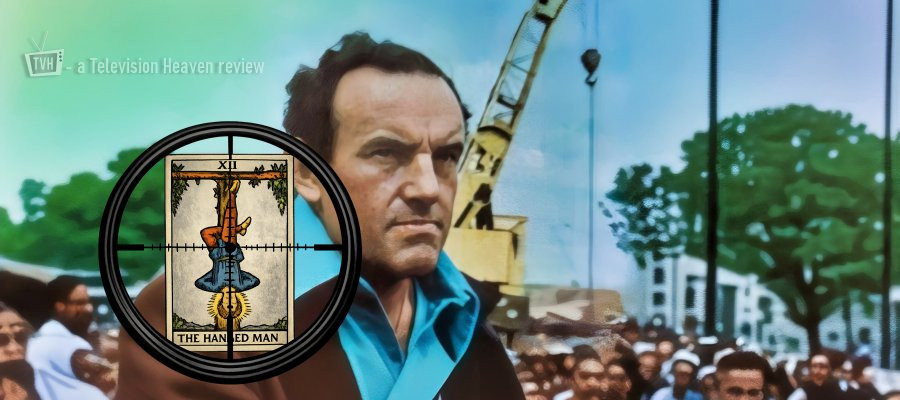
The Hanged Man
1975 United KingdomThe Hanged Man stands as a dense, muscular piece of television drama, one that blends hard-won realism with thriller invention, and it bears the unmistakable imprint of its creator, Edmund Ward. Coming from a writer who had already delivered The Plane Makers, The Power Game, The Main Chance, Grady and The Challengers, this series feels like both a culmination and a deepening of his long fascination with power, industry, and the men who survive inside it.
At its core, The Hanged Man concerns Lew Burnett, a self-made man who owns a hugely successful company in the international construction industry. His rise has not been clean or painless. Success has bred resentment, and Burnett has accumulated a long list of bitter enemies along the way. By the time the story begins, three attempts have already been made on his life. After the third, Burnett makes a desperate, audacious decision: he decides to stay dead—so that he can stay alive.
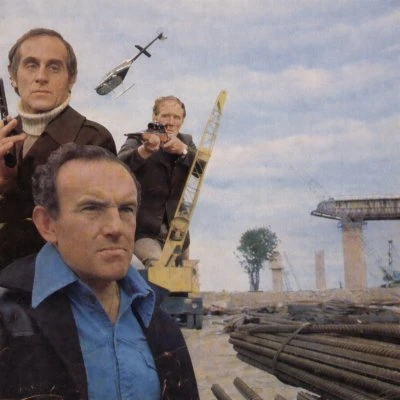
What follows is not an escape but a pursuit in reverse. Burnett begins a relentless search back through his own life to discover who loved him, who hated him, and who envied him enough to destroy him. He is on the run, but crucially, he is running towards his enemies rather than away from them. Stripped of overt power and money, he is left with only the same wits and hands that once built his small empire. The construction industry itself forms the background to this journey—presented as one of the world’s most dangerous and, at times, most profitable industries. Despite the self-imposed obstacles, Burnett’s search takes him to Switzerland and other countries, where he confronts various crime barons, all while knowing that a hired assassin, John Quentin, is still relentlessly on his tail.
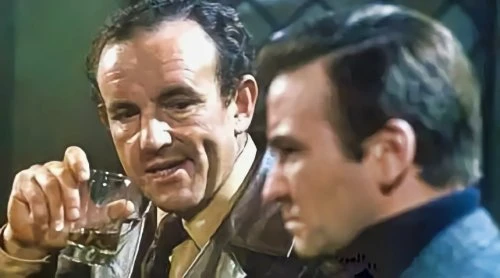
The authenticity of this world is no accident. Ward claimed that the idea for The Hanged Man first came to him in Casablanca in 1951. With the Korean War underway, Americans were building bases across the globe: airfields in Morocco, roads in Afghanistan, naval bases in Spain, and what were later called “moon bases” in the West Indies. Ward himself was initially involved in building airfields in Morocco and, through that work, found himself rubbing shoulders with four-star generals and senators. After joining them as a security guard, it was discovered that he was bilingual. Turning down the curious offer of teaching English to the employees of four madams in Casablanca’s notorious red-light district, Ward instead ended up in personnel liaison—a job he later described as “elusive.”
This role took him in and out of police stations and local prisons, and he mastered what he called the “gruesome red tape of shipping bodies back to the States.” Around him, hard men tore up the earth with giant machines, drank heavily, fought, and told stories. Ward recalled that this was where his fascination with the construction industry truly began—and where Lew Burnett began as well. From contracts like these, Burnett, like the men Ward observed, built up his construction empire.
While the initial spark came from Casablanca, another thematic element took hold during Ward’s work on The Main Chance: disappearance. Ward became intrigued by the number of unsolved murders, futile claims for maintenance sent to envelopes marked “No known address,” and the simple statistic of thousands of men who walk out their front doors and are never seen again. Were these disappearances the result of boredom, accidents, or enemies? And what if a man had the opportunity to go back down his own past? That question lies at the heart of The Hanged Man.
The series took Ward eighteen months to plan, and the scale of research is evident throughout. His investigations took him to Germany, Sweden, Switzerland, Italy, Belgium, and Canada. Along the way, he discovered how guns and ammunition are smuggled into Switzerland, how immigrant labour in an Essen ghetto raises money to send a dead man home for burial, and how fake flight plans for light aircraft are filed. He explored Iron Curtain building politics and the Brussels bars where mercenaries, past and present, exchange nostalgia and future schemes. Thousands of miles and countless hotel room tables became the foundation for what would amount to eight hours of television.
Within this meticulously constructed jungle, Burnett’s past comes alive. To build an empire in such conditions, he had to make enemies—and some friends. Corrupt politicians, hired policemen, contract hooligans, fast speculators, paid militants, and prissy Swiss accountants all wander this world for high stakes. Burnett must retrace twenty years of his life to identify those who want him dead, and in doing so, he is forced into an uncomfortable confrontation with himself.
The final episode delivers a shock revelation about who truly wanted Burnett dead and introduces a shady thief named Turtle, a character compelling enough to be spun off into his own series, Turtle’s Progress. Casting further grounds the drama in physical credibility. Colin Blakely plays Lew Burnett, “real as a sledgehammer coming down.” Michael Williams appears as Alan Crowe, the ex-mercenary officer who refuses to believe Burnett is dead, while Gary Watson embodies the hired assassin John Quentin, a dangerous puppet manipulated via telephone strings by unknown masters. Other stars appearing include William Russell, Jayne Seymour, Gareth Hunt, Jan Francis and Julian Glover.
Ultimately, The Hanged Man emerges as an action-adventure thriller rooted equally in fact and invention, drawing its genuine excitement from a very real world. It is a series shaped by lived experience, international scope, and a hard, unsentimental view of power—and it remains one of Edmund Ward’s most ambitious and resonant works.
Seen this show? How do you rate it?
Seen this show? How do you rate it?
Share on...
Published on January 26th, 2026. Written by Laurence Marcus for Television Heaven.