
The Moonbase
Review by Daniel Tessier
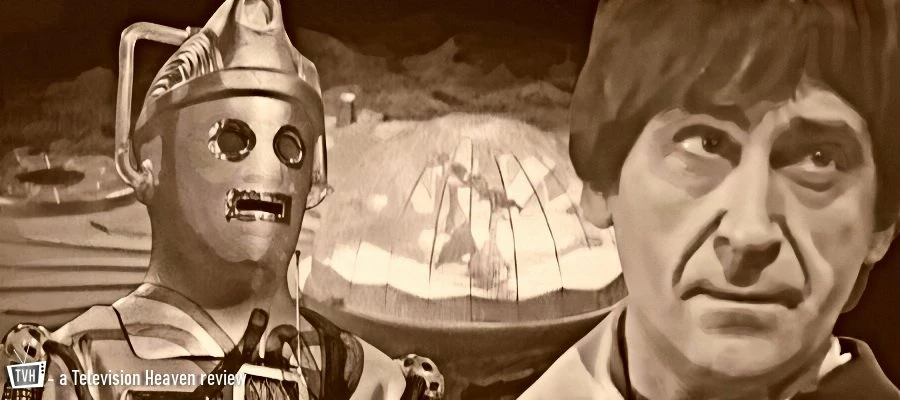
The Moonbase is perhaps the archetypal Second Doctor story. While it's virtually a remake of the last William Hartnell serial, The Tenth Planet, The Moonbase became the template for Patrick Troughton's recurrent “base under siege” serials. Such stories became a frequent, even repetitive style of adventure during Troughton's tenure on the series, falling into a simple pattern: the Doctor and his companions arrive outside some kind of fortified base, inveigle their way in, and then must defend that base from a group of monsters. The Moonbase is also the first time the Second Doctor faced the Cybermen, who would go on to become his most frequently faced enemy.
The Tenth Planet had been reasonably well-received, and the Cybermen themselves had proven popular with children. After years trying and failing to find the “next Daleks,” it was finally crucial, as Dalek creator Terry Nation would soon be off, taking his toys with him. Producer Innes Lloyd decided that the Cybermen would be the programme's new chief monsters, but that the rather ropey-looking specimens from The Tenth Planet would need a major redesign to be a serious, ongoing threat. Costumer Sandra Reid was given the job of redesigning the Cybermen costumes into something more imposing, more practical, and more reusable (although the monsters ended up being redesigned pretty much every time they showed up in the sixties).
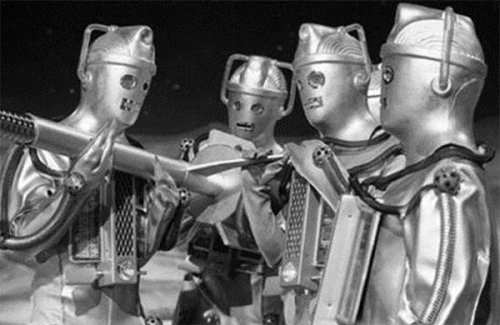
This is where the recognisable image of the Cybermen is born, unfortunately jettisoning much of what made the original cloth-faced variety so chilling. The new Cybermen are clad in rubbery silver overalls, with three-clawed hands and air-flow balls at the joints. They've got all-encompassing metallic faceplates, and, most disappointingly, the creepy, sing-song voice of the originals has been replaced by an electronic drone. Rather than being haphazardly altered, desperate survivors, the Cybermen were turned into pretty straightforward robot-men. Perfect for a tireless army that could be called on whenever a monster was needed in a hurry; not so good as a commentary on spare-part surgery. Oddly enough, the increasingly robotic Cybermen might be expected to be less human than their predecessors, but for all their claims to be purely logical, the silver-suited specimens here display clear emotions of pride and spitefulness and are keen to gloat about how superior they are. “Only stupid Earth brains like yours would have been fooled,” indeed.
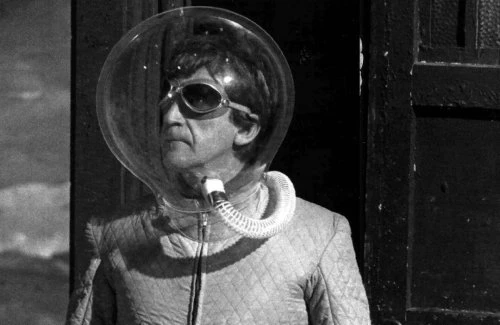
The story begins with the Doctor piloting the TARDIS on a trip to Mars. Naturally, he arrives on the Moon, although he has an excuse this time: a powerful gravitational force has drawn the Ship off course. This is the Gravitron, a powerful device installed on the Moon, used to manage the Earth's weather. Arriving on our dusty satellite in the year 2070, the Doctor digs out a set of rather nifty looking spacesuits, taking his friends on a jaunty moonwalk to the base, where it's discovered that the Gravitron is on the blink, threatening Earth with catastrophic, out-of-control weather. Who could be behind the sabotage of the Gravitron? Is this somehow linked to the mysterious disease that is affecting some members of the Moonbase crew? Whose great big silver boots are sticking out from under that bedsheet?
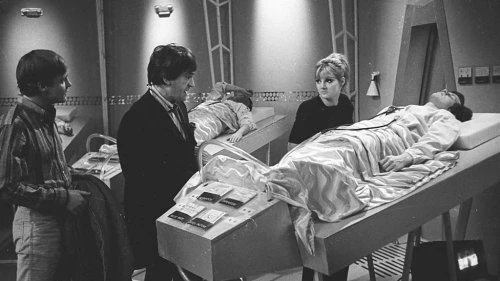
While the plot of The Moonbase follows roughly the same beats as that of The Tenth Planet, it's rather less well thought-out, with little in the way of logic to the Cybermen's plan or the actions of the humans on the base. Most of it can be glossed over as the story progresses, easy to overlook in the excitement, but the seven-foot giant robot-man hiding in the medical bay bed really does take the biscuit. However, the story gets away with a lot more than it might thanks to Troughton's performance. While the First Doctor was on his last legs in The Tenth Planet and Hartnell missing for large chunks of the serial, Troughton is on top form as the Second Doctor, equal parts conniving and commanding. There's a brief but beautiful moment where he sets out his revised moral direction. “There are some parts of the universe that have bred the most terrible things,” he says. “Things which act against everything we believe in. They must be fought.” It's as close to a mission statement that 20th century Doctor Who ever gets and firmly positions the Second Doctor as one who stands against the monsters.
Another huge element in the serials' favour is the novelty of its setting. The image of the Cybermen striding across the Moon is powerful. It's perhaps a surprise that Doctor Who took so long to do a story set on the Moon, the mission to get there being such a focus of 1960s science. In early 1967, NASA's Project Gemini had wrapped up and its successor, the Apollo programme, was just about to begin. The tragic failure of the Apollo 1 mission, the first crewed test flight of the programme, just months after the broadcast of The Moonbase, put the programme back. However, the successful Apollo 7 mission resumed human spaceflight in late 1968; and in July 1969, Apollo 11 resulted in Armstrong and Aldrin setting foot on the Moon. It would have been unthinkable that Doctor Who wouldn't have gone to the Moon too. Setting it just over a century in the future, with not merely a manned base on the Moon, but one essential to Earth's survival, was a wonderfully optimistic result of NASA's lunar ambitions.
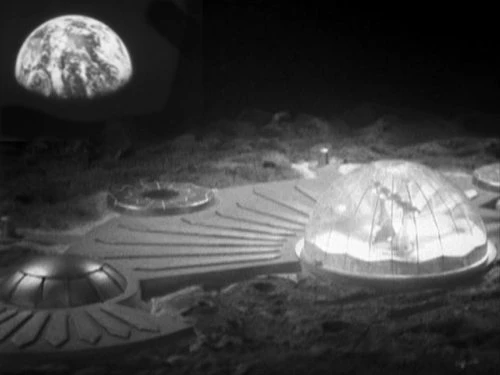
Oddly enough, though, there's no American presence on the Moonbase. While The Tenth Planet had a bullish American general leading an international military team, The Moonbase has a crew of scientists from various nations. There are British, French, Australian, New Zealand, Danish, German and Nigerian scientists on the base, and while most of them are still pretty stereotypical, it's a fairly strong attempt for the time at representing the Earth with an international team, albeit with a European and Commonwealth bias. While there's a large cast of background scientists, there are only a few proper speaking roles, and of them, only two make any real impression. Patrick Barr (The Teckman Biography, Telford's Change) gives a strong performance as base commander Hobson, while André Maranne (A Shot in the Dark, Fawlty Towers) is fun and formidable as Benoit, Hobson's French assistant.
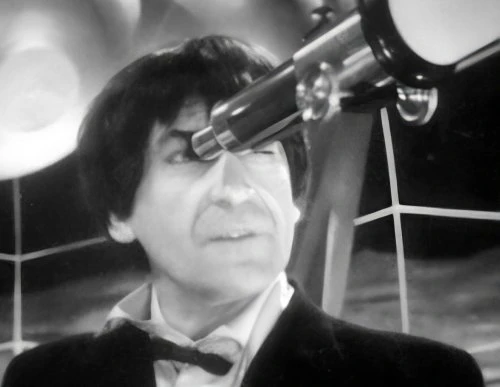
As for the rest of the regulars, this is Polly's show. Anneke Wills has held this up as one of Polly's best serials, and while the character has to put up with a lot of condescension by the menfolk, she's by far the sharpest and most inventive on the base. It's Polly who first recognises the Cybermen (a minor miracle, given how much they've changed between appearances) and comes up with a weapon against them: “Polly cocktail,” a nail varnish remover-inspired mix of solvents that dissolves their plastic respirator systems. Meanwhile, Ben is in an overly macho and aggressive mood this story, while poor Jamie is terribly out of his depth. When the TARDIS arrives he expects to meet the Man in the Moon, and he's convinced that the “Phantom Piper,” his clan's personal death wraith, is there to claim him. (It's a Cyberman, naturally.)
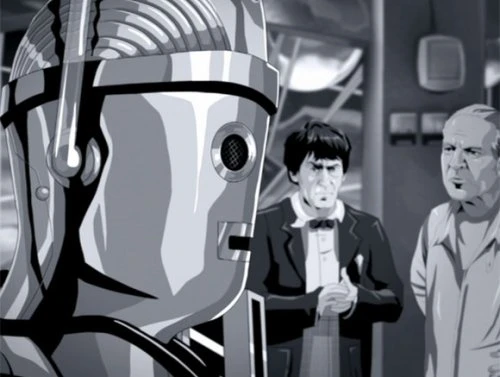
The Moonbase is yet another story that's incomplete today, with only two of the four episodes existing as film copies in the archive. It still became one of Doctor Who's most well-remembered stories thanks to its novelisation, Doctor Who and the Cybermen. Written by Gerry Davis (credited as script editor on the serial, with Kit Pedler credited as writer), it was one of the earliest Target Doctor Who books and enjoyed two major reprints. In 2014 it was released on DVD with new animated versions of the missing episodes, and this version of the serial is now on BBC iPlayer. It's one of the serials that takes well to the treatment (the Cybermen seem to work well in monochrome animation).
While flawed and formulaic, The Moonbase is a great showcase for Troughton's Doctor, showing him at his best against an implacable foe. The series would continue in this direction for the next year or so, with more monsters threatening various bases, and the Cybermen themselves would be back three more times before the sixties were out.
Share on...
Published on February 1st, 2026. Written by Laurence Marcus for Television Heaven.