

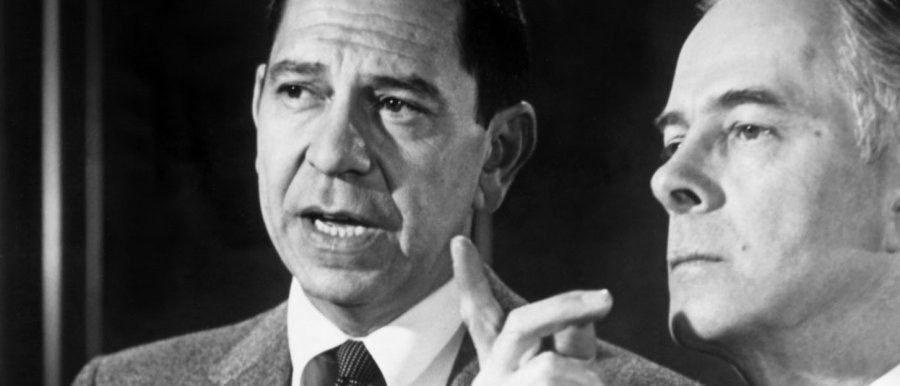
Dragnet
1952 United StatesA landmark in the formative years of American television police drama, Dragnet stands as one of the genre’s earliest and most influential achievements. It provided the blueprint from which countless later cop shows would take direction and inspiration, marking a decisive moment in the evolution of a medium that, until then, had been largely dominated by comedy and variety programming.
The series was created by its star, Jack Webb, whose talents extended across acting, directing and producing. Dragnet drew its initial inspiration from the 1949 film He Walked By Night, in which Webb appeared as a laboratory technician. The concept first found life as a radio series in 1949, before receiving a special television preview on Chesterfield Sound Off Time in December 1951. Its official television debut followed shortly afterwards, premiering on NBC on January 3rd, 1952. From the outset, its starkly realistic, documentary-style approach and meticulous attention to authentic police procedure distinguished it from the exaggerated and melodramatic portrayals of law enforcement familiar to audiences of the era.
The scale of Dragnet’s success was remarkable. For the first seven years of its run, the programme existed simultaneously as both a radio and television series, a rare achievement even by today’s standards. It also proved an early pioneer of cross-media success, spawning tie-in novels throughout the 1950s and 1960s, a feature film spin-off released in 1954, and two hit recordings of Walter Schumann’s instantly recognisable theme, Dragnet March (also known as Dragnet or Danger Ahead). One version, recorded by Ray Anthony and His Orchestra in 1953, was a major hit, while Stan Freberg’s parody St. George and the Dragonet went even further, selling over a million copies and reaching number one in the charts.
Storylines were drawn directly from real cases taken from the files of the Los Angeles Police Department, which also served as the series’ setting. Guided by the famously deadpan narration of Webb’s Sgt. Joe Friday—“It was 3:55… We were working the day watch out of homicide”—viewers were given an unvarnished look at police work. The series focused on the often mundane, methodical and unglamorous routines of detective life, presenting a level of honesty and restraint that was unprecedented on television at the time.
Investigations routinely unfolded through false leads, procedural setbacks and the constant intrusion of police work into Friday’s personal life, mirroring the realities faced by real officers. By deliberately emphasising routine, the show made its rare moments of action and the eventual capture of the criminal feel all the more convincing. The closing narration of each episode, detailing the outcome of the trial and the sentence imposed, further reinforced the programme’s documentary realism.

At its core, however, Dragnet was shaped and sustained by one defining presence: Jack Webb himself. Through Sgt. Joe Friday, Webb created a figure of quiet authority—dependable, honest and resolutely ordinary—who gradually became an enduring symbol of law and order. The character’s cultural impact has scarcely diminished with time.
Across the series’ original television run from 1952 to September 1959—after which it entered syndication under the title Badge 714, Friday’s warrant number—and its revival between January 1967 and September 1970, Webb’s creative vision and unwavering commitment provided the series with its moral and dramatic backbone. This foundation allowed Dragnet to retain its credibility even during the profound social upheavals of the 1960s, a period in which traditional authority figures, including the police, were increasingly questioned.
While aspects of Dragnet inevitably reflect the era in which it was made, both in production style and social attitudes, its significance as a defining force in American episodic drama remains beyond dispute. Through Dragnet and the iconic figure of Sgt. Joe Friday, Jack Webb left a lasting legacy—one upon which the modern television police drama continues to grow and thrive.
Seen this show? How do you rate it?
Seen this show? How do you rate it?
Share on...
Published on December 8th, 2018. Written by Marc Saul for Television Heaven.