

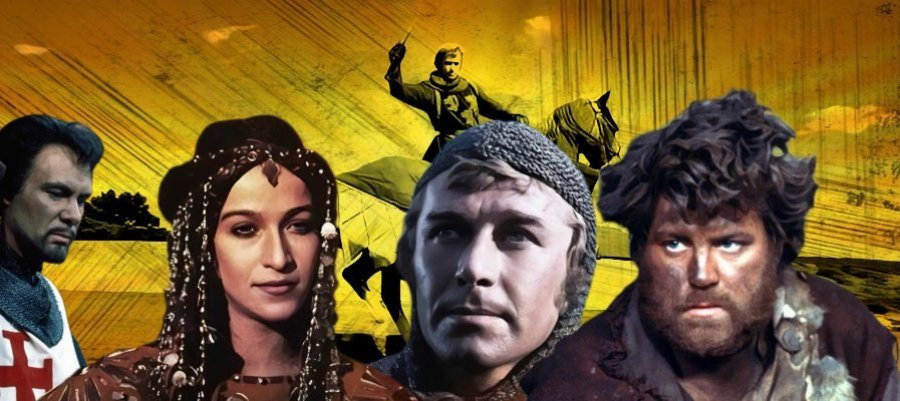
Ivanhoe
1970 United KingdomThe BBC’s Ivanhoe arrives with an enviable sense of confidence, tackling one of Sir Walter Scott’s most enduring and expansive romances with a seriousness of purpose that suits both its source and its prestigious family tea-time slot. Spread across ten 25-minute episodes, the serial proves itself a strong and largely faithful adaptation of a story that helped define popular ideas of the Middle Ages.
The year is 1194. Sir William of Ivanhoe, played with square-jawed assurance by Eric Flynn, returns to England after the disastrous Third Crusade. Homecoming brings little comfort. His father Cedric (Peter Dyneley), one of the last proud Saxon nobles in a Norman-dominated land, has disowned him for his loyalty to King Richard. Ivanhoe, however, is not inclined to brood. Old scores await settlement, most notably with the formidable Sir Brian de Bois Guilbert of the Knights Templar, played with relish by Anthony Bate.
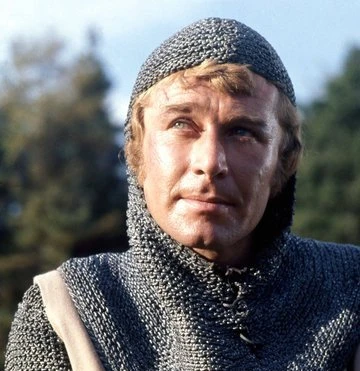
Against this personal conflict runs the larger political struggle of the realm. With Richard believed imprisoned abroad, Prince John manoeuvres to seize the throne, exploiting the divisions between Saxon and Norman. The opening episode establishes this world briskly and effectively: oppression, ambition and simmering resentment are all firmly in place, while Sir Brian looms as a dark, menacing presence from the outset.
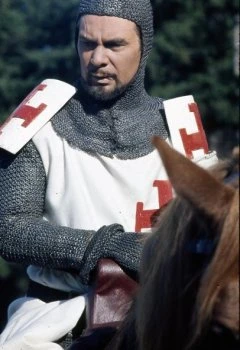
Bate’s performance is one of the serial’s great strengths. Known largely for playing establishment figures, he proves an inspired choice as de Bois Guilbert, creating a villain who is unquestionably black-hearted yet governed by a warped sense of honour. Flynn, by contrast, is an ideal Ivanhoe—upright, heroic and physically convincing. Clare Jenkins makes a warmly appealing Lady Rowena, loved by Ivanhoe but pursued by the arrogant Norman lord de Bracy (David Brizley), adding another strand of tension to the drama.
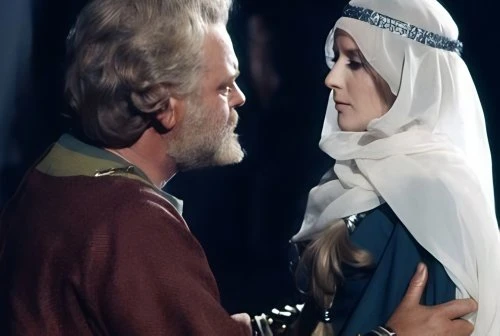
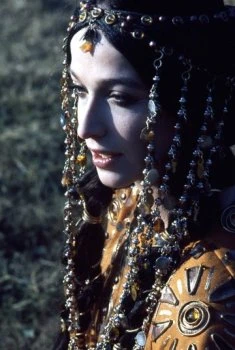
Vivian Brooks brings dignity and quiet feeling to Rebecca, the daughter of Isaac of York, the despised Jewish moneylender memorably portrayed by John Franklyn-Robbins. Rebecca’s unrequited love for Ivanhoe, after she nurses him back to health following his injury at Prince John’s tournament, is handled with sensitivity. Her rejection of Sir Brian’s later advances adds further complexity to his character and sets the stage for the serial’s darkest turns.
One of Ivanhoe’s most fascinating aspects is its role in shaping the modern myth of Robin Hood. Appearing for much of the serial as Locksley, Robin threads his way through the action, and Scott’s influence on later interpretations is unmistakable—from the famous arrow-splitting contest to the way elements of Ivanhoe’s own story would later be grafted onto Robin himself. Clive Graham gives a vivid performance as Locksley, and Michael Craze is a welcome presence as one of his men.
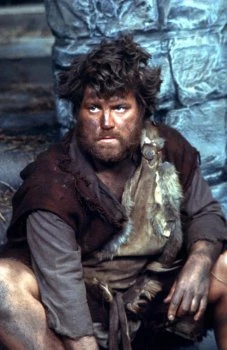
The supporting cast is impressively deep, a key reason why the serial works so well, particularly during its middle stretch when Ivanhoe lies injured and other characters step forward. Bernard Horsfall cuts an imposing figure as the mysterious Black Knight, Tim Preece is entertainingly vain as Prince John, Hugh Walters provides an off-kilter delight as Wamba the fool and Noel Coleman is typically solid as Fitzsurse, one of John’s advisors. Graham Weston impresses during a lively quarterstaff encounter as Gurth, Ivanhoe’s loyal servant, while Francis de Wolff brings brute menace to Front de Boeuf.
The story’s darker elements are not softened for a family audience. The capture of Ivanhoe and his companions by Norman knights, and Rebecca’s later denunciation as a witch—prompted by the Templars’ fury at Sir Brian’s obsession—lead to genuinely high stakes. Her claim of trial by combat, and the nomination of Ivanhoe as her champion, provides a suitably dramatic climax.
Shown originally in episodic form on Sunday’s on BBC1 and later exported to the United States, Ivanhoe exemplifies the BBC’s tradition of thoughtful, literate adaptations of classic novels. Although it has sometimes been overshadowed by the earlier ITV version starring Roger Moore, this later production is richer, more confident and mounted with far greater panache—helped, admittedly, by the advances in television technique made over the intervening years.
Verdict ★★★★☆
Overall, this version of Ivanhoe stands as an excellent example of British period drama: intelligent, well-cast and respectful of its source without being stiff. It successfully brings Scott’s sprawling epic to life and more than earns its place as a classic of BBC television drama.
Seen this show? How do you rate it?
Seen this show? How do you rate it?
Share on...
Published on January 23rd, 2026. Written by Laurence Marcus for Television Heaven.