

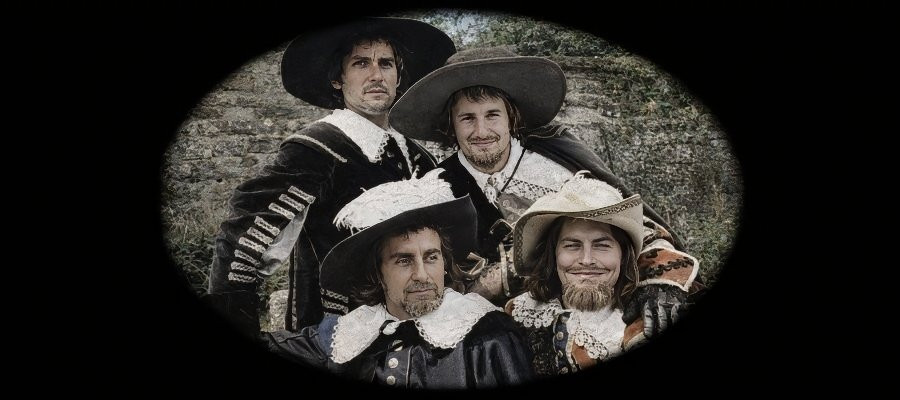
The Three Musketeers
1966 United KingdomDashed off in a matter of months in 1844, and shaped in collaboration with the prolific Auguste Maquet, Alexandre Dumas’s first d’Artagnan Romance remains one of the purest expressions of the swashbuckling spirit: flashing swords, fierce loyalties, and a romantic devotion to honour. Set between 1625 and 1628, against a France beset by foreign enemies and riven by civil and religious discord, the tale unfolds under the uneasy reign of Louis XIII (John Carlin - Taggart), while the true machinery of power lies in the calculating hands of Cardinal Richelieu (Richard Pasco – Drummonds), the all-powerful chief minister of state. It is a world of intrigue and danger, and into it rides one of literature’s most irresistible young hotheads.
This ten-part adaptation, scripted by Anthony Steven and produced by William Sterling, approaches the novel with evident respect, hewing closely to Dumas’s narrative even when the pacing falters. Each episode runs just over twenty minutes, a format that provides brisk helpings of action and character interplay, though occasionally at the cost of momentum. Some instalments crackle with tension and camaraderie; others feel slightly stretched, as if the modest production resources are being asked to cover too much ground. The low budget is unmistakable, with Dorset countryside and coastline standing in for 17th-century France and reappearing in filmed inserts frequently enough to become familiar companions.
The opening episode belongs almost entirely to d’Artagnan (Jeremy Brett – The Adventures of Sherlock Holmes), the impetuous Gascon youth from a proud but impoverished family. Mounted on a wretched horse, armed with his father’s sword and bearing a letter of introduction to Monsieur de Tréville (Michael Miller - Crossroads), he sets off for Paris in pursuit of glory. His first encounter—at a roadside inn—with the sardonic Rochefort (Edward Brayshaw - Rentaghost), an agent of Richelieu, swiftly entangles him in affairs of state. Even robbed of his precious letter, the young adventurer’s spirit carries him forward, and before long he is fighting shoulder to shoulder with the king’s Musketeers.
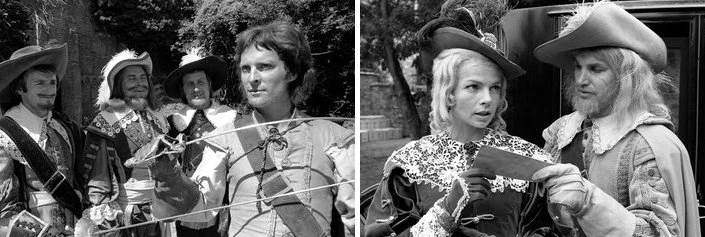
Jeremy Young (EastEnders) as Athos is wisely melancholy, hinting at private sorrows beneath his composure. Brian Blessed (Z Cars) brings genial bombast to Porthos, delighting in the character’s foppish grandeur, while Gary Watson (Hannay) as Aramis is suitably ascetic and courtly, a swordsman with a priest’s soul. Together they form the brotherhood that defines the story, though as events unfold they become less the king’s guards than the champions of the ill-used Queen Anne of Austria (played by Carole Potter – a British born actress who moved to Australia). Kathleen Breck (Number 42 in an episode of The Prisoner) lends warmth to Madame Bonacieux, d’Artagnan’s love interest, while Mary Peach (Astrid in the Doctor Who story The Enemy of the World) as Milady de Winter is all poise and calculation, a worthy adversary whose schemes intertwine with those of Rochefort and threaten the Duke of Buckingham (Simon Oates – Doomwatch) during the Musketeers’ perilous journey to England. There are also appearances from Milton Johns, Pauline Collins and Kevin Stoney.
The production may lack lavish spectacle, but it compensates with earnest performances and a clear affection for Dumas’s blend of heroism and high intrigue. There is a pleasing theatricality to the swordplay and a sincerity in the camaraderie that sustains the drama even when the sets and locations show their limitations. Sterling’s shift from the modern tone of Quick Before They Catch Us to this period adventure is abrupt but largely successful, and Peter Hammond’s direction maintains a steady if occasionally uneven rhythm.
That the BBC commissioned a sequel before the first episode was even broadcast speaks to the confidence behind the project. The immediate follow-up, adapting Twenty Years After as The Further Adventures of the Musketeers, suggests that this modest but spirited serial struck the right chord. It may not possess the grandeur its story deserves, but it captures the essential dash and loyalty of Dumas’s immortal quartet—“all for one, and one for all”—with a sincerity that carries it past its budgetary constraints.
Seen this show? How do you rate it?
Seen this show? How do you rate it?
Share on...
Published on February 23rd, 2026. Written by Laurence Marcus for Television Heaven.