

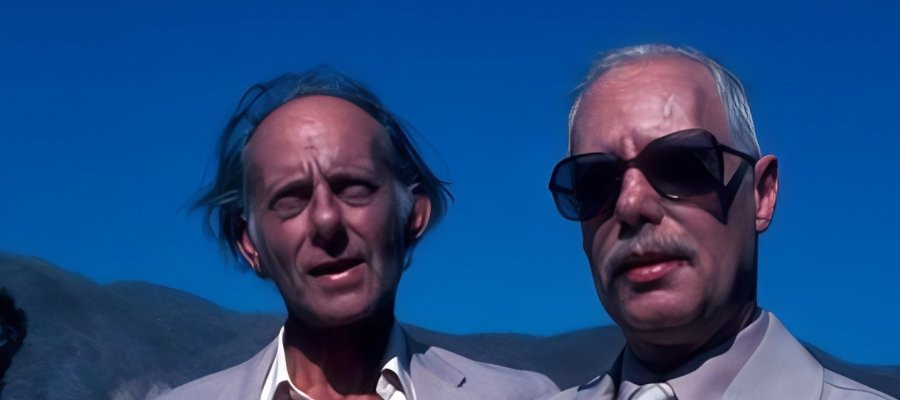
Kessler
1981 United KingdomKessler arrives burdened by the legacy of Secret Army and never quite escapes its shadow. Conceived as a contemporary reckoning with unfinished business from the Second World War, the series trades the moral urgency and tension of occupied Europe for a colder, more reflective chase across boardrooms, capitals, and safe havens. The result is thoughtful and occasionally chilling, but also strangely inert.
What the series does well is its premise. The notion that yesterday’s monsters might re-emerge as today’s respectable captains of industry is deeply uncomfortable, and Kessler leans into that unease. Suits replace uniforms, financial leverage replaces brute force, and the evil on display is all the more disturbing for its banality. The show’s greatest strength lies in this moral provocation: the idea that justice can be quietly smothered by pragmatism, diplomacy, and economic convenience.
This uneasy moral landscape is set in motion by a media exposé. A high-profile Belgian journalist publicly reopens the question of unpunished Nazi crimes, drawing attention to the vanished former Gestapo chief of Belgium. His investigation, aided by a West German intelligence officer, gradually peels back the layers of a new identity: a prosperous industrialist with global interests, a carefully curated family life, and deep connections to a clandestine network of former Nazis protecting one another from reckoning. That hidden infrastructure, rooted in loyalty and shared guilt, gives the series its sense of consequence.
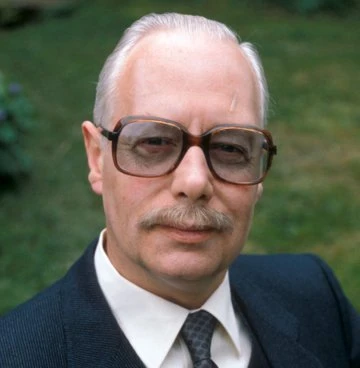
Yet where Secret Army thrived on immediacy and human stakes, Kessler often feels remote. The drama unfolds at arm’s length, its globe-trotting structure diluting tension rather than heightening it. The pursuit of an ageing Nazi by equally weathered adversaries lacks the visceral urgency that once defined the franchise. What might have felt like righteous reckoning instead drifts into a sombre, almost weary meditation on revenge, memory, and failure.
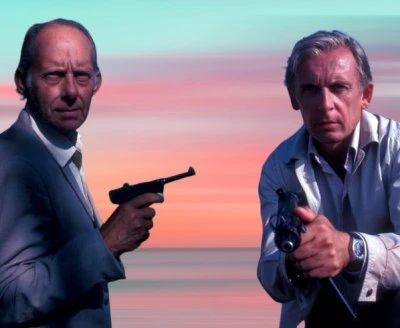
The series also struggles with momentum. Its antagonistic network is theoretically vast and terrifying, but dramatically static. Threats are discussed more often than felt, and danger tends to arrive abruptly rather than building inexorably. Even moments of violence seem less like climactic payoffs and more like grim punctuation marks in an argument the show is already convinced it has won.
Where Kessler does find resonance is in its refusal to offer easy catharsis. There is no triumphant victory, only exhaustion, loss, and the quiet collapse of a hateful ideology under the weight of its own decay. That bleakness feels deliberate, even principled, but it also helps explain why audiences failed to connect. Viewers who once tuned in for resistance, bravery, and communal sacrifice were instead confronted with moral ambiguity and emotional distance.
In the end, Kessler is a serious, intelligent sequel that asks important questions but forgets to make us feel why the answers matter. It closes its story neatly, perhaps wisely, but also conclusively demonstrates that not every compelling idea demands continuation. As a coda to Secret Army, it is intriguing; as a drama in its own right, it is sombre, uneven, and ultimately disposable.
Seen this show? How do you rate it?
Seen this show? How do you rate it?
Share on...
Published on February 6th, 2026. Written by Laurence Marcus for Television Heaven.