

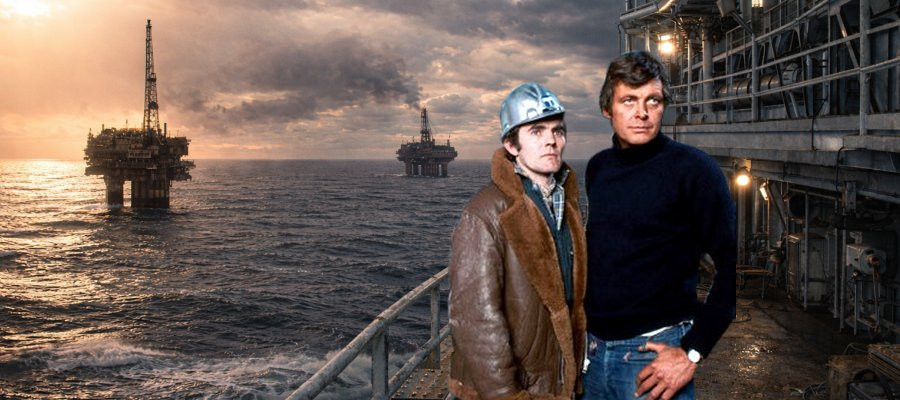
Oil Strike North
1975 United Kingdom“The toughest sea in the world.” Few taglines could be more apt for Oil Strike North, a drama series born out of both industrial reality and institutional change at the BBC. Emerging only three years after the corporation had decisively turned its back on contemporary, corporate-centred adventure drama, the series stands as both a product of its moment and a quiet rebuke to it.
The cancellation of The Troubleshooters in January 1972 marked the end of an era. Under a reshaped BBC hierarchy, programmes dealing with international corporations, modern industry and action-led contemporary settings were deemed relics of the 1960s. In their place came a determined swing towards period drama and historical reassurance: Colditz, Lord Peter Wimsey, The Regiment and War and Peace were intended to reassert the BBC’s cultural authority, even as ITV captured popular attention with energetic adventure series and a newly launched rural soap, Emmerdale Farm. As Peter Graham Scott later lamented, the result was a creative vacuum in which hard-hitting, forward-looking drama was sidelined in favour of safer, backward-looking fare.
Yet television, like the sea itself, is never static. By the mid-1970s, audience drift forced another rethink, and it was into this shifting landscape that Gerard Glaister and Norman J Crisp returned with Oil Strike North. Having already researched oil exploration as The Troubleshooters wound down, the pair proposed a drama rooted not in boardroom politics but in the physical and emotional toll of life on North Sea oil rigs. It was, on paper, a bold recalibration.
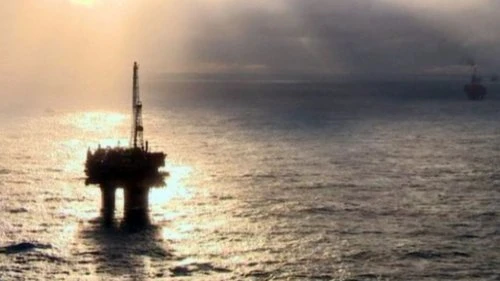
Set around the fictional Triumph Oil and its rig, Nelson One, the thirteen-part serial charts a race against time: three months before a government concession expires, the company suspects oil may lie in a neglected block, demanding a costly and perilous acceleration of operations. The North Sea itself is the true antagonist — cold, grey, storm-lashed and utterly indifferent to human ambition. Filmed in Peterhead, the series repeatedly emphasises isolation and claustrophobia, with helicopters and supply ships battling appalling conditions to keep the rig alive.
At the centre is American drilling superintendent Frank Ward (Michael Whitney) and his wife Julie (Angela Douglas), whose marriage strains under long separations, danger and emotional rootlessness. Around them swirl familiar but effective storylines: rigs imperilled by storms, supply vessels unable to reach stranded crews, an explosive freighter adrift at sea, and loyalty tested — to company, colleagues and loved ones alike. The intent, as Glaister repeatedly stressed, was to show that oil exploration was not merely about “priceless hardware” but about people at every level, from government officials to roustabouts.
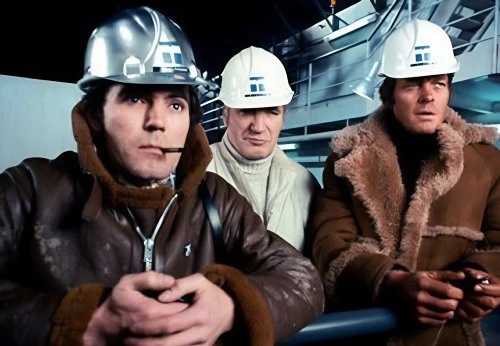
In ambition and research, Oil Strike North is unquestionably impressive. Glaister and Crisp spent two years visiting rigs, supply vessels and North Sea towns, consulting industry veterans such as adviser Ron Keen, and absorbing the human and technical realities of an industry that was rapidly reshaping Britain’s economy. The series is at its strongest when conveying the sheer hostility of the environment: pressures measured in thousands of pounds per square inch, the ever-present threat of fire or blowout, and the brutal truth that no one survives long in the North Sea in winter.
And yet, for all its authenticity and seriousness of purpose, Oil Strike North struggled to capture a broad audience. Viewers could not help but recognise the familiar DNA linking it to Mogul and The Troubleshooters, despite the creators’ insistence that this was something fundamentally different. By stripping away corporate intrigue but failing to replace it with equivalent narrative drive, the series often lacked the pace and urgency that Peter Graham Scott and Anthony Read had once brought to John Elliot’s earlier series. The hardships were real, the stakes enormous, but the storytelling sometimes felt subdued where it needed propulsion.
There is a certain irony in this reception. What had been deemed “unpalatable” in 1972 — contemporary industrial drama — was again acceptable by 1975, yet Oil Strike North arrived in a schedule still negotiating its own identity, torn between heritage prestige and modern relevance. The result was a thoughtful, well-researched series that felt important, even necessary, but not quite compelling enough to secure a second run.
Viewed today, Oil Strike North remains a fascinating artefact of British television history: a serious attempt to dramatise what Glaister rightly called “the most important economic development since the Industrial Revolution”. It may not have matched the momentum of its predecessors, but its grim portrait of men fighting the elements in the worst sea in the world endures as a sober reminder that the battle for oil was never heroic, glamorous or bloodless — merely relentless.
Seen this show? How do you rate it?
Seen this show? How do you rate it?
Share on...
Published on January 12th, 2026. Written by Laurence Marcus for Television Heaven.