

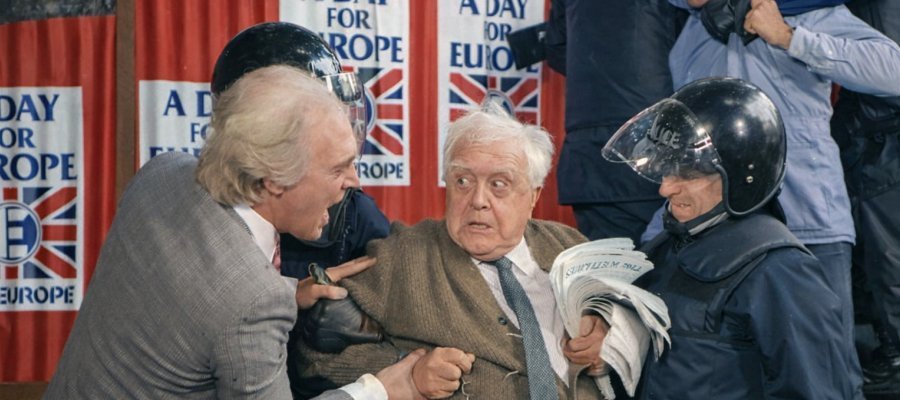
The Old Men at the Zoo
1983 United KingdomThe Old Men at the Zoo is one of those curious British TV dramas that feels both slightly eccentric and quietly unsettling. Adapted by Troy Kennedy Martin for the BBC in 1983 from Angus Wilson’s 1961 novel, it begins in a fairly contained way—office politics in a national zoo—but gradually widens into something much darker: a satire about power, propaganda and how easily decent institutions slide into authoritarianism.
At the centre is Simon Carter, played by Stuart Wilson (Anna Karenina), the newly appointed Secretary of the National Zoo and the youngest member of its senior staff. Carter is capable and observant, but also a classic administrator—someone who believes systems and committees will eventually sort everything out. The trouble starts when Smokey, a distressed giraffe, kills a keeper. Carter sees the tragedy as a chance to clean house and pushes for a public enquiry, believing it could restore the zoo’s integrity. That idea is quickly buried by the formidable press baron Godmanchester (Robert Morley – If the Crown Fits), who has far bigger plans. As president of the Royal Zoological Society and a man with enormous influence, he is far more interested in managing public perception on the eve of a looming European conflict.
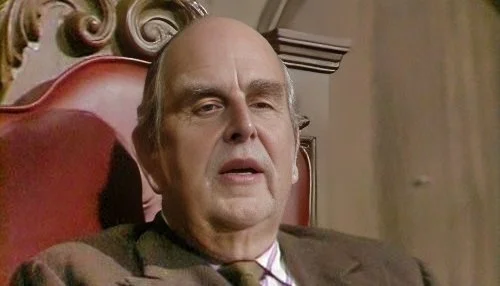
The internal tensions at the zoo are already simmering. Director Edwin Leacock (Maurice Denham – Porridge) dreams of moving the entire collection to an open National Park in Wales, while senior keeper Sir Robert Falcon (Robert Urquhart – The Plane Makers) clashes with him over responsibility for the giraffe disaster. Godmanchester seizes on Leacock’s idea for propaganda purposes: images of animals being moved out of London are meant to signal impending danger to the public. As he bluntly puts it, “the public only really understand animals.” It’s a chillingly cynical line, and it neatly sums up the series’ view of how power manipulates symbols.
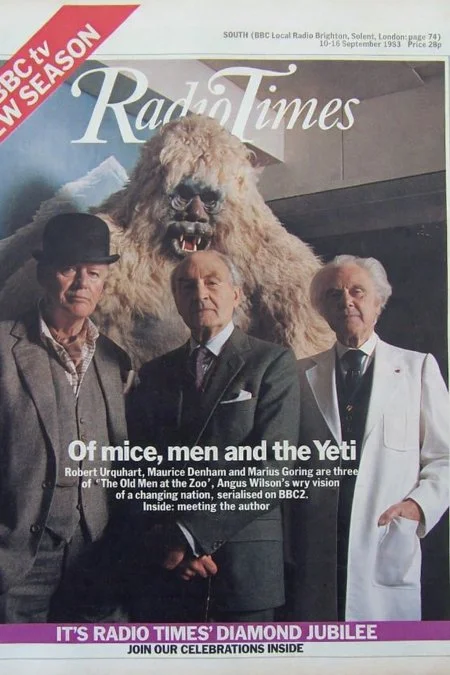
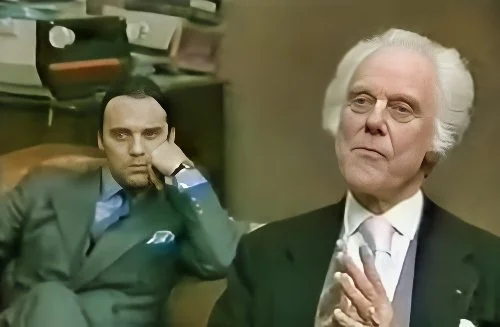
The plan backfires spectacularly. Released animals attack locals, and the social fabric begins to fray as war approaches. The series then lurches into far bleaker territory: London is heavily bombed (a major change from the novel), civil unrest spreads, and a fascist regime gradually consolidates power across Europe. The zoo itself becomes a grotesque political theatre. Falcon briefly enjoys a tyrannical spell as director, while the sinister reptile keeper Englander (Marius Goring – The Scarlet Pimpernel), an extremist opportunist, eventually takes control.
One of the most disturbing sequences comes during a grotesque “Europe Day” celebration in which the zoo stages a Roman-style spectacle, with prisoners condemned to the lions in a revival of the ancient damnatio ad bestias. It’s shocking not because the series plays it for sensationalism—it doesn’t—but because it feels like the logical endpoint of the moral compromises we’ve already seen. Carter, meanwhile, proves tragically ineffective. His attempts to remain neutral and administrative while the world collapses around him alienate his wife and ultimately land him in a concentration camp.
What makes the story compelling is that it never turns Carter into a conventional hero. He’s intelligent and fundamentally decent, but also timid and self-deceiving. Wilson’s original novel was partly an exploration of how respectable people might have behaved under Nazism, and the adaptation keeps that idea intact. The real drama isn’t explosions or spectacle but watching institutions—and the people running them—gradually rationalise the unacceptable.
Despite the grim themes, there’s plenty of dry humour along the way. Angus Wilson was known for mixing sharp social observation with comedy, and that tone survives in the adaptation, particularly in the absurd rivalries among the zoo’s senior staff. Robert Morley is especially memorable as Godmanchester, managing to be both ridiculous and faintly terrifying. The supporting cast, including Barry Stanton (Fallen Hero), Toria Fuller (A Very Peculiar Practice) and Andrew Cruickshank (Dr. Finlay’s Casebook) add real weight to what could otherwise have been a very odd premise.
Visually the production has a distinctive early-1980s BBC feel, but there are some striking touches. Peter Netley’s opening graphics play with images of imperial optimism and utopian visions, while Simon Rogers’ score gently parodies grand patriotic music. Together they reinforce the show’s central irony: the idea that civilisation is stable and enlightened, right up until the moment it isn’t.
By the end, the zoo itself has become a bleak metaphor for society. Animals, cages and keepers mirror the political jungle outside, and Carter—once an efficient bureaucrat—is left trying to pick up the pieces of a shattered institution. It’s an unusual, sometimes uncomfortable drama, but also a fascinating one, blending satire, political allegory and dark comedy in a way British television rarely attempts.
Seen this show? How do you rate it?
Seen this show? How do you rate it?
Share on...
Published on March 12th, 2026. Written by Laurence Marcus for Television Heaven.