

The Scarf
1959 United KingdomFrancis Durbridge’s enduring appeal as a thriller writer rests on an almost uncanny command of plot mechanics: the precise timing of revelations, the confident delivery of twists, and a masterly use of cliffhangers that compel the viewer from one episode to the next. Just as crucial was the role of the producer, working in close sympathy with Durbridge’s scripts to ensure that each serial was tightly edited, evenly paced and visually lucid. Few partnerships exemplified this better than that between Durbridge and Alan Bromly, whose directorial and production skills served BBC Television exceptionally well throughout the 1950s and 1960s.
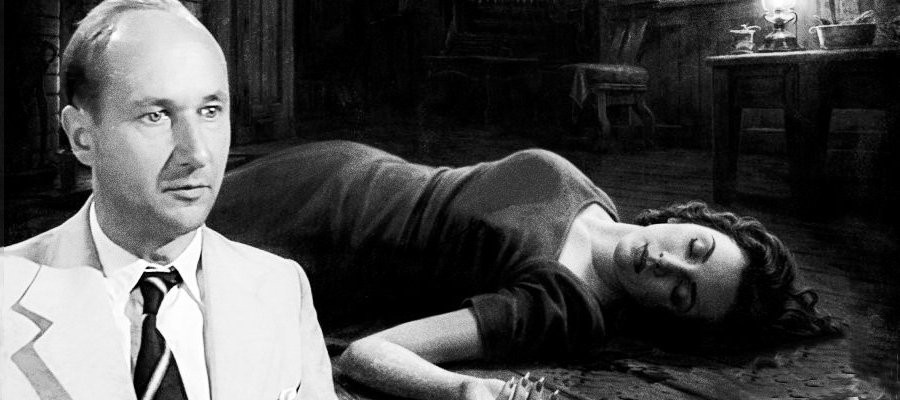
That collaboration reached one of its peaks with The Scarf, first broadcast in the winter of 1959 and attracting record audiences that were sustained – and even increased – as the story moved towards its climax. Unlike any other Durbridge serial, the titular object became both murder weapon and incriminating evidence, a simple accessory elevated into a unifying motif. Almost every major suspect is seen wearing a scarf at some point, a visual sleight of hand that enriches the narrative with a steady supply of red herrings while keeping the audience guessing.
The story opens in the apparently tranquil Midlands village of Littleshaw, where the body of local actress Fay Collins (Norrie Carr) is discovered on farmland, bearing clear signs of strangulation. Suspicion soon extends beyond the village when Detective Inspector Harry Yates (Donald Pleasance) traces a possible connection to London publisher Clifton Morris. From that point on, Durbridge deftly shuttles the narrative between rural respectability and urban menace, widening the circle of suspicion and steadily tightening the net around Morris as evidence – scarves, stolen property, planted clues – accumulates. The serial is especially effective in its handling of coincidence and concealment, culminating in a finale that reveals not only the murderer but the deliberate strategy behind an elaborate framing.
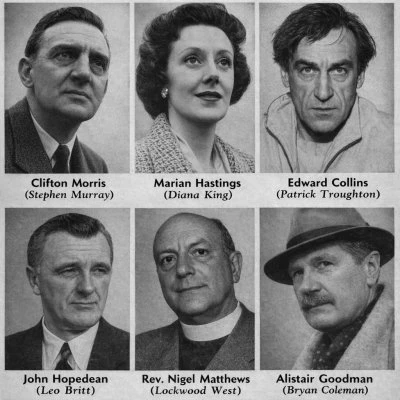
Part of the pleasure lies in the cast, which is uniformly strong and impeccably chosen. Pleasance brings an unsettling ambiguity to Yates, while the supporting players lend credibility and texture to both village and city settings. Production values were high for the period, and a now-legendary quirk of the serial’s creation added to its tension: cast members were reportedly given scripts for the final episode only after the fifth had been transmitted, ensuring genuine uncertainty that mirrored the audience’s own.
When The Scarf reached television screens in February 1959, the popular press was quick to sense a hit. Reviewing the opening episode, the Daily Express welcomed the return of what it called “the master of suspense,” noting that within minutes the murder had been committed, the police were on the scene and suspects were multiplying rapidly. The paper praised the serial as another BBC triumph, admiring its immaculate casting, slick production and hair-fine plotting. It also warned viewers not to be misled by the apparent obviousness of the prime suspect, reminding them that Durbridge excelled in complication and misdirection – even extending that unease to the inspector himself, whose slightly sinister manner invited doubt. The verdict was confident: The Scarf looked set to grip the nation for the duration of its run, and history has proved that assessment entirely correct.
Seen this show? How do you rate it?
Seen this show? How do you rate it?
Share on...
Published on January 17th, 2026. Written by Laurence Marcus for Television Heaven.