

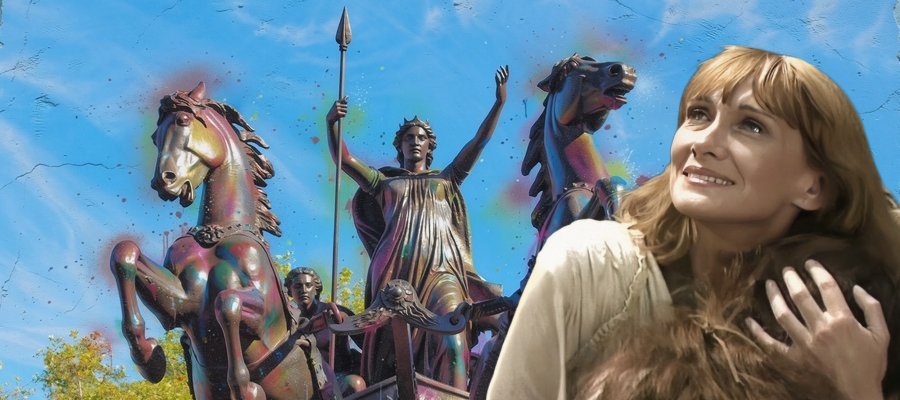
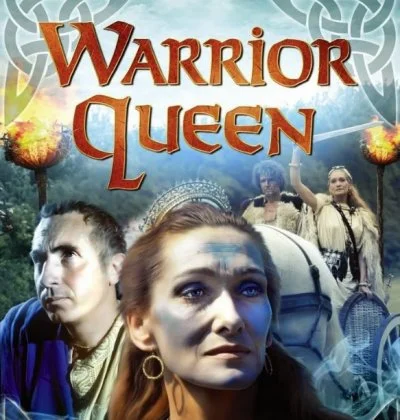
The Warrior Queen
1978 United KingdomThere’s something oddly compelling about The Warrior Queen, even if it never quite becomes the epic it clearly wants to be. Produced by Thames Television, this teatime drama takes on the story of Boudica—a figure who is equal parts history and myth—and tries to squeeze her rebellion into a format more suited to polite early-evening viewing.
At the centre of it all is Siân Phillips, who plays Boudica with a kind of steely dignity rather than outright ferocity. That’s an interesting choice, especially given how little we really know about the real woman. Most of what survives comes from the Roman historian Dio Cassius, who paints her as a towering, fearsome presence - “She was huge of frame, terrifying of aspect, and with a harsh voice. A great mass of red hair fell to her knees. She wore a great twisted gold torque round her neck, and a tunic of many colours over which there was a thick mantle fastened by a brooch. As she spoke, she grasped a spear to strike fear into all who watched.”
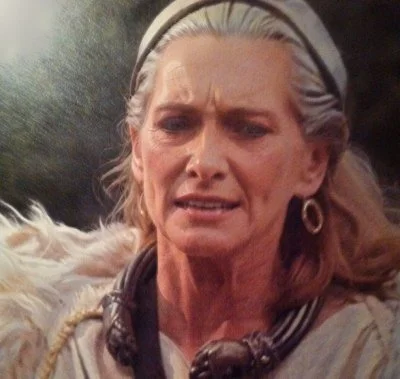
She steps back into view in 14th‑century Florence, when long‑forgotten classical manuscripts were rediscovered. The surviving evidence is scant, yet from those fragments a distinct and forceful woman still emerges. Boudica was married to Prasutagus, a “client king” — a Rome‑approved ruler of the region we now call Norfolk. Her household was already partly Romanised, sharing in the fragile prosperity granted to those who accommodated the occupiers. Then everything collapsed. Around AD 60 or 61, her husband died bequeathing half of his kingdom to his two daughters, and the other half to Emperor Nero.
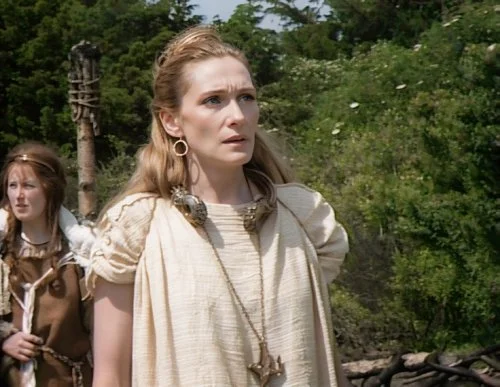
Boudica is convinced that the well‑being of her people depends on preserving peace with Rome. Hoping to honour that fragile accord, she chooses to give her husband a Roman funeral rather than the traditional Celtic rites, believing such a gesture might strengthen their standing with the empire. But opportunistic Roman officials seize the moment to enrich themselves.
Nigel Hawthorne’s wonderfully slippery Catus Decianus arrives as Rome’s tax collector, coolly declaring the treaty void and demanding payment from Boudica’s people. What follows is devastation: her property is seized and her two daughters are raped. From that betrayal, her revolt takes shape — born of a broken pact and a rage that can no longer be contained. At this moment, the story pivots decisively from wary diplomacy to unavoidable rebellion.
That said, the production itself feels constrained. Shot on videotape and filmed in places like Butser Ancient Farm and Gomshall, it has a certain educational authenticity, but it also looks a bit… flat. Battle scenes lack energy, largely because the camera tends to sit still while the action unfolds. And whenever things threaten to get truly brutal, the show cuts away—understandable for teatime, but it robs the story of some of its emotional punch.
The script is dense with dialogue for a series aimed at a young audience rather than an action-driven historical drama—though arguably a toned-down, more accessible version, for some viewers a strength; for others, it makes the pacing drag.
Still, what lingers is the attempt to humanise a figure who is, historically speaking, frustratingly elusive. Boudica might have been more title than name ('Victorious Woman', known in Latin chronicles as Boadicea or Boudicea, and in Welsh as Buddug) —and her legend only really took shape centuries later. Yet The Warrior Queen manages to pull a recognisable personality out of those sparse details.
It’s not a masterpiece, and it rarely feels as dangerous or visceral as its subject demands. But as a snapshot of 1970s British television—earnest, talky, and a bit restrained—it’s surprisingly watchable, and occasionally even gripping when it leans into the tragedy behind the legend.
Seen this show? How do you rate it?
Seen this show? How do you rate it?
Share on...
Published on April 29th, 2026. Written by Laurence Marcus for Television Heaven.