


The Day the Earth Caught Fire
Val Guest’s The Day the Earth Caught Fire remains one of the most intelligent and unsettling science fiction films ever produced in Britain. Released in 1961 at the height of Cold War anxieties, it transforms fears about nuclear testing into a remarkably plausible apocalypse, creating a film that feels as relevant today as it did over six decades ago.
Unlike many science fiction films of its era, The Day the Earth Caught Fire does not concern itself with alien invasions, giant monsters, or futuristic technology. Instead, it imagines a catastrophe born entirely from human arrogance. When the United States and Soviet Union simultaneously detonate nuclear devices at opposite poles of the Earth, they unknowingly alter the planet’s orbit, sending it spiralling closer to the Sun. The result is a steadily worsening global climate disaster: floods in the Sahara, blizzards in New York, tornadoes in the Soviet Union, and increasingly unbearable temperatures across Britain.
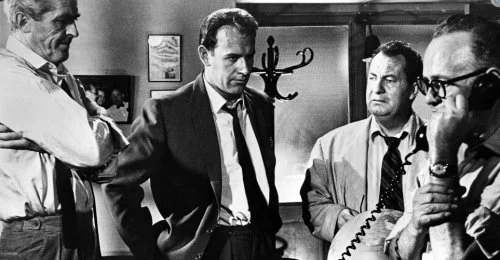
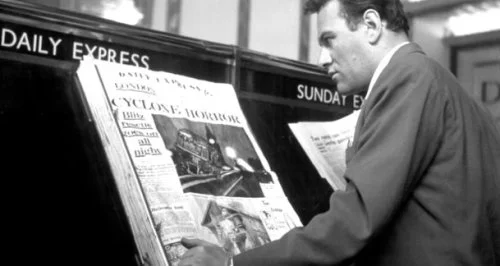
What makes the film especially effective is its choice of perspective. Rather than focusing on scientists or politicians, Guest tells the story through the eyes of Fleet Street journalists working at the Daily Express. Science reporter Bill Maguire (Leo McKern) and columnist Peter Stenning (Edward Judd) gradually uncover the truth behind the strange weather events while government officials and scientists attempt to suppress information. The newsroom setting gives the film an almost procedural quality, turning the investigation into a race against time as reporters piece together clues from around the world.
The film’s depiction of journalism is one of its greatest strengths. The bustling newsroom feels authentic because much of it was actually filmed inside the Daily Express offices, with former editor Arthur Christiansen serving as technical adviser and appearing onscreen as a version of himself. The result is a fascinating time capsule of British newspaper culture, complete with clattering typewriters, cigarette smoke, and hard-nosed editors demanding facts before publication.
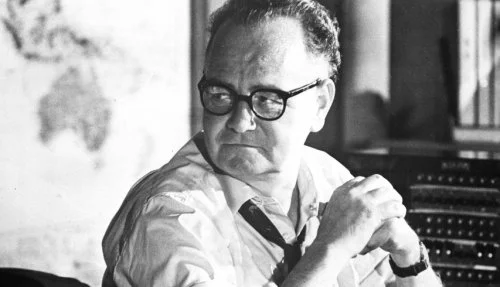
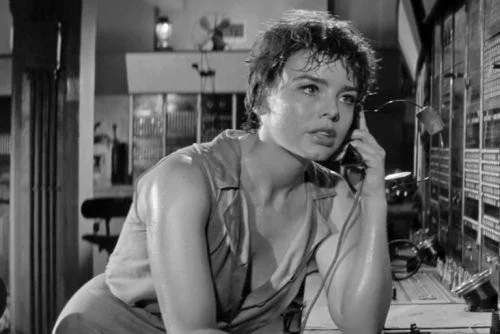
McKern is particularly memorable as the gruff and relentless Maguire. His performance grounds the increasingly extraordinary events in a sense of realism. Judd provides an effective audience surrogate as Peter Stenning, whose romantic involvement with Meteorological Centre secretary Jeannie Craig (Janet Munro) provides a crucial link to the hidden truth. While the romance occasionally feels secondary to the larger narrative, Munro brings vulnerability to a story in the face of impending catastrophe.
As well as the main stars the film also featured the likes of Michael Goodliffe, Bernard Braden, John Barron, Peter Butterworth, Geoffrey Chater, Norman Chappell and (uncredited and seen only briefly as a traffic cop) Michael Caine.
Guest’s screenplay, co-written with Wolf Mankowitz, deservedly won the BAFTA for Best Screenplay. The dialogue is sharp, cynical, and often darkly humorous, capturing the gallows humour of journalists facing the end of the world. The script never allows its scientific premise to overwhelm the human story. Instead, it focuses on how ordinary people react when confronted with extinction: governments impose state of emergency measures as social order begins to collapse, looting becomes widespread, and public hysteria grows as water supplies dwindle and the Thames itself dries up.
The science behind the plot is, of course, highly speculative. Yet Guest was inspired by genuine contemporary debates about the environmental consequences of nuclear testing. He later explained that the film originated from reading letters in The Times arguing over whether atomic tests could affect weather patterns. His simple question—"What if they did?"—became the foundation for one of cinema’s most effective doomsday scenarios.
Guest spent eight years trying to secure financing, repeatedly being told that nobody wanted to see a film about nuclear bombs. Only after the success of Expresso Bongo (1959), was he able to persuade investors to back the project. The determination paid off. Working with limited resources, Guest created an impressive vision of societal collapse. Particularly striking are the scenes of a deserted Fleet Street, covered in dust and debris. Achieving these shots required extraordinary negotiations with authorities, who only granted the filmmakers brief windows in which to transform one of London’s busiest streets into an apocalyptic wasteland.
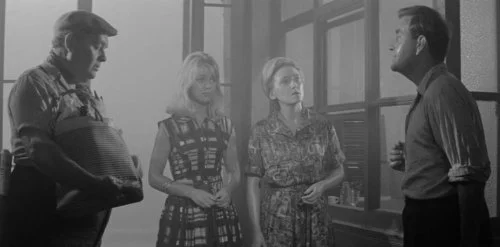
Visually, the film is superb. Its black-and-white cinematography lends the story a documentary-like realism that colour might have diminished. Some original prints featured orange-yellow tinting in the opening and closing sequences, subtly suggesting the oppressive heat of the approaching Sun. The imagery of London disappearing beneath haze and heat remains hauntingly effective.
What truly distinguishes The Day the Earth Caught Fire from many disaster films is its refusal to provide easy reassurance. As the world's governments prepare a final desperate attempt to restore the Earth's orbit using another series of nuclear detonations, Peter Stenning struggles through a dying London to reach the newsroom and write the story that may become humanity’s final headline. The film ends with one of the most famous ambiguous conclusions in science fiction cinema: two headlines waiting on the presses, one declaring "WORLD SAVED" and the other "WORLD DOOMED."
The ambiguity was deliberate. Although the American release added the sound of church bells to imply a happy ending, Guest always intended the audience to remain uncertain. It is a bold conclusion that elevates the film from a conventional thriller into something more profound. The ultimate fate of humanity matters less than the fact that humanity created the crisis itself.
Viewed today, the film feels uncannily prophetic. In one memorable scene, Bill Maguire asks a junior reporter to research the melting points of various substances in order to understand what extreme temperatures might do to London. At the time, it was a piece of speculative science-fiction dialogue. More than sixty years later, scientists genuinely study how infrastructure will withstand increasingly severe heatwaves caused by climate change. What once seemed far-fetched now feels alarmingly plausible.
That modern relevance is perhaps the film’s greatest achievement. While its immediate inspiration was Cold War nuclear testing, its themes resonate strongly in an era defined by environmental uncertainty. The story’s central warning—that humanity can accidentally alter planetary systems beyond its control—has only grown more powerful with age.
Critics recognised the film’s quality upon release, and its reputation has only strengthened. Leslie Halliwell praised it as a smart science-fiction film with a sharp eye for London life and noted how genuinely frightening it was. The Radio Times Guide to Films described it as "tautly intelligent," highlighting its fatalistic wit and cynicism. Those assessments remain accurate. The film, benefitting from superb photography, combines journalistic realism, social commentary, suspense, and apocalyptic suspense with remarkable confidence.
More than six decades after its release, The Day the Earth Caught Fire stands as one of Britain's finest science-fiction films and one of the most sophisticated disaster movies ever made. It is a tense, intelligent, and disturbingly believable vision of global catastrophe, made all the more frightening by how many of its concerns now seem rooted in reality rather than fantasy. Its final image lingers long after the credits roll, leaving audiences to contemplate not only whether the world was saved, but whether humanity has learned anything from the crisis it created.
Share on...
Published on June 19th, 2026. Written by Laurence Marcus for Television Heaven.