

Glynn Edwards
Glynn Edwards was one of those rare British actors whose face felt instantly familiar and whose presence quietly anchored whatever he appeared in. Born John Glynn Edwards on 2 February 1931 in Penang, in what was then Peninsular Malaysia, his beginnings were far from easy. His father, a rubber planter, was largely absent, and his mother died shortly after his birth. Raised by his grandparents in Southsea, Hampshire, Edwards later recalled not seeing his father again until he was eight or nine, before going to live with him and his stepmother in Salisbury, Wiltshire, where they ran the Rose and Crown public house. That pub upbringing would, in time, feel uncannily prophetic. His father died in 1946.
Educated at Clayesmore School in Dorset, Edwards discovered early passions that would stay with him for life. As a boy he devoured Arthur Ransome’s Swallows and Amazons, a book that sparked a lifelong love of river boating. By the age of ten he was already undertaking sailing expeditions along the River Avon, beginning a relationship with water that would later shape how and where he lived.
As a teenager he gravitated towards amateur dramatics, and after a year in Trinidad working as an assistant manager at a country club, he returned to England to train at the Central School of Speech & Drama in London. He completed only half of the three-year course, finding work difficult to come by. Undeterred, he formed his own small repertory company, performing at the King’s Theatre in Gainsborough, Lincolnshire. A friend sent him a new play, The Call of the Flesh, which Edwards cheerfully described as “a little bit naughty”. Its popularity was enough to take it on tour, and during that period one of his many auditions finally bore fruit, with a reply from Joan Littlewood.
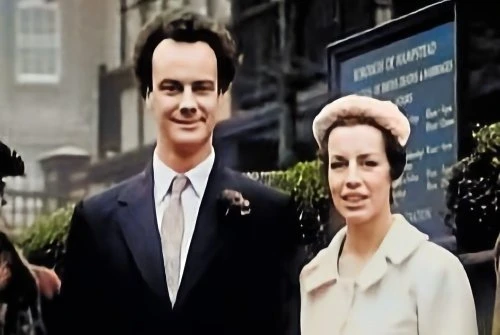
Joining Littlewood’s Theatre Workshop at the Theatre Royal, Stratford East, Edwards became part of one of the most vital forces in post-war British theatre. He appeared in The Good Soldier Švejk and in Brendan Behan’s The Quare Fellow and The Hostage, all of which transferred to the West End. He also featured in Lionel Bart’s musical version of Frank Norman’s Fings Ain’t Wot They Used T’Be, opposite Miriam Karlin and Barbara Windsor, and spent a year performing the show on Broadway. It was at Stratford East that he met Yootha Joyce, whom he married in 1958. The marriage ended in divorce in 1968, and he later married former Benny Hill girl Christine Pilgrim, with whom he had a son. This also ended in divorce and he eventually married his third wife, Valerie Edwards.
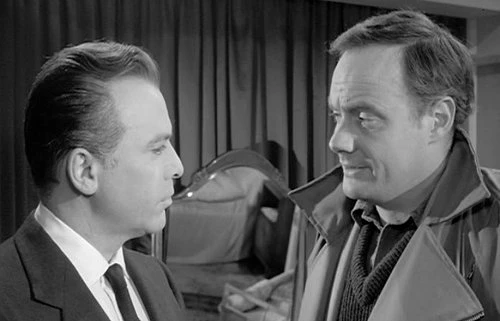
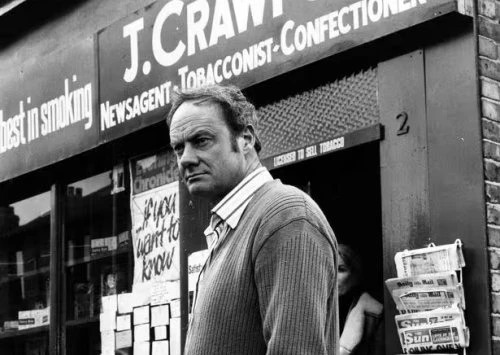
Edwards made his screen debut in 1957 as a constable in The Heart Within, though it would be four years before he appeared again, playing the Master Gunner in four episodes of Sir Francis Drake. From the 1960s onwards, his career gathered momentum as he became a familiar face in British television, with roles in The Human Jungle, No Hiding Place and Z Cars. He spent nine months in The Newcomers between 1965 and 1966, and in the 1970s played the office detective in two series of ITV’s legal drama The Main Chance (1972 and 1975). He also appeared in fourteen episodes of The Paper Lads from 1977 to 1979, alongside guest roles in Bless This House, Crown Court, Some Mothers Do ’Ave ’Em and The Professionals. Often cast as policemen or criminals, he brought texture and credibility to every part, no matter how small.
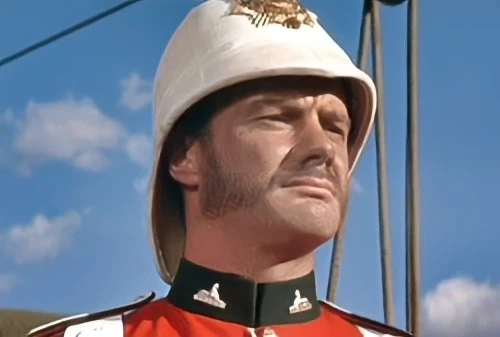
In 1964 he faced a defining choice: two offers arrived simultaneously, one for Joan Littlewood’s stage show Oh! What a Lovely War, the other for the role of Corporal Allen V.C. in Cy Endfield’s epic film Zulu. He chose Zulu, later remarking with characteristic honesty, “I would have earned far more doing the play which ran in the West End for two years.” That pragmatic streak continued as he became a regular performer in television commercials, once quipping, “I earned 10 times as much money from Bran Flakes as I did from the whole of the movie of Zulu.” He was especially remembered for a Rich Tea biscuits advert in which he told the waiting press, “Yeah, I’ll make a statement. A drink’s too wet without one!”
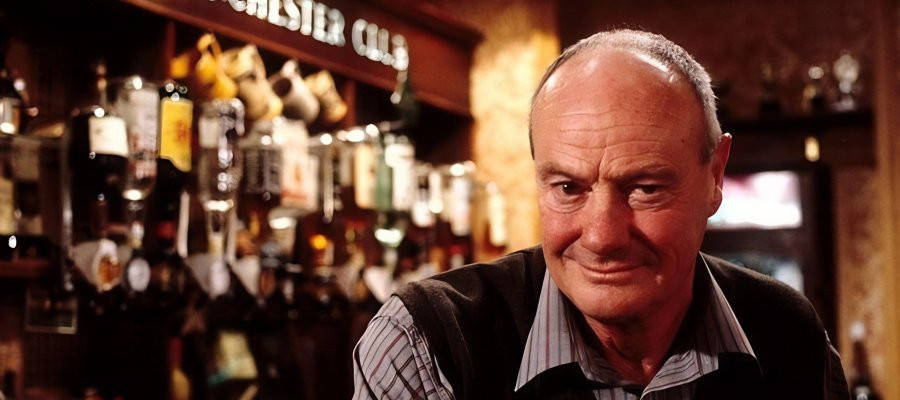
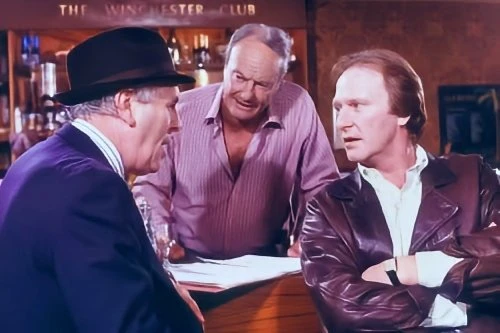
In 1979, Edwards finally took his most permanent role. The one that would come to define him: Dave the Barman in Minder. Initially dismissive of the part, he was persuaded by his agent to accept it — and was soon proved wrong. Over 15 years and almost 100 episodes, Edwards presided behind the bar of the Winchester Club, Arthur Daley’s preferred refuge. He later suggested Dave’s endurance was rooted in necessity: unable to go home because of “’er indoors” — the never-seen wife blamed for giving him “GBH of the ear ’ole” — Arthur needed a base, and the Winchester became it. As Dave, Edwards served as the dry, unflappable voice of reason to both Arthur and his minder Terry McCann (Dennis Waterman).
The role followed him beyond the series. In 1985 he appeared as a barman, in Marillion’s music video for “Heart of Lothian.”
True to his childhood passions, Edwards retained a lifelong love of river boating. He owned several vessels and during the 1980s and 1990s lived aboard a 40-foot canal boat converted into a houseboat, named Winchester after the fictional club that made him famous. Permanently moored on the south bank of the River Thames at Thames Ditton and Surbiton, it was a fitting home for a man whose life seemed to flow between water, work and warmth.
After the end of Minder in 1994, Edwards retired from acting, having amassed more than 200 television appearances. In his final years he divided his time between Spain and Scotland. He died at his home in Edinburgh on 23 May 2018, aged 87.
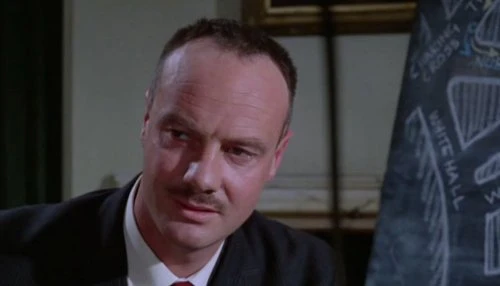
Glynn Edwards never chased stardom, yet he became indispensable. With his steady presence, dry humour and unmistakable humanity, he embodied the very best of the British character actor — a man who made the bar feel like home, and whose work continues to be raised in fond remembrance, glass in hand.
Share on...
Published on January 24th, 2026. Written by Laurence Marcus for Television Heaven.