

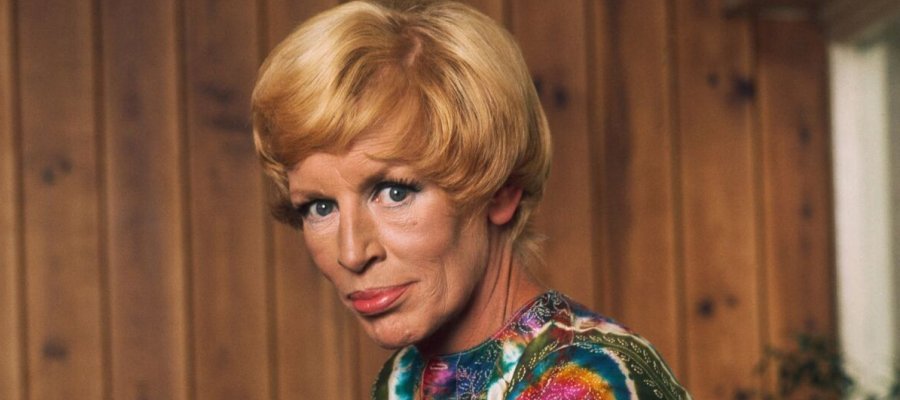
Yootha Joyce
Few performers embody the bittersweet charm of post-war British entertainment quite like Yootha Joyce. With her unmistakable poise, razor-sharp timing, and the ability to suggest whole inner worlds with a single raised eyebrow, she became one of television’s most quietly magnetic figures. Best known to millions as the indomitable Mildred Roper, Joyce brought a rare blend of elegance, vulnerability, and comic precision to every role she touched. Yet behind the effortless wit and polished performances lay a life marked by discipline, private struggle, and a fierce dedication to her craft.
Yootha Joyce Needham was born in Wandsworth, London, on 20 August 1927, the only child of musical parents Percival Needham, a singer, and Jessie, a concert pianist. Her unusual first name came from a New Zealand dancer in her father’s touring company—one she later admitted she “loathed and detested.” According to biographical accounts, her mother went into labour while walking on Wandsworth Common during an interval in her husband’s performance; seeking help, she found a nearby nursing home, where Yootha was born.
The family lived in a basement flat in Wandsworth, though Joyce spent extended periods with her maternal grandmother while her parents travelled for work. She began her education at Battersea Central Co-educational School but was evacuated at the outbreak of the Second World War to Petersfield, Hampshire, where she attended Petersfield County High School for Girls. Although she later claimed to have “hated” her time there, it was in Petersfield that she first explored performing, joining fellow evacuees in staging plays, dances, and songs in the local church hall. Returning to London in 1941, she found her family settled in Croydon, where she completed her schooling at Croydon High School.
Her parents offered little encouragement toward an acting career, often remarking that she lacked their musical abilities and “wasn’t much good at anything.” Nevertheless, her early experiences on stage strengthened her resolve to pursue acting, determined to break from family tradition and become a serious dramatic performer. She earned a place at the Royal Academy of Dramatic Art in 1944, studying alongside Roger Moore, and made her debut there as Lydia Bennet in Pride and Prejudice.
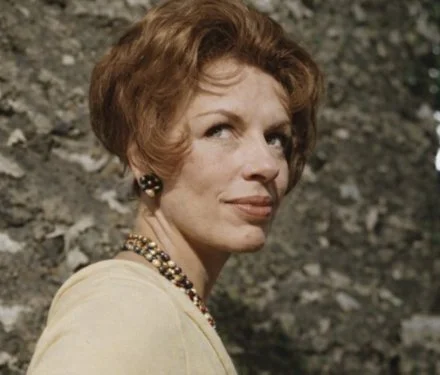
Despite being told by one director that she had “nothing to offer the profession,” Joyce pressed on. She gained practical experience as an assistant stage manager at The Grand in Croydon and joined repertory companies, appearing in productions such as Escape Me Never and Autumn Crocus. When she briefly returned to RADA in 1945, she adopted the professional name Yootha Joyce, dropping “Needham” as unnecessarily cumbersome. She left the academy for good in early 1946, disillusioned by what she felt was an overly rigid and discouraging environment.
After leaving RADA, Joyce spent several years touring with repertory companies across Britain, steadily building her reputation. A significant turning point came in 1955 when she joined a production of The Call of the Flesh at the King’s Theatre in Gainsborough. There she met Glynn Edwards, who would become both her partner and, later, her husband. The production, widely billed as bold and provocative, proved a major success and attracted the attention of influential director Joan Littlewood, who invited Edwards to join her Theatre Workshop at the Theatre Royal Stratford East.
By 1956, Joyce had moved in with Edwards in Hampstead and soon joined Littlewood’s Theatre Workshop herself, performing alongside rising talents such as Bob Grant, Stephen Lewis, Brian Murphy, Barbara Windsor, Murray Melvin, and Victor Spinetti. She married Edwards on 8 December that year. Despite her growing success, she remained deeply anxious about her career, often confiding that she feared unemployment and believed each role might be her last. Her stage work with the company, including Fings Ain’t Wot They Used T’Be, brought her increasing recognition.
Joyce made her television debut in 1962 in Brothers in Law alongside Richard Briers, and soon after appeared in Sparrows Can't Sing, marking her entry into film. Although she and Edwards divorced in 1969, they remained close friends, maintaining a bond that endured long after their marriage ended.
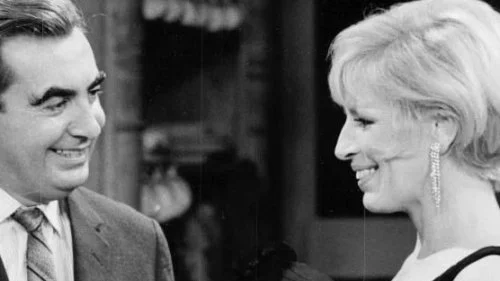
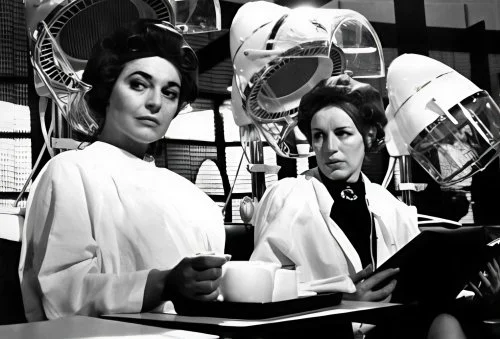
During the 1960s and 1970s, Joyce became a familiar presence on British screens, taking on a wide range of roles in both television and film. She played her first substantial recurring role as Miss Argyll in Me Mammy (1968–71) opposite Milo O'Shea, though much of the series is now lost. Earlier, she had delivered a striking cameo in The Pumpkin Eater, acting opposite Anne Bancroft in a performance later praised as an exceptional example of screen acting. She went on to appear in Our Mother's House with Dirk Bogarde, as well as the Hammer horror Fanatic, and took on villainous roles in television series such as The Saint, The Avengers, and Jason King.
Alongside her dramatic work, Joyce demonstrated a strong flair for comedy, appearing in popular programmes such as Steptoe and Son and On the Buses. Her film credits from this period included the Hammer film Die! Die! My Darling starring Stefanie Powers, Peter Vaughan and Donald Sutherland (1965), Catch Us If You Can (1965), A Man for All Seasons (1966), and Charlie Bubbles (1967), as well as spin-off films like Nearest and Dearest (1972) and Steptoe and Son Ride Again (1973). She also featured in the Seven of One pilot episode of Open All Hours in 1973.
Her major breakthrough came that same year when she was cast as Mildred Roper in the sitcom Man About the House, starring alongside Brian Murphy, Richard O'Sullivan, Paula Wilcox, and Sally Thomsett. The series ran until 1976 and centred on the comic tensions arising from a shared flat arrangement above the Ropers. Joyce’s portrayal of the sharp-tongued, socially ambitious Mildred proved iconic.
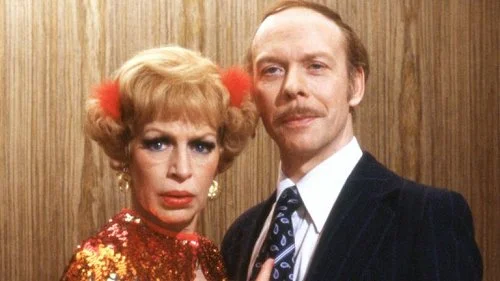
Following the show’s success, she reprised the role in the spin-off George and Mildred, which began in 1976. The series followed the Ropers’ move to suburban life in Hampton Wick, with much of the humour stemming from Mildred’s aspirations for a better life continually undermined by her husband’s contented inertia.
Behind the scenes, Joyce struggled with alcoholism for many years, a battle that increasingly affected her health. She continued working into 1980, when a feature film version of George and Mildred became her final project. That summer, amid growing concern, she was admitted to hospital and died of liver failure on 24 August 1980, shortly after turning 53. Brian Murphy was at her bedside. Her funeral took place at Golders Green Crematorium, where she was cremated and her ashes scattered in the grounds.
She appeared posthumously in a final television performance, singing “For All We Know” in a duet with Max Bygraves on his show Max, broadcast on 14 January 1981. Reflecting on the performance, Kenneth Williams wrote in his diary that she seemed close to tears, adding that as she left the set, “one had the feeling she never intended to return.”
Her legacy has endured in the decades since her death. A 2001 ITV documentary, The Unforgettable Yootha Joyce, featured tributes from colleagues and friends, while a 2019 stage production, Testament of Yootha, brought renewed attention to her life and career. Today, Joyce is remembered not only for her iconic portrayal of Mildred Roper but also for the depth, subtlety, and humanity she brought to every performance—a testament to an artist of rare emotional intelligence and quiet brilliance.
Share on...
Published on April 3rd, 2026. Written by Laurence Marcus for Television Heaven.