

The Underwater Menace
Review: Daniel Tessier
The War Between the Land and the Sea was far from the first time the worlds of Doctor Who explored an underwater civilisation. Not even The Sea Devils got there first. No, it was The Underwater Menace in season four, which took us beneath the waves to the sunken city of Atlantis.
The Underwater Menace is only the third of Patrick Troughton's Doctor Who stories, and the represents the earliest surviving episodes of his tenure. The second and third episodes of this four-part adventure have been recovered as film telerecordings, intended for sale to overseas broadcasters. Episode two was missing for decades, only being discovered in 2011 among the various possessions of a former TV engineer. This copy had been made for broadcast in Australia, and had several cuts made to remove scenes that the (surprisingly squeamish) Australian censors thought would be too distressing for viewers. Fortunately, all the cut sequences were still in the National Archives of Australia, along with some from episodes one and four; their only surviving footage.
It's a pity, really, that a better serial couldn't have made it as the earliest of Troughton's stories to survive. It's not that The Underwater Menace is without merit. Indeed, it's better than its dreadful reputation suggests. It is, however, a risible load of old nonsense, with most of the enjoyment being of the “so bad it's good” variety. The script was written by Geoffrey Orme, a career screenwriter who'd been in regular work since the 1930s and was best known for writing the screenplays for the film outings of the baffling music hall drag act Old Mother Riley, before moving into television primarily with episodes of children's adventure series Ivanhoe starring Roger Moore. Imagine if someone had worked on Mrs Brown's Boys, moved onto Robin Hood, delivered a virtually unfilmable Doctor Who script and then retired.
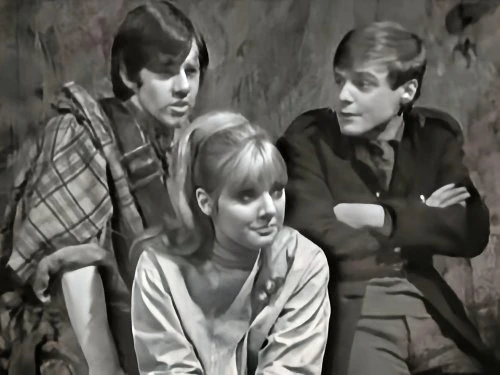
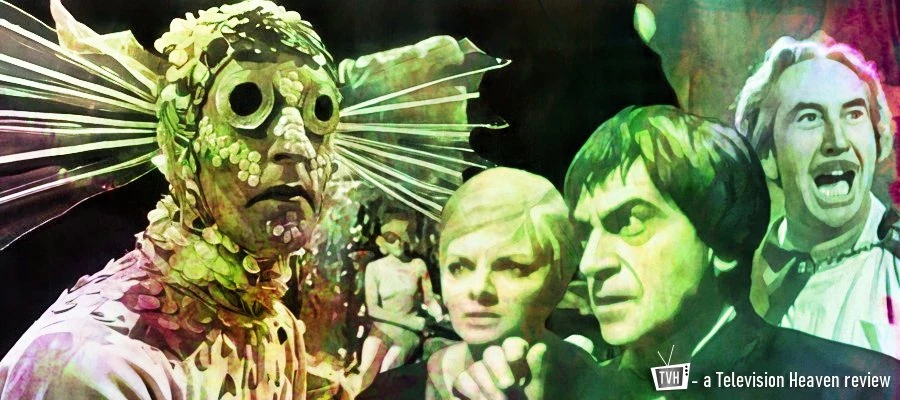
The story sees the Doctor, Ben, Polly, and the newly joined Jamie, captured by survivors of the sunken Kingdom of Atlantis. Taken beneath the waves to their underwater city, the time travellers encounter Professor Zaroff, a full-on mad scientist who wants to destroy the world, for some undisclosed reason. While they're down there, the travellers will have to deal with fish people, ritual sacrifices to the great fish god, and sundry other fishy ideas.
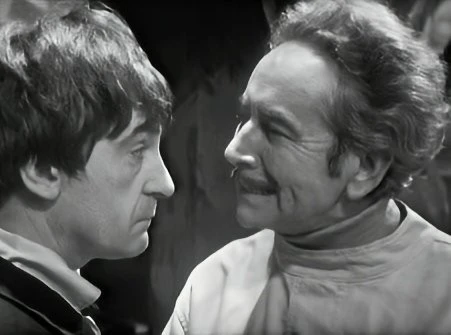
Zaroff has escaped from the pressures of mad science during the Cold War by hiding out in Atlantis, providing delicious planktonic food for the Atlanteans and promising to raise their city back to the surface. This is the first time that Doctor Who dabbled in the Atlantean legend, but not the last. The sunken city south of the Azores would be joined by an entirely different Atlantis in 1972's The Time Monster, while the previous year's The Daemons had already provided another account of its destruction. Having three possible Atlantis’s is hardly the most egregious of Doctor Who's continuity conundra, although one of the most celebrated among fans. You could probably reconcile the stories, if you try hard enough and squint, and if you can be bothered.
This Atlantis has survived thanks to a handy air pocket leading up a volcanic vent to an Atlantic island (making one wonder, why didn't the survivors just go and live there?) The sets for Atlantis are genuinely quite impressive, particularly Zaroff's large laboratory and the great idol of the goddess Amdo, in a silly kind of way. Still, these Atlanteans want to raise their city from the depths, and Zaroff has promised them just that. Unfortunately, to do that he plans to drill a hole into the core of the Earth, through which all the waters of the oceans will be drained, and then converted to steam. Atlantis will be on the surface, technically, for the few moments before the world explodes from the build-up of pressure. Any residue of the series' initial remit of educating the young audience has long since dried up.
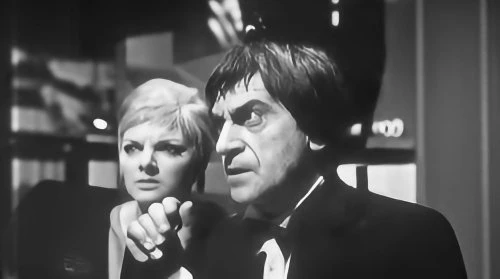
In a more immediate concern, the Atlanteans want to convert Polly into a Fish Person. These are the poor unfortunates who have been operated on given plastic gills, so that they can leave the city and harvest the ocean for plankton. Zaroff has been able to give the Atlanteans nuclear-generated electricity, but no refrigeration, so their food has to be constantly replaced as it spoils. The first cliffhanger, which sees a struggling Polly about to be anaesthetised as she's carted off for surgery, is genuinely disquieting. Plus, this subplot gives us one of Doctor Who's greatest ever lines: “You're not turning me into a fish!”
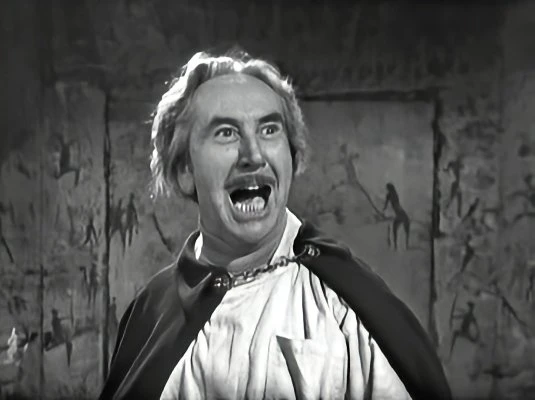
The cast all do their best with the material, but the superstar of this story is Zaroff himself, Austrian actor Joseph Fürst. A frequent face on British and Australian films, often in villainous roles, Fürst appears to the only actor who understands how to play this script: by sending it up. A lot of viewers assumed that his outrageous Teutonic accent was put on for the part, but no, that's his real, everyday voice. He certainly makes the most of it, though, getting audibly madder as the serial goes on. Who could forget his triumphant line at the end of part three: “Nuzzink in ze vorld can stop me now!”
The Doctor's solutions to his mounting problems include setting the reactor to overload, and flooding the city, with little concern for the many lives that will surely be lost. There are some survivors, at least, and presumably the Fish People are able to swim to start new lives out at sea. Maybe they join the Aquakind – now there's a missed opportunity for The War Between the Land and the Sea. I've not even mentioned the Doctor's disguises, the two random sailors who get involved, the man-eating octopus, or the Fish People forming a labour union. Frankly, this serial has it all. And it's all barmy.
The serial was originally scheduled to be directed by Hugh David, but he was moved onto the preceding story, The Highlanders, when he insisted Doctor Who Under the Sea (as it was then called) couldn't possibly be made on the series' tight budget. He was right; the serial ended up costing more than double its £2000 budget. It could have been worse; David had been offered the role of the Doctor in 1963; in another history, he could have starred in this nonsense. The original director of The Highlanders, Julia Smith, had done good work with the previous historical serial that year, The Smugglers. Lumbered with this production, she struggled, and the cast didn't help, with Troughton encouraging the young regulars to misbehave. Smith's tactic of asserting her authority had worked with Hartnell, but it only made Troughton and his gang act up even more. Smith never worked on Doctor Who again, but it's unlikely she regrets that; she went on to direct the acclaimed adaptation of The Railway Children that year, and later co-created EastEnders.
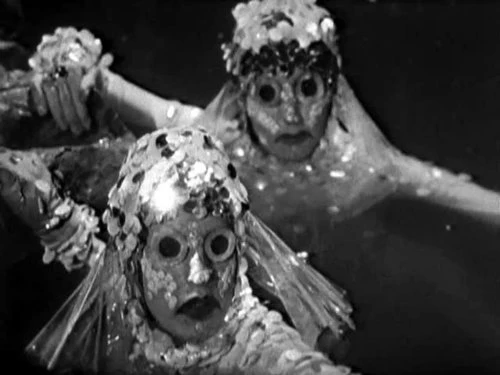
As always, it's hard to judge her direction given the paucity of surviving material; for a long time, we only had episode three to go by, and a lot of that is taken up with what is usually described as the “Fish Person ballet.” Allegedly, it was the good impression this made on the BBC that led to the episode being saved from ultimate destruction. Some young girls were so impressed by piece and the Fish People's sequinned costumes that they wrote into the BBC to ask how to make their own. If any of you are reading this, do please get in touch.
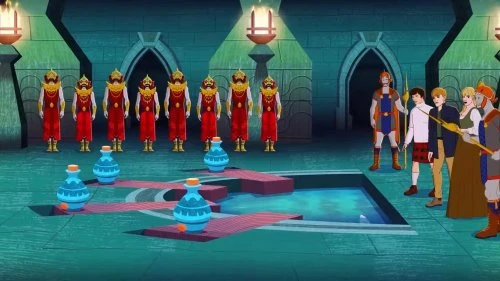
The serial had a tumultuous time even after the wiping, with the initial plans to animate the still-lost first and last episodes back in 2014 being cancelled when the animation company employed for the project went bust. Versions hastily reconstructed from clips were put together so that the “complete” serial could be released on DVD in 2015. A completely animated version of the story was eventually made, and released in November 2023, apparently considered a suitable treat for the programme's sixtieth anniversary. You can now watch either version of the serial on BBC iPlayer, if you're in the mood for a laugh.
Share on...
Published on January 28th, 2026. Written by Laurence Marcus for Television Heaven.