

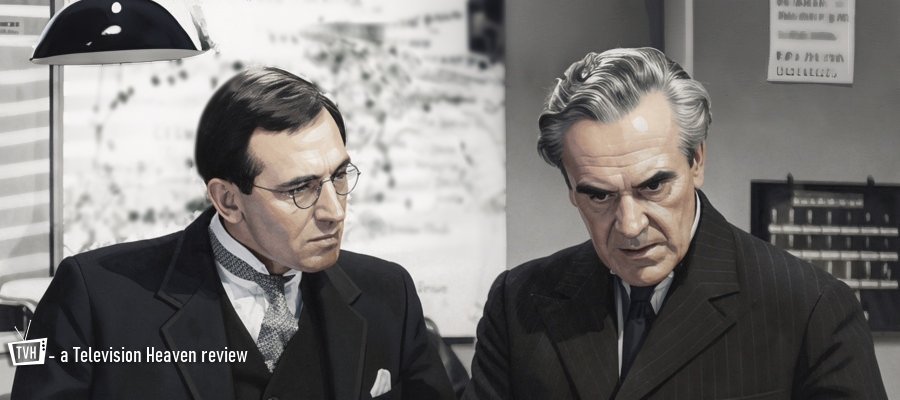
Dr. Knock
1966 United KingdomJules Romains’ Doctor Knock (or Knock ou le Triomphe de la médecine) is one of those rare comedies that manages to entertain and unsettle in equal measure. First staged in 1923 at the Théâtre des Champs-Élysées under the direction of Louis Jouvet, the story became something of a French schoolroom classic and has long since earned its place as a staple of French theatrical tradition—one that continues to resonate far beyond its original era.
Translated into the English language by Harley Granville-Barker, it premiered in London at the Royalty Theatre in April 1924.
At first glance, the premise feels delightfully simple: a new doctor arrives in a sleepy rural town and transforms a failing practice into a booming enterprise. But under Romains’ sharp pen, this becomes something much more incisive.
Romains skewers not just the medical profession but the human tendency toward self-diagnosis, health obsession, and the seduction of authoritative language. The villagers’ rapid descent into hypochondria feels exaggerated, yet uncomfortably familiar in a world increasingly preoccupied with wellness trends and medical information. It’s this that fuels the play’s humour: we laugh at the gullible villagers, yet the laughter catches slightly in the throat when we recognize our own anxieties reflected back at us.
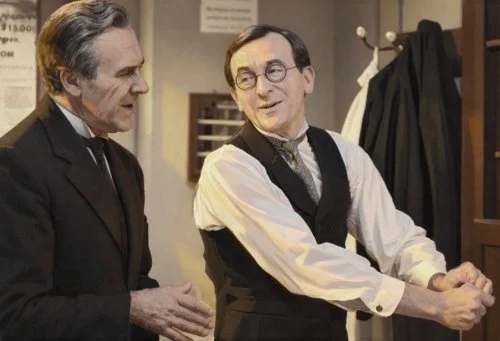
The 1966 Theatre 625 BBC television adaptation benefits enormously from its casting. Leonard Rossiter brings a sly intelligence and unsettling charm to Dr. Knock, making him less a caricature and more a chillingly believable opportunist who is no more than a scheming quack. Opposite him, John le Mesurier as the weary Dr. Parpalaid provides a perfect foil—bemused, understated, and quietly outmatched. Their interplay underscores the central tension between old-fashioned, almost casual medicine and the rising tide of professionalized, profit-driven healthcare . Dr. Knock’s philosophy—that no one is truly healthy and that everyone is, in some sense, a patient-in-waiting—is both absurd and eerily plausible.
In the end, this is a comedy with teeth—one that draws blood precisely because it lands so close to home. It provokes laughter, certainly, but also a flicker of self-awareness: the uneasy recognition of how readily we outsource our certainty to a reassuring voice without checking its credentials, and how quickly a casual worry can be coaxed into conviction. The joke is on the villagers, until it isn’t; their credulity begins to look suspiciously like our own. And when the laughter fades, what remains is a faint, prickling embarrassment at the thought that, under the right pressure and the right rhetoric, we too might be persuaded to become patients-in-waiting.
Seen this show? How do you rate it?
Seen this show? How do you rate it?
Share on...
Published on April 25th, 2026. Written by Laurence Marcus for Television Heaven.