

Hattytown
1969 United KingdomHattytown is one of those quietly enchanting children’s television series from the late 1960s and early 1970s that feels both utterly of its time and strangely timeless. First airing in 1969 and running until 1973, the series emerged from a place of intimate creativity rather than corporate design: bedtime stories told by illustrator Keith Chatfield to his young son, stories that would unexpectedly change the course of his life and leave a gentle imprint on British children’s television.
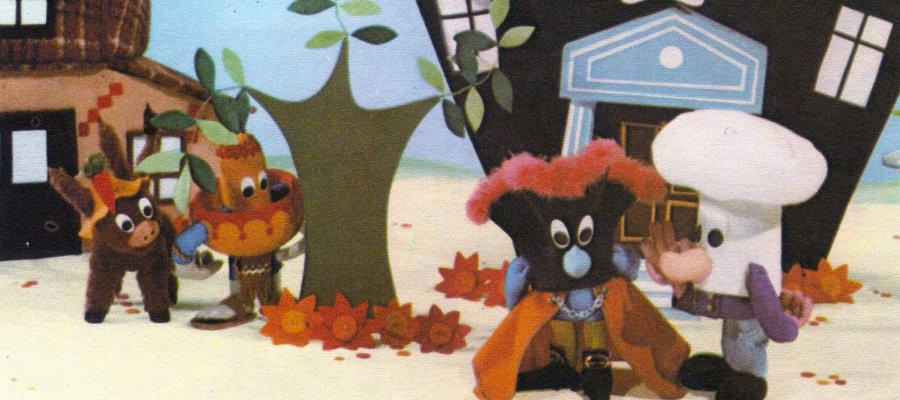
Chatfield’s account of the show’s origins gives Hattytown much of its charm. At the time, he was working in marketing, inventing stories simply to entertain his six-year-old son. Visually, the series sprang from a wonderfully playful idea. Chatfield drew a little boy hidden almost entirely beneath an enormous sombrero: “all hat with a little boy inside”. This character became Sancho, a Mexican sombrero with legs and expressive eyes. His loyal companion, Carrots the donkey, was given one of the series’ most memorable visual gags: because Carrots never knew where to go, Sancho tied a carrot on a stick and fixed it to Carrots’ hat, giving him something to follow at all times. It is a simple, childlike joke, but one that perfectly encapsulates the programme’s gentle absurdity.
A friend recognised the characters potential and, despite Chatfield’s doubts, took the scripts to both the BBC and Thames Television. Thames made the first offer, and from there the project blossomed.
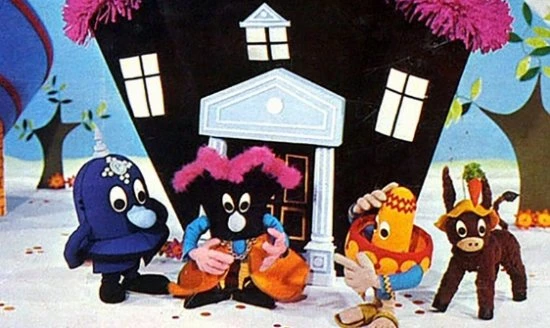
From Sancho and Carrots grew a whole community. Chatfield began drawing more characters, most of them dominated by hats, and soon these “Hatty folk” needed a place to live. The solution was Hattytown itself: a town made up entirely of hat-shaped houses, each reflecting the role or personality of its occupant. Produced as a 39-episode stop-motion animated series by FilmFair for Thames Television, and directed by the legendary Ivor Wood, Hattytown became a showcase for inventive design and meticulous craftsmanship. The puppets and décor, created under Wood’s guidance, gave the series a tactile warmth that remains appealing decades later.
One of the most distinctive aspects of Hattytown is how character is communicated through design. The residents are anthropomorphic hats, and the style of each hat signals the character’s ethnicity, job and attitude. Bobby the constable, for example, literally resembles a policeman’s hat, while the buildings themselves mirror this logic, with hat-shaped architecture suggesting function as well as identity. It is visual storytelling at its simplest and most effective, instantly readable for young viewers without the need for heavy exposition.
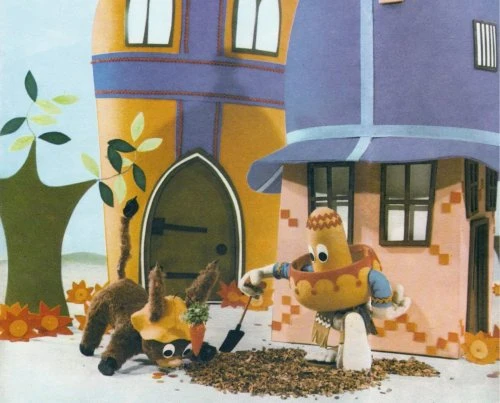
Narrated by Keith Chatfield himself, the series unfolds at an unhurried pace, allowing its small stories to breathe. Episodes often revolve around everyday problems and mild mishaps rather than high drama. A typical example involves an angry bird that makes its nest in Sancho’s car, snapping at anyone who tries to move it. The eventual reveal of eggs and their hatching provides a gentle lesson in patience and understanding, delivered without overt moralising. This softness of tone is a defining feature of the show: conflict is never threatening, and resolutions are reassuring rather than triumphant.
Beyond television, Hattytown enjoyed a healthy life in print. Books were published by World Distributors, while the characters appeared in Playland Comic and a series of children’s annuals over a ten-year period. This broader presence reinforced Hattytown as a small but coherent fictional world, one that children could revisit across different formats.
Hattytown stands as a fine example of late-1960s British children’s television at its most imaginative and humane. It lacks the frenetic energy or merchandising-driven urgency of later decades, but that is precisely its strength. Rooted in storytelling, visual wit and affection for its characters, the series feels like a storybook brought gently to life. For those who grew up with it, Hattytown remains a fond memory; for newcomers, it is a reminder of how much warmth and creativity can come from a simple idea, a bedtime story, and a very large hat.
Seen this show? How do you rate it?
Seen this show? How do you rate it?
Share on...
Published on January 18th, 2026. Written by Laurence Marcus for Television Heaven.