

The Corbett Follies
1969 United KingdomThe tragedy of so much 1960s British television is not merely that it was ephemeral, but that entire strands of entertainment history vanished almost without trace. Few programmes embody that loss more completely than The Corbett Follies, London Weekend Television’s lavish 1969 variety series starring Ronnie Corbett. Produced during the height of the ITV wiping era — when videotape was routinely erased and reused as a matter of policy — the programme is now considered totally lost. No episodes, clips, production recordings, or off-air material have surfaced in the holdings of the BFI, ITV archive catalogues, Kaleidoscope recoveries, or private collector circles. In archive terms, it has disappeared absolutely.
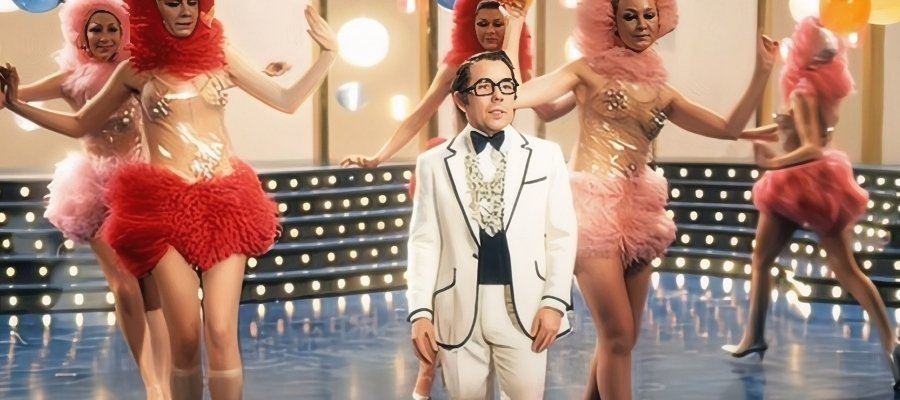
What survives instead is reputation, documentation, and the memory of those who saw it. By all accounts, The Corbett Follies was an ambitious and highly glamorous attempt to place Ronnie Corbett at the centre of a fast-moving light entertainment spectacular in the mould of the Folies Bergère. Corbett was surrounded by eight dancers known as “The Corbettes” and six showgirls billed as “The Corbett Lovelies” — Andrea Ward, Gillian Elvins, Penny Everton, Valerie Field, Gwendoline Brittane and Anne Chivers — with the programme combining comedy sketches, musical performances, dance routines, and celebrity guest appearances into a polished Saturday-night showcase.
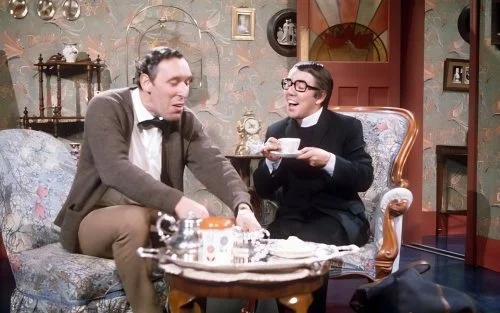
The guest list alone captures the breadth of the production’s ambition: Engelbert Humperdinck, Roy Castle, Ronnie Barker, Vikki Carr, Sandie Shaw, Ray Barrett, Julian Orchard, The Kaye Sisters, and even Corbett’s wife, actress Ann Hart, all appeared during the run. Made between the second and third series of No – That’s Me Over Here!, the series represented a fascinating moment in Corbett’s career, when he was moving from ensemble performer to major television star in his own right.
What makes the loss especially frustrating is that The Corbett Follies seems to have showcased an aspect of Ronnie Corbett’s talent that was often underestimated. Corbett has frequently been viewed primarily as a comic actor or as the quieter counterpart within double acts, yet his greatest performances demonstrate extraordinary precision in timing, rhythm, and character escalation. His comedy was rooted in detail and patience rather than aggression. Even in The Two Ronnies, sketches now remembered chiefly for Ronnie Barker’s verbal brilliance often depend just as heavily on Corbett’s reactions and gradual collapse into frustration. “Four Candles” works not simply because of Barker’s wordplay, but because of Corbett’s mounting exasperation as the bewildered hardware shop owner slowly loses control of the situation.
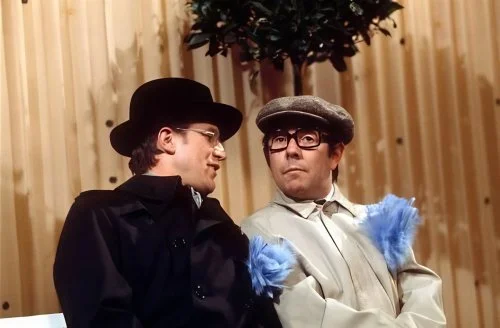
That same comic instinct reportedly sat at the heart of The Corbett Follies. Corbett’s own description of himself as “R. Corbett, purveyor of high class vaudeville” was typically modest, but entirely accurate. He possessed a deeply traditional entertainer’s skillset: sketches, timing, musicality, audience rapport, and physical comedy delivered with deceptive ease. The series appears to have embraced those strengths wholeheartedly, presenting him not merely as a comedian but as a complete variety performer.
It is also a reminder of how rich and visually extravagant British light entertainment could be during this period. ITV variety productions of the late 1960s were often mounted with enormous ambition, despite their later reputation as disposable programming. Shows such as The Corbett Follies were designed to feel luxurious, glamorous, and energetic — television as Saturday-night spectacle. Yet these were precisely the programmes most vulnerable to wiping policies because they were considered commercially and culturally transient.
Ronnie Corbett would remain a familiar and beloved presence on British television until his death in 2016, his contribution to British comedy becoming impossible to ignore with hindsight. But The Corbett Follies occupies a particularly intriguing place within that legacy: a lost showcase for a performer whose range and sophistication were often underestimated. The absence of even a few surviving minutes means the series has passed almost entirely into legend, remembered only through production stills, listings, and contemporary accounts. As a result, it now stands not simply as a missing television programme, but as a symbol of an entire era of British entertainment that was never preserved because nobody imagined it would one day matter so much.
Seen this show? How do you rate it?
Seen this show? How do you rate it?
Share on...
Published on May 27th, 2026. Written by Laurence Marcus for Television Heaven.