

The Legend of Vox Machina
2022 United States‘…even more than story, the appeal of any production, whether dramatic or comedic or both, comes down to the appeal of the characters, and this is the great strength of The Legend of Vox Machina’
Review of Seasons One and Two: John Winterson Richards
The story of how The Legend of Vox Machina came to be is in many ways far more interesting than the animated series itself. It resembles one of those "let's just put on a show" Hollywood films where a bunch of eager kids do something simply because they enjoy it and it turns out to be an unexpected success.
It also illustrates how several trends in entertainment media can come together and offer a new business model for the future. While some consider it a sign of the decline of Western civilisation that so many film and television projects are now adaptations of "comic books" and video games, it cannot be denied that the best of them have genuine merit. The recent Netflix Arcane shows the potential of video game characters given a strong storyline and some clever world building.
If video games are still generally in the basement of respectability as source material for adaptations, The Legend of Vox Machina takes us lower still - to a sub-basement that most people had forgotten. It is based on a game, but nothing so sophisticated as a modern video game.

Older people might remember that in the days before video games there were multiplayer games in which players interacted in real life, hard as that is to imagine now. Some were board games of considerable complexity, such as realistic wargames. Some, called role playing games or RPGs, involved players assuming other characters. The most famous of these was, and still is, 'Dungeons and Dragons,' which is set in a Tolkienesque high fantasy universe. 'Dungeons and Dragons' has developed its own film and television franchise, but to date it has not been a great success. The Legend of Vox Machina is not part of that franchise.
Indeed, The Legend of Vox Machina is not based directly on the game itself but on a particular session of people playing the game - or rather a webstream of a particular session of people playing the game.
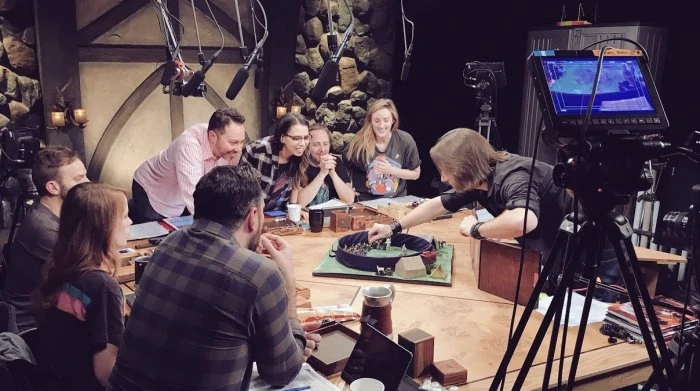
Anyone who has ever played a serious board game over a few drinks with friends might wonder why someone would bother to record it - and why anyone else would bother to watch it. The appeal of such a thing becomes even more incomprehensible when one reads that, like many 'Dungeons and Dragons' sessions, it was rather long, and the session became many sessions. It was given its own name, 'Critical Role,' and each session is titled, more appropriately, a "campaign." At the time of writing 'Critical Role' are in their third campaign. The first, on which The Legend of Vox Machina is based, ran to 115 episodes of about three hours each.
So who would want to spend hundreds of hours watching someone else play 'Dungeons and Dragons'? Apparently, quite a lot of people. The first episode has over 18,000,000 views on 'YouTube' at the time of writing and 'Critical Role' has grossed over $9,000,000 on 'Twitch.'

It has to be stressed that 'Critical Role' is more than the traditional stereotypical geeks playing D&D. The regular participants all just happen to be established voice actors. The in-joke, mentioned but not explained in the animation, is that 'Vox Machina' means "Voice of the Machine," referencing the participants' vocations. They also seem to be people of considerable imagination skilled at improvisation. Yet in spite of their obvious professionalism, they are apparently genuine friends - including two married couples. The webcast is therefore a lot more enjoyable than it sounds (while it has not been possible to watch all 115 three-hour episodes as part of this review process, they have a pleasant atmosphere that makes them easy listening).
Seeing that all this was doing no harm to their careers, the participants in the game decided to make an animation to introduce their characters. They launched an appeal for funding on 'Kickstarter.' They gave themselves 45 days to raise $750,000 for a 22-minute cartoon. They raised the whole sum, indeed over a million, in the first hour. Then the money kept coming. They ended up with $11,000,000 from over 80,000 individuals, enough for a ten-episode season.
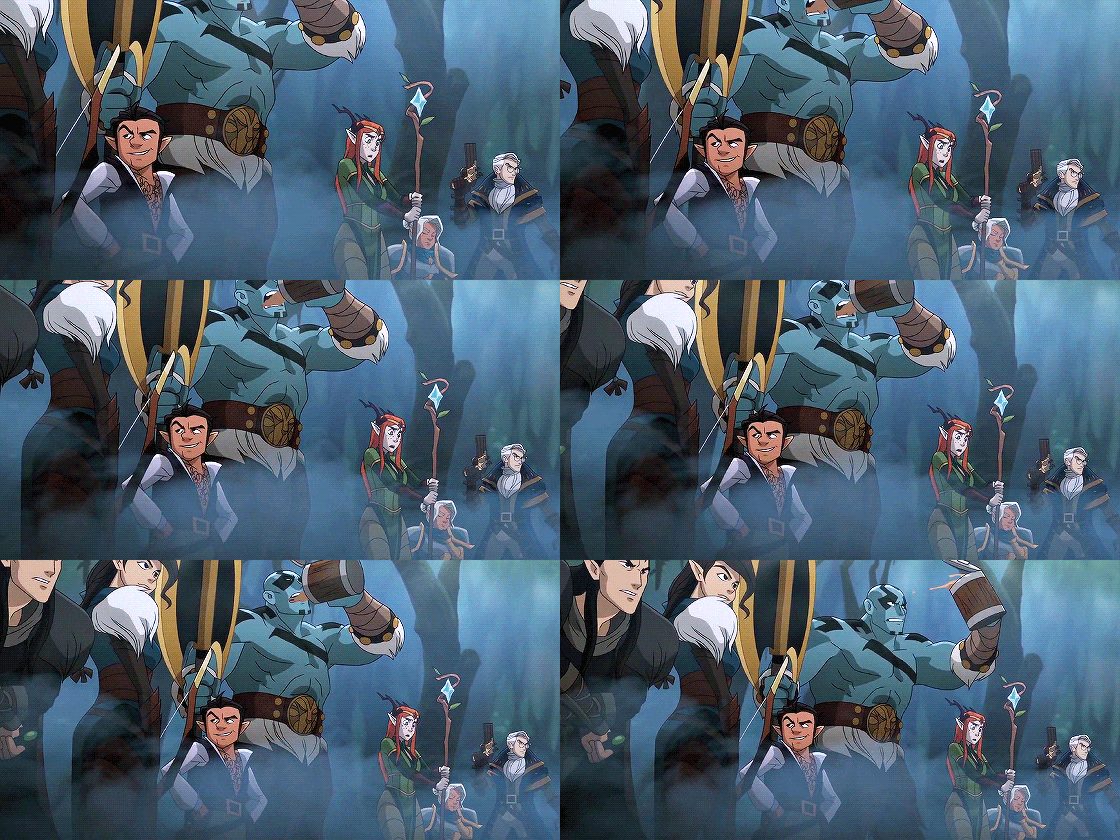
It was at this point Amazon stepped in. There seems to be a sort of arms race between Amazon and Netflix in the animation for grownups market. Amazon had a breakthrough with Invincible but Netflix went one better with Arcane, a huge critical and "cult" hit. Amazon is now enjoying similar success with The Legend of Vox Machina. In addition to buying the ten episodes funded by the 'Kickstarter' appeal, Amazon commissioned two new episodes to round out the first season and a complete second season of twelve episodes, fourteen in all.
The lesson for all those struggling for their big break in the entertainment industry is that it will come only when you are already successful.
It is worthy of that success? Well, it is to be said that for a cartoon based on a webcast of a gang of actors playing a 1970s RPG for hours on end, it is a lot better than it sounds. The key to this is its sense of humour and, perhaps more importantly, getting the balance right between the humour and a healthy respect for the conventions of the high fantasy genre. It is a proper dramatic story, with characters about whom we care in real jeopardy.
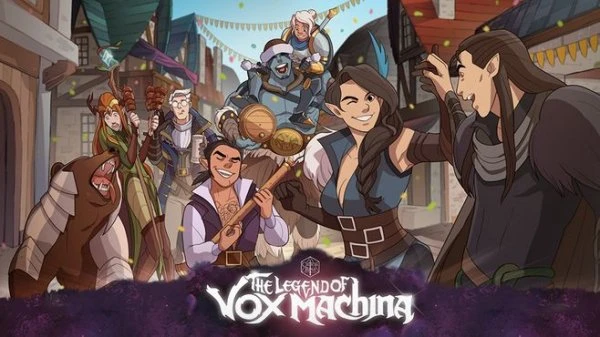
In the opening seconds we are introduced to a Fellowship of stock noble fantasy characters whose subsequent fate sets the tone for the whole season. Amusing lines have greater impact when the situation is serious. This is what Joss Whedon understood in Buffy the Vampire Slayer and Angel. He also understood that, even more than story, the appeal of any production, whether dramatic or comedic or both, comes down to the appeal of the characters, and this is the great strength of The Legend of Vox Machina.
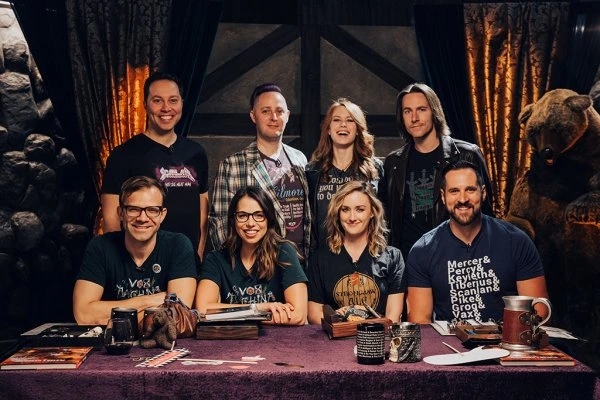
The original cast of the webcast reprise their roles in the game. This would normally be a recipe for disaster, and, in buying the rights, Amazon would normally have insisted on replacing them with more familiar names. In this case, however, they are all seasoned professionals who know what they are doing and they are thoroughly familiar with their roles, far more so than any celebrity guest voices could be. It is obvious from even a brief glance at the webcasts that they put a lot of thought into the development and backstories of the characters, and grew with them through hundreds of hours of gameplay, so that they knew instantly how they would react in any situation.
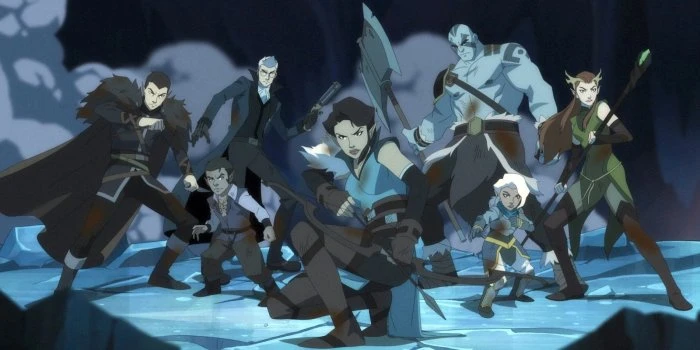
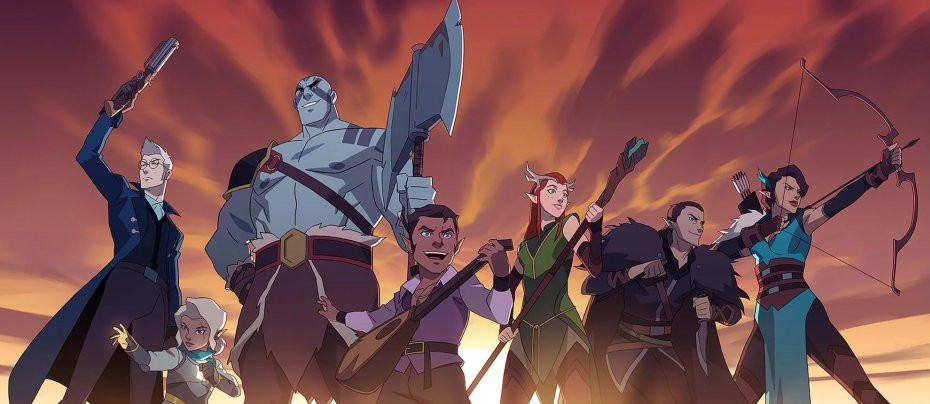
As a result this two dimensional animation has more three dimensional characters than most live action fantasy and science fiction drama. Our heroes are a financially unsuccessful band of mercenaries, very much the B-Team of heroic Fellowships. Percy (Taliesin Jaffe) is an aristocratic gunslinger whose desire for revenge is literally eating his soul. Keyleth (Marisha Ray) is a slightly ditzy druid with low self-confidence who ran away from her responsibilities but is now forced to master what seemed too much for her before. Scanlan (Sam Riegel), a gnome, is a promiscuous bard with an odd set of minor powers. Pike (Ashley Johnson), also a gnome, is a kindly cleric who, like all religious people on television, has a crisis of faith. Vax and Vex (Liam O'Brien and Laura Bailey), half-elves, are a highly competitive twin brother and sister, whose common front of bravado hides differing vulnerabilities. Vex has a pet bear called Trinket, who is criminally underused. Grog (Travis Wllingham) is a hulking brute, apparently a "Goliath Barbarian," not overly blessed in the intellect department, who proclaims he has only two interests in life - ale, women, and combat - which sums him up fairly accurately. Matthew Mercer, the "Dungeon Master" of the 'Critical Role' game, voices a number of supporting characters in accordance with "Dungeon Master" tradition.
Since The Legend of Vox Machina is an ongoing series, this is technically a spoiler light overview of the first season rather than a full review, but the plot really does not matter that much. Suffice it to say that there are dragons and vampires and zombies. The real story is the growth of our protagonists and the relationships between them.
The 'Critical Role' team are joined by a number of more familiar guest voices, including Gina Torres, David Tennant, Stephanie Beatriz, Dominic Monaghan, Stephen Root, Kelly Hu, Tracie Thoms, Indira Varma, Esme Creed-Miles, and a perfectly cast Rory McCann.
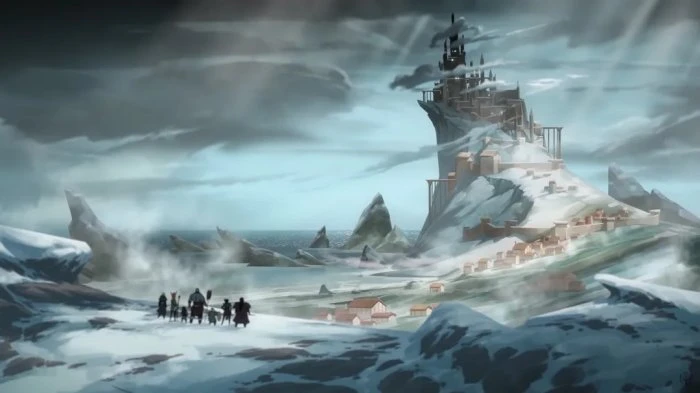
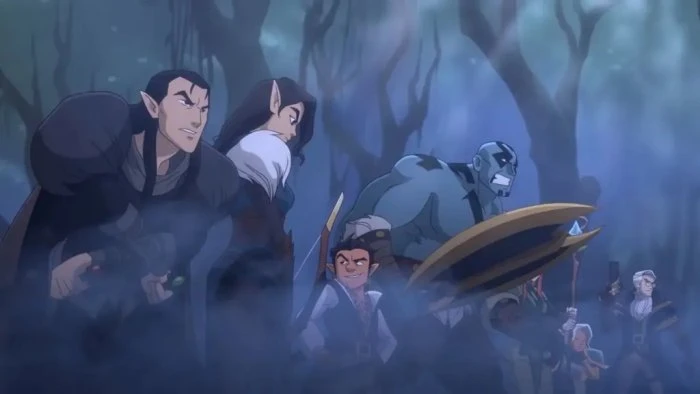
The animation references the cheap and cheerful 'anime' style. Some of the movement sequences may remind older viewers of the cartoon segments of The Banana Splits show. However, even more than in Invincible, the animators include enough beautifully drawn panels, especially landscapes and cityscapes, to remind us that they are being ironic and that they are quite capable of being sophisticated when they want. The cruder sections are themselves marked with a great deal of inventiveness and wit, not least in a childlike planning sequence. One can see a lot of film and television influences, especially the Living Dead films and Game of Thrones. There is good use of colour and light.
One suspects that the high viewer appreciation scores on IMDb and 'Rotten Tomatoes' may have been inflated a little by having a million fans so dedicated that they will watch three hour webcasts of someone else playing a game, including 80,000 who will put their own money into a 'Kickstarter' appeal. Nevertheless, The Legend of Vox Machina is a superior product with a great sense of fun - subject to the reservation that the four letter words, scatological humour, fairly explicit sex, and graphic violence, including the deaths of children, animals, and sympathetic characters - will not be to all tastes. While it is difficult to see how long the animation format can be sustained, and it is unlikely to run to 115 episodes, it has certainly earned its second season.
Season Two review
Just as Season Two of The Legend of Vox Machina assumes familiarity with the characters introduced in Season One and what happened to them, this overview assumes the same, or at the very least that the reader has glanced at our overview of that season. Otherwise it is spoiler light in that it does not reveal major plot points but it does discuss structure and themes.
At the time of writing, quite a number of recent shows have had promising first seasons only to disappoint on their return. It is not that their second seasons are necessarily bad. It is simply that, by definition, an original idea loses its originality when it is repeated. So most shows fall into one of two traps: they either give us a second season that looks uncannily similar to the first or they try to be different for the sake of being different, and in the process lose whatever it was that made the show special in the first place.
In fairness this is a well-established phenomenon, and it applies to all cultural endeavours, not just television. The difficult "second novel" or "second album" has become proverbial. In the case of television this problem is exacerbated by the fact that, not always by choice, writers and producers usually have a long time to get things right before finally getting a commission, but if a show is a commercial success and gets renewed, the network or streaming service will want to follow it up as quickly as possible. The time between getting confirmation of renewal and start of production may only be a matter of weeks.
On top of this, the need to get that commission in the first place, and then attract the audience to get that renewal, may well tempt the producers and writers to "front end load" the first episodes with all their best ideas. With very rare exceptions, a show that does not make a strong impact on its launch will disappear without trace very quickly, so there is little point holding back and building slowly. Networks have always been ruthless about cancellation and streaming services are getting more so.
In this respect, "Critical Role," the amiable gang of professional voice actors behind The Legend of Vox Machina started out with two unusual advantages that served them well.
Their first advantage is that the project is based on videos of Critical Role acting out three long "campaigns" of the fantasy role playing game Dungeons & Dragons - not on the game itself, which has its own franchise, just on them playing it. This gives them literally hundreds of hours of potential source material.
Their second advantage is the extraordinary success of their 'Kickstarter' fundraising campaign that gave them enough money to finance most of the first season on their own. This put them in the rare position of being able to make more or less the show they wanted to make, which in turn gave them a level of self confidence which is usually inaccessible to professionals unless they are already high profile and "bankable" (Critical Role being already too experienced to be vulnerable to the self confidence of cocky amateurs that is based on ignorance and usually ends abruptly when confronted with reality).
Success jumping on success, as is often the case, Amazon were so impressed that they bought the show and agreed in advance to fund a second season. This gave Critical Role the precious gift of knowing they had time to tell their story.
They used it wisely. The first season ended on a "cliffhanger" introducing the second, and the ending of the second seems to take it for granted that there will be a continuation. After all, even if Amazon did not renew, which seemed unlikely given the very positive response from critics and audiences alike, Critical Role could probably raise enough money from fans to complete the story independently. In the event, it was no great surprise that Amazon greenlit Season Three before Season Two was even shown.
The first two seasons - and presumably any subsequent seasons - were therefore structured as a single whole. It is a structure that will be familiar to "gamers," especially those familiar with "role playing games" (RPGs). Season One started with an introduction and then a preliminary quest before settling in to the main quest that took up most of the rest of the season. The ending of the season set up a completely new main quest for Season Two.
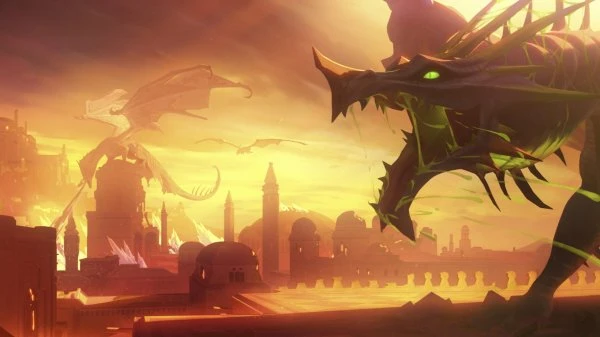
The first episode of the new season expands on this, showing the power of the new antagonists, a formidable flight of dragons called the Chroma Conclave. Our heroes' ultimate objective is to defeat them, but that is not what Season Two is about. The dragons are simply too strong. Our heroes must therefore get stronger if they are to stand any chance at all. So, following classic RPG structure, the protagonists must set aside the main quest temporarily in order to undertake a series of "side quests" to acquire a set of artefacts, called "vestiges" here, that will increase their own powers.
One of the good things about gaming is that it acknowledges that characters grow and develop. The notion that there can be a cumulative effect is therefore central to the plot in The Legend of Vox Machina, which is always looking back to what has gone before. Television drama in general, much of which still seems to be influenced more by its episodic origins than by the relatively recent increase in the importance of story and character arcs, could learn a lot from this.
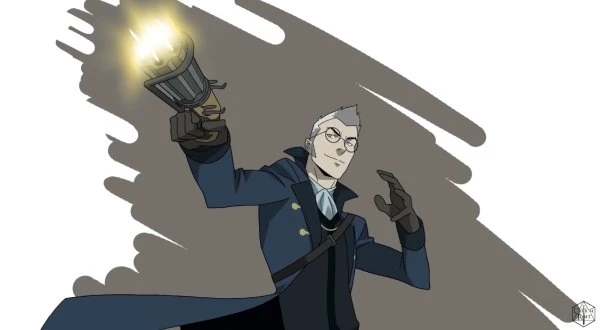
So, even if some of the plotting of Season Two can seem like "busy work," the real purpose of the season is to show how the characters are changing and how they are influenced by the past, both by events in Season One and by what happened before they got together as Vox Machina. Percy (Taliesin Jaffe) the gentleman gunslinger's origin story was revealed in Season One and was central to the main plotline. In Season Two we get to find out more about the earlier years of half-elves Vax (Liam O'Brien) and Vex (Laura Bailey), their pet bear Trinket (Matthew Mercer), druid with low self esteem Keyleth (Marisha Ray), gnome cleric Pike (Ashley Johnson), and the hulking Grog (Travis Willingham), previously described as a "Goliath barbarian, now a "half giant" for some reason. We also get to meet other members of all their families. To be honest, none of these subplots is really essential to the main story, but we have by now invested enough in these people to want to know more about them, so it is time well spent.
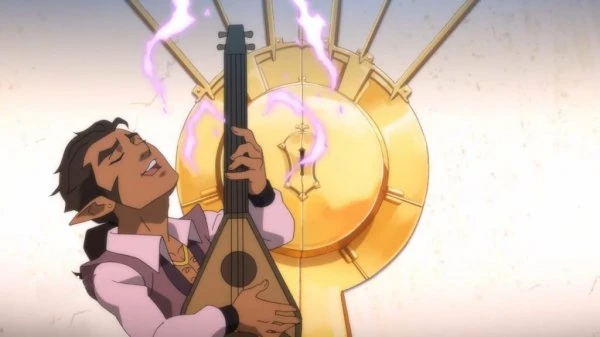
Only Scanlan the bard (Sam Riegel) remains something of a mystery, despite being apparently the most superficial of our band of mercenaries. We do find out a bit about his past, but not how he became what he is. He also seems to be evolving a bit, even if he has some way to go. His unrequited love for Pike becomes more obvious this season. The apparent impossibility of seedy Scanlan ever getting together with pious Pike is both comic and tragic.
Other members of Vox Machina also change. Vax becomes more serious and Vex becomes more humorous. It is once again a pity that a convenient device is found to keep Trinket out of the action for much of the season, but having a bear almost literally up their sleeve would make a lot of the fights too one sided.
Eventually the characters who have gone their separate ways on side quests for a while link up again to resume the main quest together, there is an impressive big fight, and a final twist is well executed, resetting the board completely for Season Three and increasing the stakes.
As in the first season, there is some variation in the quality of the animation. A lot of the casual movement scenes are pretty basic but there is a lot of artistry in many of the backgrounds and in the character design. The dragons are great, but then dragons always are. Whoever is responsible for Keyleth's ever changing facial expressions deserves a special mention. The palate is commendably colourful.
If one wants to be picky, some of the action sequences go on too long and one can lose track of them. Fast cutting can generate a sense of excitement in small doses but can get boring very quickly when prolonged.
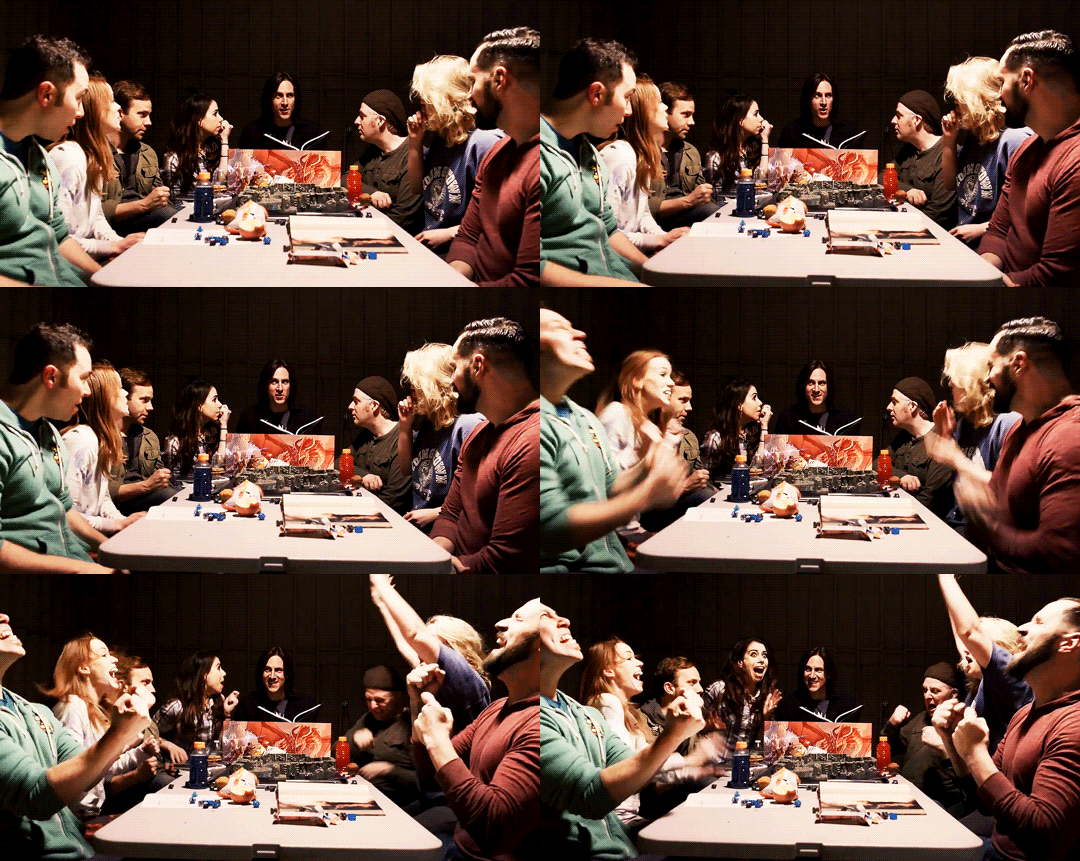
Critical Role know their business. All inhabit their characters with comfortable ease. Yet as professionals they also know the value of a strong guest cast. Gina Torres, Kelly Hu, Indira Varma, Stephanie Beatriz, and Esme Creed-Miles all return as the characters they played in Season One. They are joined by, among others Henry Winkler, Lance Reddick, Ralph Ineson, Fred Tatasciore, Tony Plana, and, following in the footsteps of his fellow Hobbit Dominic Monaghan in the previous season, Billy Boyd. Winkler, Reddick, Ineson, and Plana are particularly good.
The net result of all this is a show that really knows what it is doing. Critical Role have taken the trouble to learn exactly what their fans expect and they deliver. There is no laboured attempt at subversion. It is perhaps significant that, while the second season of Amazon's other big animation success, Invincible, is unlikely to drop before the second half of 2023, over two years after its first, Season Two of The Legend of Vox Machina dropped almost exactly a year after Season One. This suggests that Critical Role spent a lot of time thinking what they might do if Vox Machina broke through and were totally ready to go when it happened. In spite of this, the whole project still seems fresh and good natured, and one cannot help but look forward to Season Three and, hopefully, beyond.
Seen this show? How do you rate it?
Seen this show? How do you rate it?
Share on...
Published on February 23rd, 2022. Written by John Winterson Richards for Television Heaven.