
The Claws of Axos

The Claws of Axos is another distinctive story from Doctor Who's eighth season, a serial that perfectly captures the colourful, slightly surreal style of the early Jon Pertwee era while also delivering a genuinely effective alien invasion story. Written by Bob Baker and Dave Martin, it combines science fiction spectacle, political intrigue, horror, and the ongoing presence of the Master into a fast-moving adventure that remains, alongside The Daemons, as one of the highlights of Season 8.
The story begins with the arrival of a mysterious alien craft on Earth. The visitors, known as the Axons, appear to be benevolent beings in desperate need of fuel. In exchange for assistance, they offer humanity a miraculous substance called Axonite. According to the Axons, Axonite is a "thinking" molecule capable of replicating any substance and multiplying matter almost without limit. The implications are staggering: world hunger could be eradicated, resources could be produced endlessly, and humanity could enter a new golden age.
Naturally, the Doctor is suspicious.
His instincts prove correct when the truth behind the Axons is revealed. The beautiful golden humanoids are merely disguises worn by a vast parasitic organism called Axos. The ship, the Axons, the monstrous creatures lurking within, and the Axonite itself are all parts of the same living entity. Axos' real purpose is not to help humanity but to feed upon it, draining energy from every living thing on Earth. The promise of Axonite's benefits is simply a means of ensuring its distribution across the globe, allowing Axos to consume the planet on an unimaginable scale.
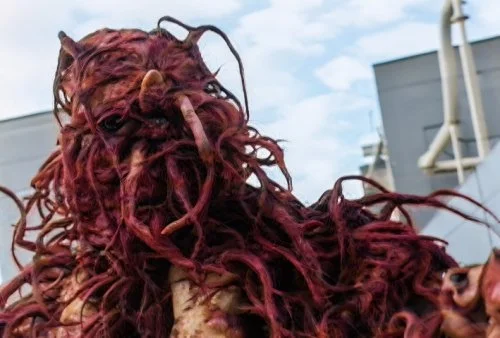
It's a wonderfully deceptive premise. The invasion is not conducted through military force but through generosity. Humanity is threatened not by an obvious enemy but by a gift that seems too good to refuse. This "invasion by stealth" approach gives the story a premise that helps it stand out among many other alien invasion narratives.
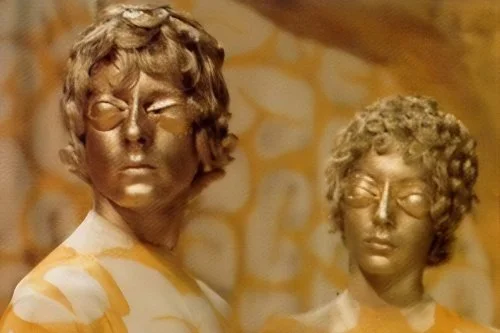
At the heart of the serial’s appeal lies the unforgettable, otherworldly beauty of the Axons. Their initial appearance is unforgettable. They are tall, statuesque beings with smooth, almost featureless faces, glowing golden skin, and large luminous eyes. Their movements are slow and graceful, giving them an unnerving elegance. They resemble living sculptures or mannequins, radiating an almost angelic beauty designed to inspire trust.
That visual beauty makes the revelation of their true nature even more effective. Once the façade drops, the audience sees the grotesque biological reality beneath. Axos is revealed as a sprawling mass of pulsing organic matter, twisted forms, and root-like tendrils. The contrast between the attractive exterior and the hideous truth reinforces one of the serial's central themes: appearances can be dangerously deceptive.
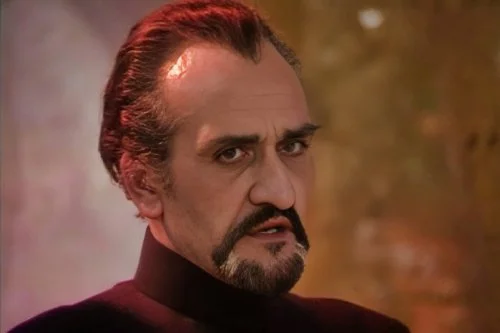
The theme of deception extends beyond the monsters themselves. Season 8 is structured around the recurring presence of the Master, and The Claws of Axos uses him extremely well. Captured by Axos and forced to bargain for his survival using his knowledge of Earth, the Master eventually escapes and seeks refuge in the Doctor's TARDIS after his own has been seized.
As always, the uneasy relationship between the Doctor and the Master provides much of the story's entertainment. Roger Delgado's Master is charming, manipulative, and endlessly resourceful. His scenes with Jon Pertwee crackle with energy, and their temporary alliances remain some of the most enjoyable aspects of the entire season. In many ways, the Axons' strategy mirrors the Master's own methods: both rely on presenting a friendly face while concealing far darker intentions.
The story reaches its strongest point once Axos becomes interested in the Doctor's knowledge of time travel. Having discovered a new opportunity to expand its feeding grounds, Axos decides it will no longer be satisfied with consuming energy across space alone. It wants access to time itself.
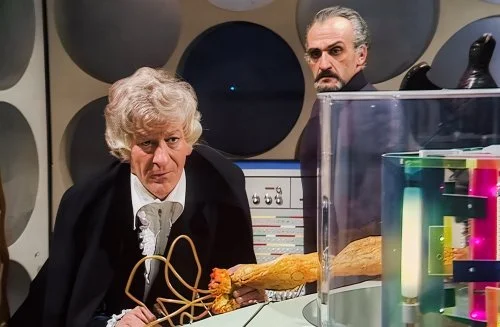
Realising that Axos must be stopped before it gains mastery over time travel, the Doctor tricks the creature into linking its drive systems with the TARDIS. After manipulating the Master into completing essential repairs to the ship, the Doctor sets a trap that sends Axos into an endless time loop. The result is a memorable climax in which every part of Axos, including the Axonite and the Axon automatons, dematerialises from Earth and disappears into perpetual temporal imprisonment.
With the Master escaping during the confusion in his own TARDIS, the Doctor discovers that the Time Lords have once again interfered with his freedom. Despite his intentions, his TARDIS automatically returns him to Earth, prompting the wonderfully frustrated observation that he has become "some kind of a galactic yo-yo!"
Behind the scenes, The Claws of Axos had an interesting development process. In late 1969, script editor Terrance Dicks approached writing duo Bob Baker and Dave Martin after reading a script they had offered elsewhere within the BBC. Initially submitting a story for the Second Doctor, they produced concepts that eventually evolved into this serial.
The earliest versions were significantly more ambitious. The original storyline featured evil aliens arriving in Hyde Park in a skull-shaped spacecraft, large-scale space battles, and even a giant carrot crashing into the park. Battersea Power Station was intended to play a major role, and the action ranged across famous London landmarks. While the production team loved the imagination on display, budgetary realities quickly forced a rethink. Baker and Martin scaled the story down, relocating much of the action to a power complex outside London and removing many of the large-scale action sequences.
Several titles were considered during development, including Doctor Who and the Gift, The Friendly Invasion, and The Axons. Perhaps most intriguingly, the story spent much of its early production life under the title The Vampire from Space. The name survived through production of the first two episodes and was only changed before filming began on episode three. Fans can still see traces of this abandoned title in surviving production materials and DVD extras.
The production also encountered a rather unusual problem during location filming. Scenes involving a tramp were shot across multiple days, but an unexpected overnight snowfall created obvious continuity issues. Rather than ignoring the problem, the production cleverly incorporated a line of dialogue explaining the rapidly changing weather as "freak weather conditions" caused by Axos' arrival.
The Claws of Axos marks the first time viewers see substantial interior TARDIS scenes during the Pertwee era. The TARDIS configuration is unlike any other version seen before. The monitor appears as a circular screen embedded within one of the wall roundels rather than the familiar rectangular display. Even more unusually, the console room doors open into a corridor decorated with roundels instead of leading directly outside. Both features disappeared when the TARDIS interior returned in the following serial, Colony in Space.
More than fifty years later, The Claws of Axos remains a remarkably inventive piece of Doctor Who. It combines effective science fiction ideas with memorable monster design, strong performances, clever plotting, and some excellent location work. It is a story that perfectly showcases the strengths of the Pertwee era and stands as one of Season 8's most imaginative and entertaining adventures.
Share on...
Published on June 24th, 2026. Written by Laurence Marcus for Television Heaven.