
Bravo Two Zero
1999 United KingdomReview: John Winterson Richards
Corunna, the Charge of the Light Brigade, the Anglo-Zulu War, Khartoum, Mons, Dunkirk, Arnhem, the British have always been adept at spinning military disasters, due as often as not to extreme British incompetence, into tales of courage and resilience in adversity, and, if the worst comes to the worst, no one does heroic Last Stands as well as stiff upper lipped Britons.
We celebrate military failure in paintings and poems, in books and films, and, even now in this cynical time, on television. The two part BBC television miniseries based on Andy McNab's memoir Bravo Two Zero is a perfect example of this well-established tradition, and as such also something of a cheerful anachronism when revisionist anti-war drama is more the fashion.
In strict fairness, the overall operation of which the real Bravo Two Zero patrol was part was a great success. During the First Gulf War, the Special Air Service took on the difficult task of locating mobile Scud missile launchers deep in Iraq and calling air strikes in on them. The Iraqis hoped that these missiles would provoke Israel into retaliation and thus split the Coalition being assembled against Iraq following the invasion of Kuwait. It is in large part due to the efforts of the SAS that this never happened. Yet it is typical of how military history works that it is the only patrol that failed in its mission, the one given the temporary operational radio call sign "Bravo Two Zero," that has become the stuff of legends.
The events remain a matter of extreme controversy. No less than three of the five survivors have published their own accounts, the first being the patrol commander, Sergeant Steven Mitchell writing under the pseudonym "Andy McNab." Their respected RSM at the time added his own conclusions in his memoirs, and the closest thing to an official version is a long digression in Storm Command, General Sir Peter de la Billiere's commentary on the Gulf War, in which he served as Commander-in-Chief of the British Forces involved. Sir Peter had previously been Director SAS at the time of the Iranian Embassy Siege, and retained a great interest, and pride, in the contribution of his old Regiment to Operation "Desert Storm."
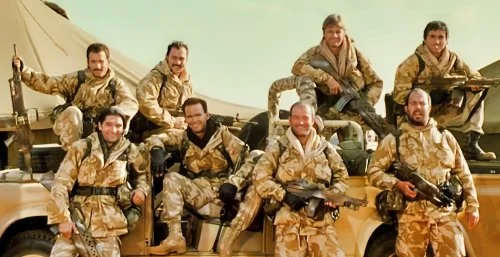
Your reviewer is in no position to judge between these controversies, and in any case would not dream of offending any of these gentlemen who, even in old age, are probably still quite capable of killing with their bare hands. Suffice it to say that it should always be borne in mind that the BBC dramatisation is very much McNab's version of events. That said, the script, written by the great Troy Kennedy Martin (Edge of Darkness), often departs from the book, especially when it tries to soften McNab's very hard edges. For example, when the patrol is discovered by an Arab shepherd boy, the fictional McNab gives a voice over explanation of why they did not simply shoot him which ends on a sentimental note, but the book makes it brutally clear that the boy did well to run away.
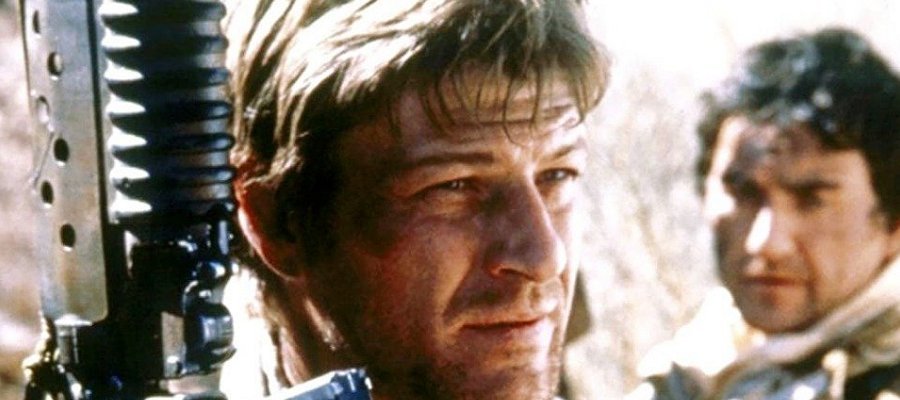
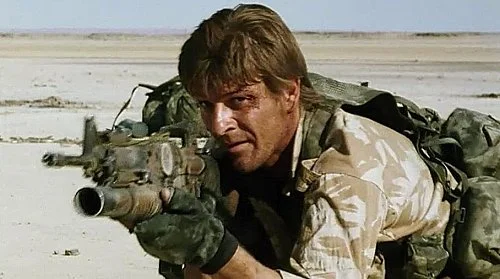
That our sympathies remain with McNab in Bravo Two Zero is ensured by the casting of Sean Bean to play him. Best known at this point for his extended run in Sharpe, Bean had already proved a that he could portray both leadership and working class hero in the same character. He had also subverted his own image to a certain extent with his comedy relief role as the SAS-obsessed fantasist Spence in the classic feature film Ronin the year before. The Sean Bean character in Bravo Two Zero is therefore exactly who the Sean Bean character in Ronin dreams of being. One wonders if that was a factor in Bean accepting the role in Bravo Two Zero, to prove, or rather to remind everyone, that he could still play the real thing as well as the parody. A more tangible factor was that the director, Tom Clegg, had worked with Bean on Sharpe. This was all, of course, before Bean became something of an internet meme for his characters always getting killed off in his projects - statistically this is not true, but some of his screen deaths are just so memorable that he is never going to shake it off. It is no spoiler to say that he does not die this time since Mitchell/McNab obviously survived to write his book, and also act as military adviser to the production. As such, he apparently got on very well with Bean.
Although McNab was the first patrol member to publish his account, he was beaten to adaptation by Colin Armstrong, writing under the pseudonym "Chris Ryan," whose The One That Got Away was published after Bravo Two Zero but was made into television film by LWT for ITV in 1996, three years before the BBC miniseries, starring Paul McGann as Ryan and David Morrissey as McNab (in a neat, slightly ironic parallel, McGann was originally the first choice to play Richard Sharpe before he was replaced by Bean after an injury). In his book Ryan was very critical of the patrol's leadership, specifically of McNab himself and of his second-in-command, who died of hypothermia during the mission. By contrast, the television Bravo Two Zero handles Ryan more diplomatically, portraying him merely as a chippy outsider. Again, your reviewer is in no position to say how fair this is: his criticism of his colleagues, especially one who lost his life in the line of duty, probably earned Ryan no friends, but he has since gone on to become a very prolific and financially successful author.
It also has to be said that at least some of McNab's decisions really were questionable, and Bravo Two Zero deserves credit for showing him doubting himself. With hindsight it was certainly absurd to expect even superfit SAS operatives to carry average loads of 210 pounds on foot over long distances, even if British infantry seem to be habitually overloaded these days.
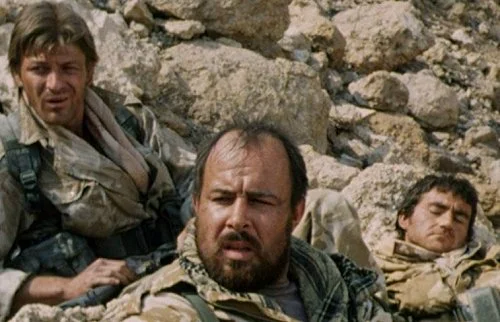
The production leans heavily into the narratives that the SAS is, more than most, a Regiment run by its NCOs, and that the rank and file consists largely of high IQ soccer hooligans. Again, your reviewer is no position to comment, except to say it does not accord with his own experience of past SAS operatives, who are usually characterised by an air of calm, understated competence. The supporting cast look and play the parts as written in the script, even if one wonders if some of them would meet the extreme standards of fitness demanded by the SAS. Overall, one cannot help feeling that the production made the SAS look far more amateurish than they really are. This may be the real reason McNab was banned from the SAS Mess after writing his book. The ostensible reason was that it publicised allegedly secret procedures, but in reality, it contained nothing that the many real life Spences did not know already.
The drama in Bravo Two Zero breaks down neatly into three acts: the standard mission preparation; the patrol's insertion, almost immediate compromise, flight, accidental division, and eventual capture; and harrowing extended interrogation scenes. The last is the best, with Bean committing totally and demonstrating that he is a first class actor, not just an action star. There is no pretence at heroics here: although it is convenient for some to claim torture never works, Special Forces resistance training is based on the assumption that it always does and even the strongest will eventually break in time. The function of the training, as Bravo Two Zero shows vividly, is only to prolong that time in order to maintain operational integrity.
The preparation scenes are solid, giving us literal snapshots of the various characters, even if there is no time to develop any of them very much. It is therefore surprising that it is the middle act, the action packed one, that is the weakest link. This is largely because the real life events were more a comedy of errors than the stuff of high drama. There is a great battle sequence in which the eight man patrol gives a fine illustration of section fire and manoeuvre tactics, but this is rather undermined by the knowledge that it is an exaggeration of what really happened. The BBC production budget was evidently not huge, but Sharpe veteran Clegg does well to hide that by keeping things moving fast. There is a good in joke about music, reflecting the fact that whether one finds the contemporary songs nostalgic or annoying is a matter of personal taste.
Seen this show? How do you rate it?
Seen this show? How do you rate it?
Share on...
Published on April 6th, 2026. Written by John Winterson Richards for Television Heaven.