

Star Trek: Picard
2020 - 2023 United StatesSeason One Review: Daniel Tessier (reviewed in 2020)
Star Trek: The Next Generation is one of the most popular and successful series in the entire Star Trek franchise. It revitalised the concept for television in the 1980s and led to its own spin-off films and series. Now, with Trek having found new success on the small screen thanks to Star Trek: Discovery, CBS have expanded the franchise again in all sorts of directions, and it's no surprise that the production team decided to look back to The Next Generation for inspiration, in particular one of its most beloved and enduring characters.
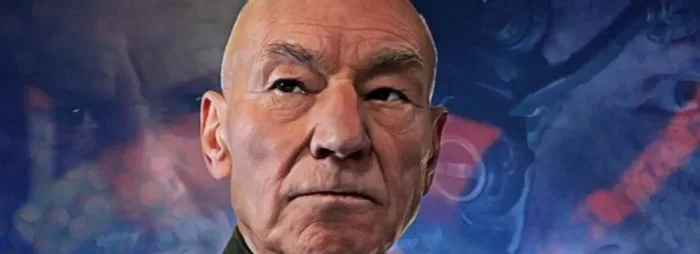
Patrick Stewart was initially reluctant to return to the role of Jean-Luc Picard. He'd last played the captain of the USS Enterprise on the feature film Star Trek Nemesis back in 2002. His career had moved on since then, and many would say, so had the franchise. However, when he met with Michael Chabon, the showrunner, to explain his refusal to take on the role, they spoke at length about their respective thoughts of where Picard would be after so much time, and Chabon was able to convince Stewart to take the role. Key to this was that the actor would be heavily involved in the plotting of the series and the conception of his character. They would be joined by new Trek supremo Alex Kurtzman, who had previously worked heavily on the 2009 film Star Trek and its sequel Star Trek Into Darkness as well as co-creating Discovery, and writer Kirsten Beyer and writer-director-producer Akiva Goldsman.
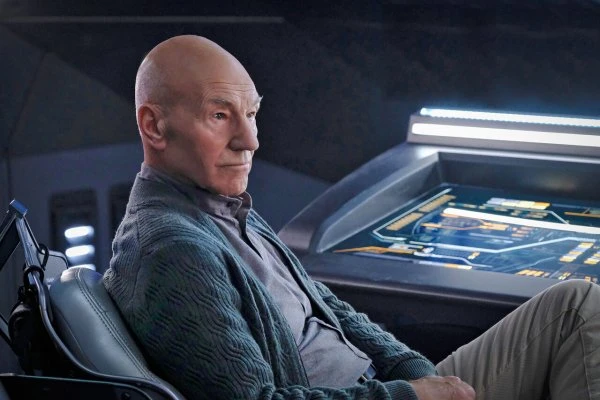
Star Trek: Picard is a highly serialised story, more in the mode of the highly bingeable online series, with the franchise adapting to a more modern mode of television storytelling. Tellingly, Picard is the first Trek series since The Next Generation not to be named after the main ship or space station of its setting. There are starships aplenty, of course, but this is a series about characters, and Picard's character is central. However, previous events in the Trek universe weigh heavily on the series. The first season is set in 2399, twenty years after Star Trek Nemesis and 29 years since the end of The Next Generation. The planet Romulus was destroyed by supernova fourteen years previously, as referred to in the 2009 movie.
The essentials of the series are easy enough to grasp, although the viewer is expected to have at least some knowledge of Star Trek. Picard's fallen out with Starfleet due to their mishandling of a refugee crisis, something with clear parallels to the controversial handling of (largely Syrian) refugees moving across Europe, and the increasingly xenophobic border controls of the United States. The Romulans, one of the most recognisable races in Trek, are now without a home world and the power gap in the region has led to turmoil. The Federation is also reeling from a terrorist attack by androids, which directly led to them dropping the refugees at the side of the road and has led to a hatred and mistrust of artificial beings. Oh, and the Romulans have gotten their hands on a knackered Borg Cube, which poses considerable risks for everyone.
That's already a lot of backstory to be catching up on for a more casual viewer, but the series focus on character sketches it in with a lightness of touch. Each episode begins with a flashback lending context to the events and their effect on the characters. A working knowledge of the Trek universe would certainly make for a richer experience, but it's certainly possible to come to the series fresh, and many of the ideas are tried-and-tested sci-fi tropes.
Stewart's performance as Picard (now 94 years old – the character is fourteen years older than the actor) is the cornerstone of the series, and he is absolutely exceptional. Stewart portrays Picard – retired from the admiralty – as a man with deep convictions but who hides a bitterness at Starfleet for what he feels was a betrayal. While still powerful, intelligent and energetic, he's an old man now and isn't without frailty. In a notable element of continuity, he is suffering from a degenerative neurological condition, something that was foreseen by the TNG finale, “All Good Things,” and this is beginning to affect his capacity. He is, though, as resolutely kind and compassionate as he ever was, and has rather mellowed in his old age (who'd have expected to see him become such a hugger?)

Into his life falls Dahj Asha, a young woman who has just discovered she is an android – or synth as the late-24th century parlance would have it. She has seemingly been created as the “daughter” of Data, Picard's second officer on the Enterprise, who lost his life in Nemesis. Data's loss is profoundly felt throughout the series, with Picard dreaming of his former friend. Brent Spiner returns to the role of Data as though he'd never been away, appearing several times in some unexpected ways throughout the season. Picard is unable to save Dahj from Romulan assassins, but his investigations lead him to discover that she has a twin sister, Soji.
Both Soji and Dahj are played by Isa Briones, primarily a musical theatre actor prior to this (she sings the closing song on the season, Irving Berlin's “Blue Skies,” a song beloved by Data). To begin with, her portrayal of Dahj is rather more dynamic than that of Soji, who is working as a scientist on the Artefact – the abandoned Borg Cube – with no idea that she's not human. However, as Soji learns more about herself, including the fact that she's only three years old, her world falls into turmoil and Briones gets to really impress with a heartfelt performance.
Picard goes on a quest to find and protect Soji from the Romulan secret intelligence service, not easy given she's on an extremely dangerous artefact run by Romulans, and that he now has next to zero influence in Starfleet. He recruits his former friend Raffi Musiker, a new character who became Picard's right hand while he was admiral. Played by Michelle Hurd, Raffi is one of the most interesting and three-dimensional characters in the series. Having been forced out of Starfleet due to her association with Picard, she's become a recluse and a substance abuser, an unusual level of harsh realism for a human character in Trek. Raffi's relationship with Picard is tenuous but she is unable to let go of the cause; she's become a paranoid conspiracy theorist in her years alone but just so happens to be absolutely right.
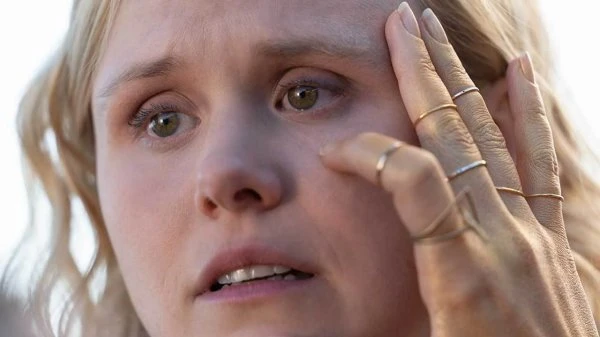
Alison Pill plays Dr. Agnes Jurati, a cyberneticist who works for the Daystrom Institute (an oft-mentioned but previously unseen research organisation in the Federation). With links to Bruce Maddox (a character who made a vital appearance in the TNG episode “The Measure of a Man” arguing against Data's rights as a person), she was involved in the early work which led to the creation of the synths. She's new to star travel and both her enthusiasm and fear are wonderfully real.

Santiago Cabrera brings a lot of charm and sex appeal as Cristobal Rios, another Starfleet drop-out with a difficult backstory. Rios is the captain of the starship La Sirena, an old but fast and sophisticated freighter (hints of the Millennium Falcon there), and technically the man Picard has to answer to as he is chartering the ship. In an ingenious move, Cabrera also plays the entire holographic crew of La Sirena. Star Trek: Voyager introduced the Emergency Medical Hologram, and twenty-odd years later, such things are ubiquitous that La Sirena comes with a whole suite of holograms. It's a sort of Microsoft Office for the 24th century. Cabrera plays holograms for medical, engineering, hospitality, navigation and tactical, each with his own personality, accent and hairstyle. The six characters give Cabrera an amazing opportunity to show off his range, and he's an absolute highlight of the series.
Picard also picks up Elnor (Evan Evagora, a new face) a young Romulan refugee who was raised by ninja space nuns (really) on the planet Vashti, where Picard visited during his time trying to organise relief and evacuation. As Picard's bodyguard, Elnor's pretty one-note but he adds some youthful excitement to the series. There are a lot of Romulan characters in the series, notably Picard's housekeepers Zhaban and Laris, who liven up the earlier episodes. Played respectively by Jamie McShane and Orla Brady, they're former Romulan intelligence agents, which is rather handy. On the opposite side, working on the Artefact, are Narek and his shifty sister Narissa. Harry Treadaway plays Narek, a sneaky charmer who manipulates Soji, using her and pushing her to discover her true nature. Narissa, played by Peyton list is a pretty two-dimensional space assassin, and she gets irritating pretty quickly. There's also Admiral Oh, the head of Starfleet intelligence, played by Tamlyn Tomita, who is a supposedly Vulcan officer, but up to no good behind the scenes.
The season sees Picard on the trail of Soji, heading to the Artefact via various stops across the galaxy, alternating with scenes involving Soji on the Artefact, until Picard is able to rescue Soji and accompany her on her journey to discover her origins. The ten-episode season is paced unevenly. It spends the first three episodes largely on set-up, although there's still plenty of action, before moving faster on its galaxy-spanning journey. The slower pace is actually very refreshing and allows far more focus on character development than would otherwise be possible, but it has its drawbacks. By about the seventh episode, the more leisurely stopovers have left the remaining episodes with a lot of heavy lifting to do, and far too much action and information have to be covered in the two-part finale. On the whole, though, the season is well-plotted, with the episodes “ Stardust City Rag” and “Nepenthe” being highlights, each one stopping on a new planet and introducing favourite characters.
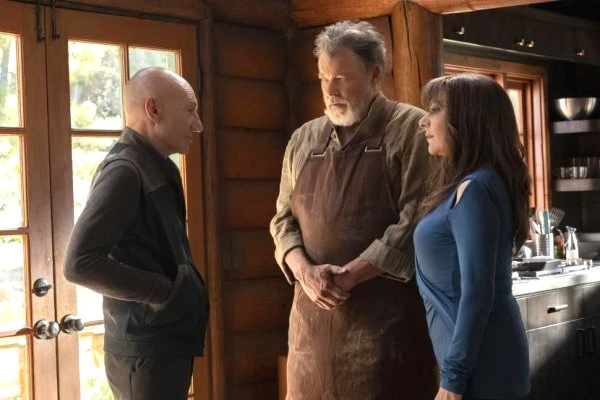
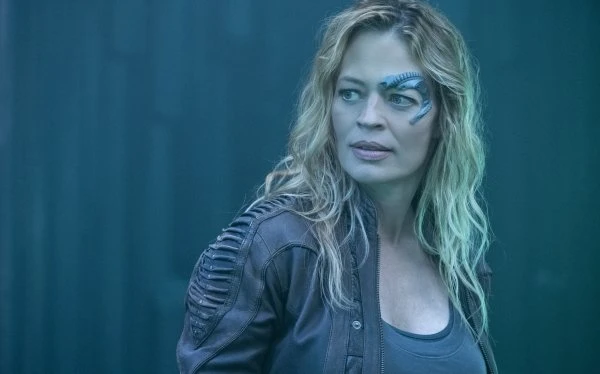
Classic characters returning to the franchise is an obvious draw for Trek fans. Jonathan Frakes (who also directs several episodes) and Marina Sertis return as William Riker (now Admiral) and Deanna Troi, central characters of The Next Generation and married as of Star Trek Nemesis. Now living on the planet Nepenthe, they're mostly retired and raising their daughter Kestra (Lulu Wilson, a young actor who is definitely one to watch – she steals the episode). Picard meeting his old friends is a wonderful reunion amidst intense action. They're not the only old friends, though. Jonathan del Arco returns as Hugh, the former Borg who made two appearances on TNG, and from Star Trek: Voyager comes Jeri Ryan, as a battle-hardened, more cynical Seven of Nine. (One excellent element of the series is its prominent roles for older actresses.)
While the pacing problems stop the first season of Star Trek: Picard from being a classic opening season, it features some gripping and beautiful material centring on some excellent performances. Stewart's dedication to the role is evident, and his work behind the scenes is essential for what makes the series work. With the treatment of both the Romulan refugees and the outlawed synths reflecting western society's attitudes to foreigners and marginalised groups, and the increasingly inward-looking Federation reflecting the more right-wing governments that have become prominent across the world, Picard holds a mirror up to a world going through a tumultuous and difficult period. For Trek fans, it's also a wonderful chance to revisit the universe they love in a new era, catching up with old friends and seeing how the future history has developed. While it's certainly a grimmer, more adult take on Star Trek than we're used to, this adds a level of realism that balances the increasingly miraculous future world depicted. The finale, which is both rushed and resolves the season with some very controversial decisions, is nonetheless powerfully optimistic and shows there's hope for both the world of Star Trek and our own.
Season Two Review: John Winterson Richards (reviewed in 2022)
It is fair to say that Star Trek fans - the people who really put "fanatic" into fandom - are deeply divided on Star Trek: Picard. This is unusual because there seems to be a broad consensus among people who probably take Star Trek far too seriously that the Original Series, The Next Generation, and Deep Space Nine are landmarks of Western Civilisation, while Voyager and Enterprise are flawed but not without their merits, and Discovery is best not mentioned. There is no such consensus about Picard. Some really liked it but a great many positively hated it.
The main point of contention is the more adult tone of the piece. This is most controversial in its abandonment of Gene Roddenberry's generally optimistic view of the future, at least in his terms, in favour of a sour 21st Century perspective. This is more realistic and believable in many respects, but people never looked to Star Trek for gritty reality. They watched it to escape all that. They wanted to hope that things will get better.
It should perhaps be remembered that all the various incarnations of Star Trek have been to a great extent a reflection of the times in which they were made. The Original Series was conceived in aftermath of the Kennedy Administration and there is a definite propagandist element to its positivity. The Next Generation was even more upbeat because it was a product of the euphoria of the surprisingly peaceful end of the Cold War. It is therefore only to be expected that Picard is in turn a product of its time, a more uncertain period in our history. It should also be noted that even in the classic first three television versions, especially Deep Space Nine, there was a subtext, or at least hints, that all was not well in the Federation. So Picard is by no means at odds with the ethos of classic Star Trek.
This reviewer takes a middle position on all this, inclining more to the favourable view of the show growing up a bit, but understanding why people feel upset at the loss of their childhood innocence, the days when they could be confident that all would be well at the end of the episode even when the story went to some pretty dark places along the way.
The best things about Season One were the cast and characters, and the fact that Amazon had obviously spent a great deal of money literally making the production look good in the visual sense. The worst things were the plotting and the pacing.
The same is broadly true of Season Two. Having put together a likeable crew of misfits by the end of Season One, with the pleasant prospect of them all hitting the Final Frontier for adventures together, Season Two begins with them all split up, having gone their separate ways. Some of those ways seem odd. After getting a new lease of life, Picard is simply back at his vineyard, watching machines harvest and bottle his wine for him. Chris Rios, a Han Solo or Mal Reynolds type, is suddenly a regular Star Fleet Captain. Romulan samurai Elnor is a Cadet at Star Fleet Academy. Are these the same people?
Yet they all seem to have bonded so that they are now all close friends when they meet. How long exactly were they together in the first season and in the intervening period? Not long, but long enough for Rios and Dr Agnes Jurati to have had a fling and for it to be over. More surprisingly, it is implied, more and more heavily as the season progresses, that Raffi and Seven of Nine have also been more than just friends, despite nothing on these lines ever having been suggested before. Again, are these the same people?
Anyway, it takes a couple of episodes to get the gang back together. A lot of people liked these first two episodes but it must be said that it is tedious to have to wait until the third episode for the main story to get properly underway.
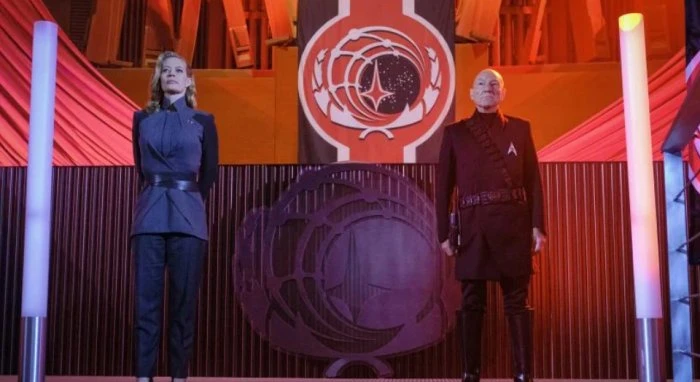
That story is pretty tense, if a little formulaic. Our heroes have a limited amount of time to stop something very bad happening and then get home. New adversaries and obstacles are put in their way, and they meet new allies. This is traditional Star Trek storytelling and all the more welcome for it. To be honest, if you think about it for more than thirty seconds, there are a huge number of gaping holes in the plot and inconsistencies with previous canon - which, since this is Star Trek matters a lot to a lot of people - but the pacing is much better than it was in the previous season, so you will probably only think of them all afterwards unless you are one of those fans with a Spock-like brain for such things.
To compensate there are a great many references or 'homages' to the canon for such fans to enjoy spotting them. Some are not subtle. Indeed, the plots of whole episodes are recycled - we get one with an evil parallel universe, one with time travel, one with Picard being interrogated, one with him trapped inside his own mind, etc. This perhaps invites unfavourable comparisons with the original classics, but some of the more detailed references are fun, especially a couple of witty moments that pay tribute to one of the most fondly remembered of the feature films, Star Trek IV: the Voyage Home.
References to that film are particularly appropriate because it just so happens - as it does so often in science fiction - that the destination point of the time travel is the United States around the period when filming is taking place. Well, what are the odds on that? Very short as it turns out, because it is a narrative device that enables observations to be made about the current state of our world and, more importantly, saves a fortune on production.
Quite a lot still seems to have been spent on location work, especially in Los Angeles. The best visual scenes, including a good old fashioned car chase in Downtown, are positively cinematic, but there are also some fairly cheap looking sets and computer generated imagery that remind us that this is still television science fiction. It should be stressed that this does not mean that the CGI is poor. On the contrary it is generally of a very high quality. The problem is that viewers have now become very good at recognising it for what it is and the strength of some of the live action sequences actually makes the contrast with the effects all the more obvious.
Overall, Season Two scores high on aesthetics, possibly higher than Season One. The elegiac theme music also sticks in the mind.
The real reason to watch the show is, of course, in the title, and it has to be said that Sir Patrick Stewart still delivers the goods as the eponymous Admiral. All right, there are some scenes, especially where some action is required, where it is painfully obvious that this is a man in his eightieth year, but we also get what we paid to see, some moving speeches by a first class Shakespearean. There is one about fear that is particularly powerful. One character says she wishes Picard was her father and she is far from alone in that.
There would probably be a good market for nine hours of Picard doing no more than just sitting and doling out paternal advice.
Most revivals of once popular shows are essentially pointless, except for the obvious financial motivation. This is not true of Picard, even if Jeff Bezos effectively driving an Amazon delivery van full of cash to Sir Patrick's house was doubtless a factor. Picard has some original and important things to say about ageing, coming to terms with mortality, and reflecting on life that could not have been said by the younger Jean-Luc.

Season Two Picard has a serene wisdom that Season One Picard seemed to lack. He is also more of a leader, the producers evidently having addressed the widespread criticism that he seemed to lack agency for much of the previous season. There is, however, one major irritation. The huge change at the end of Season One comes across as wholly irrelevant. No one, not even Picard himself, seems interested in whether Picard is even really Picard any more. While it may be possible to transfer memories to a new body, given the technology, that is not the same as transferring consciousness. Is consciousness something that can ever be transferred? Or can it at best just be copied? If so, would it be the same consciousness? What are the implications? Might physical immortality be possible? Would we really want it if it was? The usually very reflective Picard suddenly seems totally unmoved by his own unique experience.
Neither are any of the people who are or must be aware of this are intrigued by it. Yet again, are these the same people we met before?
They still make an agreeable gang, even if their tight bonding in a relatively short amount of time seems a bit contrived. Picard, or Stewart, retains the gift of becoming the focus of an interesting group. This is the best thing about Season Two as it was about Season One.
Were it not for Stewart's presence, Alison Pill would be acknowledged as having stolen the show. She starts as a goofy science geek with more than a touch of comic relief about her, but from there she gets to go to some really dramatic places. She finds herself in a struggle for her own soul with a powerful entity. She goes on to be a 'femme fatale' and later an authority figure. She even gets to sing at one point.
Michelle Hurd has real personality as Raffi and it is a great pity that the writers do not really know what to do with the character. She makes a great bickering double act with Seven, so that it was quite unnecessary to dump a contrived sexual agenda on top of it which actually detracts from a convincing portrait of female friendship - itself a rarity in science fiction.
It is also a pity that so little is made of the subplot in which Seven (Jeri Ryan) loses her vestigial Borg-ness. It is interesting to note how she demonstrates, as Picard himself did in Star Trek: First Contact, that no one is more anti-Borg than an ex-Borg. So much for the Star Trek message that understanding breeds tolerance. That ethos does prevail in the end, but not through Seven, who seems a bit irrelevant where she should be most relevant.
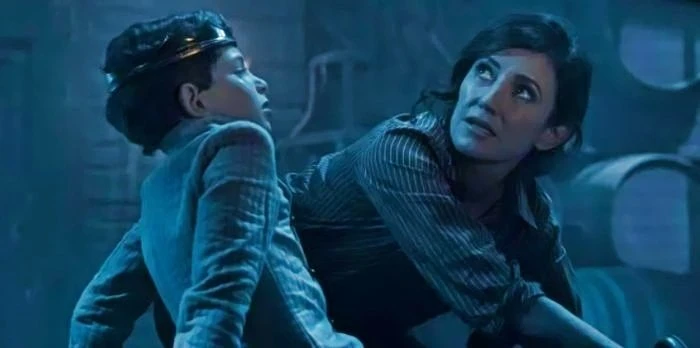
Orla Brady, whose relatively brief appearance as Laris, Picard's apparently Irish-Romulan secret police trained housekeeper, made a big impression in Season One - despite her being inexplicably left on Earth for most of it - happily gets a lot more to do here. In the intervening period Laris has been rather conveniently widowed. No prizes for guessing where this is going, in spite of her looking young enough to be Picard's daughter.
In purely dramatic terms - and this from someone not exactly known for being "woke" or "politically correct" - it is very refreshing to have a drama in which so much of the plot, dialogue, and character development is carried forward by four actresses of an age appropriate for the knowledge and experience of their characters. No one would blink twice if four middle aged males were doing the same, but it still a rarity for women to be allowed to be, well, normal in this way. Even now female representation is too often in the form of sexy youngsters given an unlikely level of maturity. Picard gives us strong women as they really are. Pill, Hurd, Ryan, and Brady make it all seem credible and natural and unforced. It is not by any means pushing an agenda to want to see more of this sort of thing.
Santiago Cabrera balances this with a strong shot of testosterone as Rios. It is a pity that the character now has so little in common with the almost piratical adventurer of the previous season and his arc is ultimately a disappointment. His multiple hologram versions of himself are also missed. Evan Evagora is likeable as Elnor, but no one can make the character interesting, and it is no great loss that he is sidelined for most of the season.
Without spoiling surprises by naming names, four familiar faces from The Next Generation turn up in guest roles, and we get to say an emotional final farewell to one of them - but since we said an emotional final farewell to another of the four in the last season and he turns up again, maybe the farewell is not so final.

Jay Karnes, from The Shield and Sons of Anarchy, is well cast as a cut price Fox Mulder. Sol Rodriguez is very attractive and it is not her fault that her role, as an unlikely Latina physician running a clinic for immigrants, is just the sort of contrivance that the four older actresses are challenging. Annie Wersching channels Alice Krige very effectively as a Borg Queen with a notably human dose of megalomania. Her scenes with Pill are particularly good.
Science fiction fans will welcome James Callis, who committed grand larceny in the "reboot" of Battlestar Galactica, making a house call on another big franchise.
There has been some criticism of the show's heavy handed political subtext. While there is, again in purely dramatic terms, irrespective of what one feels about the actual agenda, some merit to the complaint, it ought not to be forgotten that The Next Generation also wore its politics in its sleeve. The difference is that the "Culture Wars" are now very much a real conflict and viewers are more likely to be sensitive to such things. This may be one of the reasons why fan reaction has been so divided. Viewed objectively, Season Two is well produced, well-acted, visually impressive, and true to the traditions of Star Trek. It seems to have learned from at least some of the mistakes of Season One. The plotting is untidy - Executive Producer Alex Kurtzman seems to have a thing for "time jumps" which has not always served him well - but in the end it is a satisfying story and the characters keep us involved. We really have no right to expect more from it than that.
Season Three Review: John Winterson Richards (reviewed in 2023)
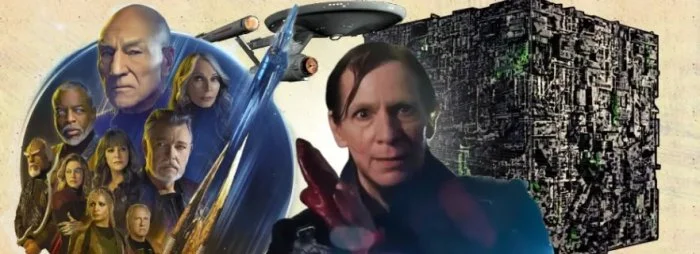
It seems that, as with so many things these days, the way to build a following as a film or television critic is to take extreme positions, either totally for or totally against something. You will find there are many people who will agree with you and will love you for endorsing whatever their own opinion might be. Yet for those of us who prefer at least to try to be strictly honest, life is rarely, if ever, that simple. On the one hand, there has never been a perfect work of art of any sort: part of the whole point of art is that it is an eternal quest for perfection, eternal because it is hopeless. At the same time, and at the other end of the spectrum, it is almost impossible for a group of professionals to work for any length of time on any project, no matter how bad, without it having at least some redeeming features.
So it is difficult to imagine a show that really deserves a rating of 100% (even if I, Claudius, which happens to feature the future star of Star Trek: Picard, may be as near as we can get) or of 0% (even if it is possible to think of a number of projects that come close).
Applying all this to Star Trek: Picard, a lot of people who really know their Star Trek, and whose opinions deserve to be taken seriously, took a very extreme position against the first two seasons only to be converted to taking an equally extreme position in favour of the third. As is often the case, there is none so zealous as a convert. It is respectfully suggested that neither extreme position, for or against, is completely justified. On balance, this reviewer rather enjoyed Seasons One and Two but felt that they had some major flaws - and exactly the same words could be applied to Season Three.
However, there is a difference of degree and that difference is everything. Star Trek: Picard deserves credit as a show that improved with each season: contrary to what audience appreciation ratings might suggest, the second was much better than the first; and practically everyone agrees that the third was the best of the three by a mile.

There are two main reasons for the popularity of Season Three. Most obvious is the fact that it gave the fans what they wanted all along, a reunion of the Star Trek: The Next Generation crew and what is almost certainly a dignified final farewell to that show. Where the original Star Trek had ended on a high note with Star Trek VI: the Undiscovered Country, there was general feeling that the feature film Star Trek: Nemesis was an unworthy conclusion to The Next Generation. There had been high hopes that Star Trek: Picard would provide the grand send-off that Nemesis should have been, but in its first season it went off in a completely different direction with most of the emphasis on entirely new characters. This disappointment explains much of the excessive unpopularity of its first two seasons. Equally, the fact that the fans were pleased at finally getting their way may have contributed to their extremely positive reaction to Season Three. Fans are more inclined to like something if they feel their feelings have been taken into account. This has been demonstrated several times recently in relation to other major franchises, including the DC Justice League, Spiderman, and Sonic the Hedgehog.
Season Three was put in the capable hands of Terry Matalas, a man whose involvement with Star Trek goes back a long way - he began his career on Voyager and Enterprise - and who seems to understand the underlying reason for its appeal. He therefore stripped it back to basics and gives us a show that somehow "feels" more The Next Generation, while still using the latest effects and visual technology. It helped having the old cast on hand, but he and his team also made clever use of the script, production design, and music to put together episodes oddly reminiscent of their 1990s equivalents, except with much better production values (being honest, the old show was produced on the cheap in many respects and, as usual, the very elements that looked modern back then now look the most dated).
The story and dialogue are full of references, both explicit and subtle, to what has gone before. Events in the past are shown as having ongoing consequences. There are more "Easter eggs" than on a supermarket shelf in March. There are welcome cameos from a favourite Voyager character and a memorable Next Generation antagonist. A brief appearance by a tribble is guaranteed to make a fan smile. It was a particularly nice touch to give a respectful nod to Constable Odo (the late Rene Auberjonois) from Star Trek: Deep Space Nine, neatly built into the central story without him being named. Star Trek fans are the sort of people who notice and appreciate such things.
Yet the main selling point of the show is still that it got the band back together. While most episodic television shows maintain professional courtesy on their sets - the production schedules these days are punishing and there can be no tolerance for the sort of egotism seen on film sets - they are rarely places where deep friendships are forged, not least because the last people one wants to see after a very long day at work are the people one was just with. The Next Generation was a famous exception. The cast really bonded, and their easy interaction at conventions and the like suggests that these people are genuine friends - that or even better actors than we thought.
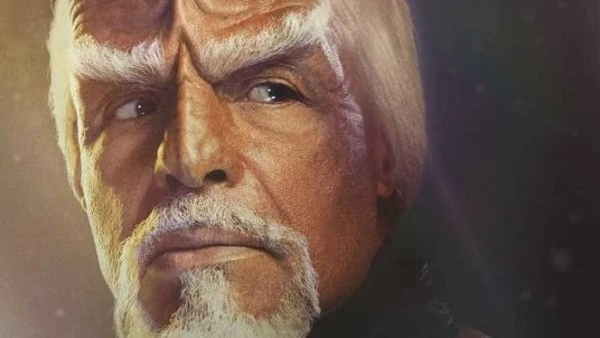
This comes through on screen. The scenes with Admiral Picard (Sir Patrick Stewart) and his old "Number One" Will Riker (Jonathan Frakes) are a joy, one of the best portraits of a straightforward male friendship on television in any genre. Almost as good is the slightly more competitive friendship between Riker and Worf (Michael Dorn). Worf also gets a great entrance and, as usual, most of the best lines.
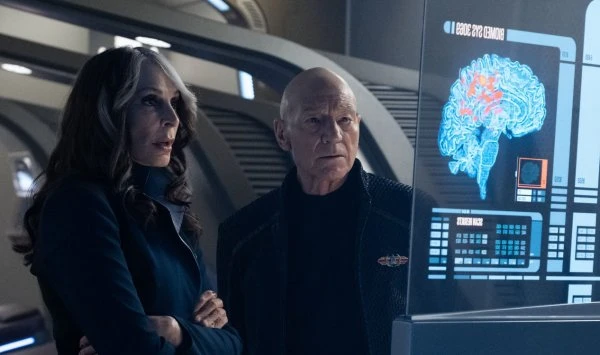
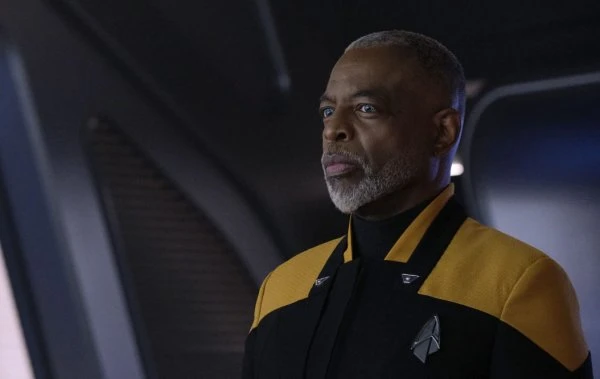
The dialogue they are given is worthy of them. There are however some false notes. A brief conflict between Picard and Riker seems forced, as is Riker's subsequent temporary descent into despair. This sequence seems totally out of character for both men. Picard also has some artificial conflict with Dr Crusher (Gates McFadden) and later Geordi La Forge (LeVar Burton) for reasons that do not stand much scrutiny. While the reunion would not be complete without Brent Spiner, and he enjoys himself in multiple clever variations on a theme, even the script seems to acknowledge that it is getting ridiculous how he keeps coming back from the dead, especially after Data's emotional farewell in Season One.
Meanwhile, Riker has another contrived conflict, this one with his wife, Deanna (Marina Sirtis). The scriptwriters have obviously been taught that conflict is good for drama. By contrast, Gene Roddenberry wanted interpersonal conflict banished from his idealised Federation because he wanted to believe humanity would move beyond it - despite being rather prone to it himself in real life. While Roddenberry's ideal was always too unrealistic to be credible, conflict for the sake of conflict is just as unconvincing. Surely there is enough room on the middle ground for compromise between his position and the Picard writing team's. Conflict should flow naturally from character and events. It does not always do so here.
There are many other points that strain both credibility and consistency with the rest of the franchise. Part of the appeal of Star Trek is that it was about a hierarchy and about how the characters were progressing up it. This was as important to the characters themselves as their actual adventures, and the risk to their careers was as much a factor in their decision making as the risk to their lives. Yet Picard has several people with questionable backgrounds, to put it mildly, jumping up the ladder very quickly. Other characters give the impression that Starfleet's selection and screening processes in general leave a lot to be desired. Then there is Picard and Riker's casual assumption that they can just commandeer a starship. Remember the difficulty Admiral Kirk and his crew had doing this in Star Trek III: the Search for Spock? Evidently Starfleet do not because they would surely have tightened procedures if they did.
It is no surprise that Picard and Riker turn out to be right. They eventually get their way in spite of the open hostility of the Captain of the ship in question. At this point the chain of command goes completely bonkers: it seems an Admiral on the Retired List outranks the appointed Captain of a vessel on his own command deck but an Acting Captain outranks the Admiral.
Starfleet in general comes across as pretty amateurish. There are a lot of obviously wrong decisions, some of them made by our heroes. A supposedly unsympathetic character who opposes endangering five hundred lives to save four is clearly in the right. Events appear to justify him. The same mistake is made again much later when we are invited to rejoice as four lives are saved apparently at the cost of unnamed thousands offscreen.
There are many other storytelling choices that might be questioned if we were not enjoying ourselves so much with our old friends. Some regrettable reversions to the negativity of the first season rather undermine the return to the ethos of The Next Generation. Indeed the season begins with a respected character incinerating a disabled opponent on the ground. There might be a defensible tactical reason on that occasion, but the process is repeated later as if a matter of routine. When did Starfleet abandon "set phasers to stun"? At one point Picard himself seems resolved to execute a prisoner summarily. It remains unsettling that the abuse of illegal narcotics is still widespread in the 25th Century Federation. There is even a criminal underworld, complete with a Vulcan ganglord - even if one cannot argue with his rationale that, since crime is inevitable, it is logical that it should be organised.
It would also be disappointing if the recent fashion for using swear words to emphasise emotion has not died out in a supposedly more advanced culture. They sound particularly out of place coming from the famously self-controlled Picard.
Yet it should be stressed that these lapses do not alter the fact that the basic architecture of the script is solid. It begins with two threads, the main story concentrating on Picard and Riker responding to a request for help from an old friend, and an apparently independent subplot involving Raffi (Michelle Hurd) from the first two seasons wandering around said criminal underworld. These two plots converge, and, one by one, the other veteran characters from The Next Generation all become involved. The way this happens seems perfectly natural and uncontrived.
There is a very good guest appearance from one of the strongest supporting characters from The Next Generation whose character arc was never resolved properly back in the day - possibly due to bad career advice. This leads to some of the best acting moments in the franchise. Later a huge twist reveals a new enemy, or rather the return of an old enemy, complete with a familiar voice. To say more would be to risk spoilers, and that would be a pity because both these dramatic turns in the plot are well conceived and well executed.
Another familiar voice turns up in the final episode in a role that has delighted fans and a familiar face makes a somewhat incongruous appearance in a mid-credits scene. Yet another beloved voice, this one associated with someone no longer with us, is used organically in a tasteful tribute. The eagle eyed will recognise the Fleet Admiral: yes, she really was ambitious.
The real appeal is still the return of the Magnificent Seven, and they all fit comfortably back in their parts as if they had never been away. The humorous banter between them is unforced, and it is pleasing how they all contribute something to beating the insurmountable odds with which they are confronted. This was not always the case in the feature films which seemed to ignore some of them in the name of brevity.
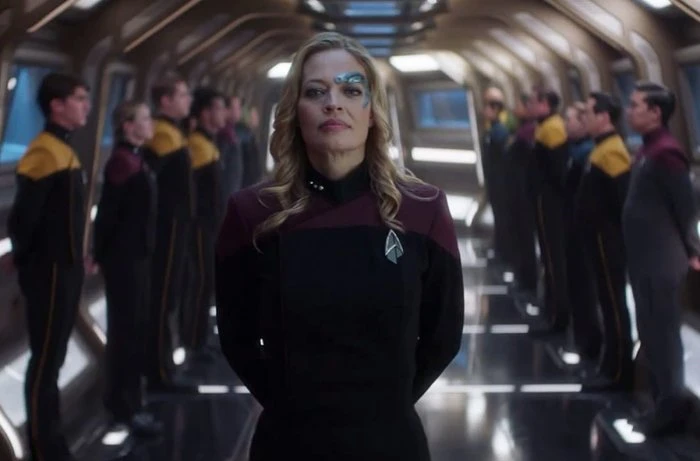
Jeri Ryan returns as Seven of Nine and Orla Brady has a couple of scenes as Picard's Romulan housekeeper - it really is hard to be certain if she is his girlfriend or his carer. Apart from them and Hurd, the rest of the new characters introduced in Seasons One and Two have been dropped fairly heavily. One can see the commercial and narrative reasons for this, but the actors surely deserved at least a respectful mention of the parts they played. There was an opportunity to give at least one of them a proper ending to her character's arc, which instead remains curiously up in the air and gives the plot something of an avoidable consistency problem.
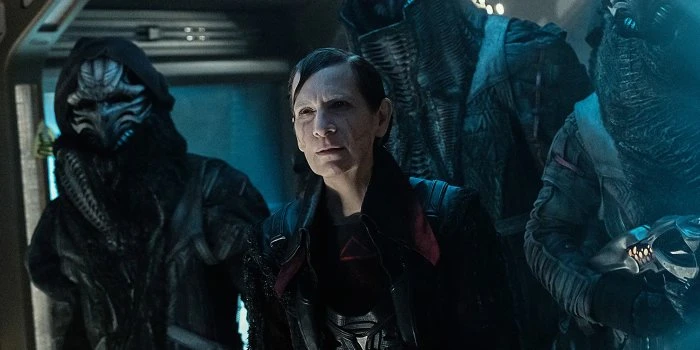
An almost unrecognisable Amanda Plummer goes gloriously over the top as the apparent principal antagonist. Ed Speleers does well in a poorly conceived but pivotal role, even if the part is not sufficiently strong to provide the male lead in the "follow up" show for which the conclusion seems to be begging. A show based on the initially antagonistic Captain Liam Shaw, played to perfection by Todd Stashwick, might have been a better proposition. He steals almost every scene in which he appears, something that takes doing in this company. At first he comes across as an obnoxious idiot, but hidden depths are revealed gradually. It turns out that he has understandable reasons for some of what he says and does, he sees things that others do not, and his judgement is usually good. In the end he reveals a certain nobility beneath his boorish exterior. This is first class character construction, providing the framework for first class acting.
The effects are good even if they are obviously effects. The destruction of a Starfleet recruitment base by a "portal weapon" which displaces large masses is very well done. A couple of epic space battles look duly spectacular despite being wholly unrealistic if one stopped to think about them - which, happily, we are not given time to do. There are some beautiful images associated with what is assumed to be a nebula.
A very strong design team, including the Star Trek legend that is Michael Okuda, stays true to many of the concepts of The Next Generation but updates them, and gives them a greater texture and depth that was never really possible on the budgets they had in the Nineties. This strengthens the impression that Picard is taking place in a universe in which people might actually live rather than on a set. Many of the starship designs are aesthetically very pleasing.
The drama benefits a great deal from one of the best soundtracks of any recent television show. The composer Stephen Barton, assisted by Frederik Wiedmann, had no qualms about raiding the rich musical back catalogue of the whole franchise and then adding their own little twists. The whole is a graceful tribute to the work of Alexander Courage, Jerry Goldsmith, and James Horner. The use of a subtle variation of the Klingon attack theme to introduce Worf was particularly clever, and the stately, elegiac theme from Star Trek: First Contact was the perfect choice for the end titles.
The season was evidently structured deliberately and very carefully as a whole. It starts relatively slowly, but then the pace picks up. The fourth episode is a good old fashioned "starship in a hopeless situation with time running out" classic helmed by Frakes, who is also one of the franchise's most accomplished directors - among other things, he also directed First Contact, generally held to be the best of the later Star Trek films after The Undiscovered Country. Following that there is a pause to regroup before more revelations and then a truly cinematic action-packed finale.
Yet, for all the sound and fury, this is a thoughtful, reflective show that deals with mature themes. Maturity is itself one of them. It is good to see a television show in which older people are valued and shown as having something to offer. Since most hard core Star Trek fans are now likely to be well over thirty - one suspects recent entries in the franchise have failed to find much love in the younger generation - this has probably endeared the season to the franchise's main fanbase even more. Indeed it is quite subversive that an important plot point comes when young people under 25 turn out to be unreliable because their brains are still growing and are therefore more susceptible to manipulation.
Cue knowing grunts of approval from ageing Trekkers all over the world. Incidentally, like much of the science in Star Trek, the neurobiology behind this is accurate.
Even more subversive is an explicit warning against the dangers of collectivism and centralisation, both in technology and decision making. Trek has never been so libertarian. There is also a moment of vindication for those of us who have always been suspicious of the transporter system (it basically disintegrates you every time and then copies you exactly somewhere else, in effect killing you and cloning you, begging the question, which the show never answers, if the person who comes out of the transporter is the same person who went in).
The main theme is, of course, family - and friendship, and the overlap between the two, which was always the subtext of The Next Generation. To be honest, the Picard Season Three script often rather beats us over the head about this when it could have made the same point with far less "on the nose" dialogue. It is nevertheless a very good point and at least some of the many scenes in which it is made have real emotional weight.
Finally, as the President of the Federation reminds us, quoting an old comrade of his father's, there is always hope, there are always possibilities.
This point is made very powerfully in that excellent fourth episode when, after Riker's crisis of faith, our heroes manage to get out of an apparently hopeless situation. It is reinforced in the final battle when the situation seems even more hopeless. The show is a powerful reminder that just because we see no grounds for hope does not mean that there are none and that trying our best in the absence of any prospect of success can sometimes open up opportunities that we did not know existed or that did not exist before we tried.
This is a lesson the world really needs today.
It might be said to have applied to the show itself. Like most of the other big intellectual properties, including Lord of the Rings and Star Wars, the Star Trek franchise has been treated as a cash cow in recent years following a well-established management consultancy system, the BCG Matrix. The brand name has been stamped on second rate "content" with a view to making as much money as quickly as possible before it loses all value. Season Three of Picard, possibly along with Season One of Star Trek: Strange New Worlds, proves that things do not have to be this way. Fans are beginning to chat online about the potential of "Terry Trek." The suggested follow up show, already given the unofficial designation Star Trek: Legacy, has not been approved at the time of writing, but studios and producers are beginning to treat fanbases with more respect after some recent disasters and surprise successes. They would be fools to ignore the very positive fan reaction to Season Three and the money on the table it represents. There is always hope, there are always possibilities.
Perhaps the same may yet prove true of our culture as a whole. It will be counterproductive if the studios conclude that the lesson of Season Three is that the future lies with legacy characters. On the contrary, what they need to do is invest more in originality, to build the franchises of the future, rather than exploit the originality of previous generations until they are drained of all that made them special. The lesson of Season Three is instead a simple one, the oldest one in business: offer people what they like and they will buy it.
It would be overstating things to imply that Picard is a game changer. Nor is it, like The Next Generation itself, one of the all-time greats. Some generally intelligent people rather overreacted in condemning the first two seasons and then overreacted the other way in imputing to the third a perfection it does not possess. It is simply a well-made show produced by experienced professionals who really knew their product and their market.
Yet when one has finished with all the hard-headed reviewer stuff, there is still one more thing that has to be said. Forgive the subjectivity, but this old Trekker was surely not alone in enjoying a moment of intense happiness on seeing the seven veterans together on the bridge of a starship for one last adventure and hearing Picard giving the familiar order, "Engage."
Such happiness is not something one often feels watching television. It should be cherished whenever it happens to turn up.
Seen this show? How do you rate it?
Seen this show? How do you rate it?
Share on...
Published on July 9th, 2026. Written by Daniel Tessier & John Winterson Richards for Television Heaven.