

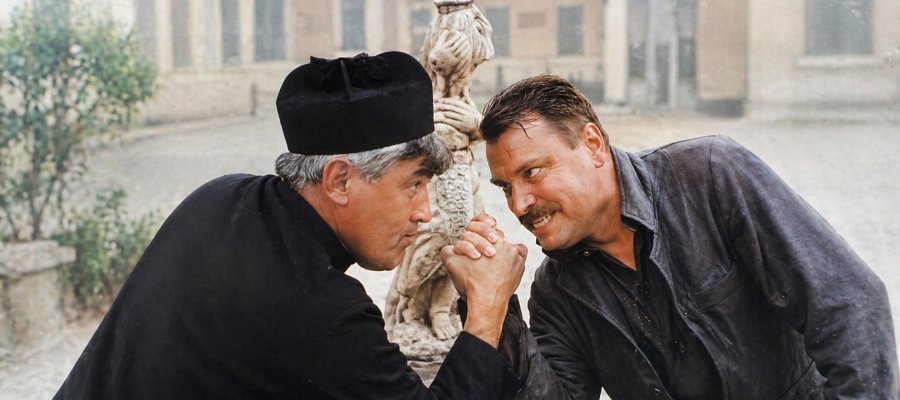
The Little World of Don Camillo
1981 United KingdomReview: John Winterson Richards
The recent passing of the veteran German character actor Mario Adorf brought back memories of his brief but delightful sojourn on British television in 1981, The Little World of Don Camillo, a 13-part BBC series based on the stories by the Italian journalist Giovannino Guareschi.
Practically everyone who watched it, including your reviewer, seems to remember it with great affection. Alas, as often happens with high quality niche productions, there were not as many of us as it deserved. As a result, there were no subsequent seasons, despite the availability of a small mountain of source material, a total of 347 stories, and the whole thing was forgotten very quickly. Indeed, it looks like there was practically a deliberate effort to erase it from the official record: it was never repeated in the UK and it has never been released in any commercial video format. One almost begins to wonder if it was a dream. This is true of many old television shows and is one of the reasons that websites like this one are very important.
As a matter of policy - one might even say of ethics - I do not review an old show unless I remember it fairly well, which usually means I watched it more than once, or I have been able to rewatch at least a substantial part recently or during the review process. Since neither is possible in the case of the The Little World of Don Camillo, having watched it only that one time it was shown almost half a century ago, this is necessarily something of a provisional review.
It is a two edged sword that I was already familiar with the source material on which it was based, having read all the 132 Don Camillo stories that had been translated into English at that point, and seen at least one of the highly enjoyable European feature films based on them. This means I remember the basic plots very well, but I cannot be certain if what I am remembering is really from the books, the feature film, or the BBC series. There is a definite "Lord of the Rings Effect," which I discovered when I re-read Tolkien's novels, which I knew well, for the first time in many years, and was quite shocked to realise how much of what I had thought was Tolkien was in fact Sir Peter Jackson.
The same is undoubtedly true of The Little World of Don Camillo, even if I have a definite memory of being quite pleased when it was aired that it stayed fairly close to the books.
It certainly stayed close to the original premise, the odd friendship between Peppone the Communist Mayor and Don Camillo the Parish Priest of a fictional small town in Post-War Italy. Both served together in the Partisans fighting against Mussolini's puppet state "Social Republic," and both have deep roots in their local community, but ideological differences and their respective roles force both to suppress how much they have in common.
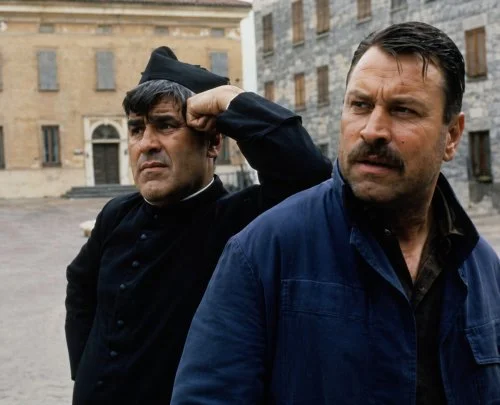
At one level the stories can be read as a quaint tales of ordinary people trying to come to terms with a changing world, very much in the tradition of Balzac. Their evocation of simple humanity in a long established and tight knit rural community feels authentic, but also nostalgic because it is at the same time a valediction as what has been taken for granted for centuries is disappearing at a bewildering pace.
The stories are a great success on this level, but the political satire adds an additional dimension. There is an obvious parallel with Gabriel Chevallier's French novel Clochemerle, which was itself given a star studded adaptation by the BBC in 1972, in that in both the petty squabbles in a small municipality become representative of a whole nation in turmoil. The difference is in the nature of the turmoil. By 1923, when Clochemerle is set, the Third French Republic had reached a point of relative stability, or at least exhaustion, following the Great War. That was definitely not the case in Italy in the immediate aftermath of the Second World War and the fall of Mussolini. No one knew what was going happen next and civil war was in the air.
Hidden beneath the gentle humour of The Little World of Don Camillo is a very sharp edge. Italy had reverted to the state of chaos and uncertainty that had led to Mussolini's seizure of power after the First World War, except it was now exacerbated by several factors. The Monarchy had been abolished following a referendum and hardly anyone had much affection for the new Republic. On one side, almost half the population, including Guareschi, had voted to retain the Monarchy, while on the other the dominant force were the Communists, who wanted to take things a lot further. There were obvious parallels with the early days of the Weimar Republic in Germany, which had not exactly ended well.
The Communists, by then firmly Stalinist and backed by Moscow, were in a far stronger position after the Second World War than after the First. There was a widespread perception, by no means confined to the political Left, that momentum was with them. In Italy they only had to look across the Adriatic to Tito's Yugoslavia to see that one more push was all they needed. One of the most memorable of the stories has various Communists trying to warn Don Camillo secretly that he was about to be arrested when it was assumed, erroneously, that they had won the crucial 1948 election. It is played for laughs, but the dark truth is that, even as it was, there seem to have been a large number of purely political murders in Italy around this time, and in such situations Priests were usually the first to be shot by Communists - not least in Spain, just across the water on the other side of Italy. Under very slightly different circumstances, Don Camillo might have become a Martyr, and he and all the other characters in the stories, and all the Italians who read them at this time, would have been constantly aware of that.
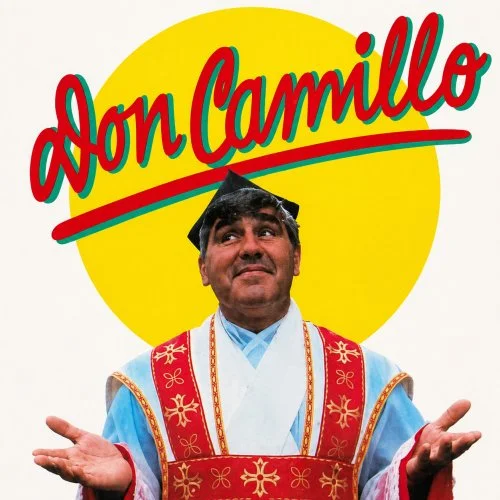
Most Britons watching the adaptation in 1981 would not, and the adaptation, understandably, in order to keep the tone light, did not dwell on this dark subtext. Indeed, it rather downplays the politics, possibly because Guareschi was a maverick conservative and not part of Italy's generally Left leaning cultural Establishment. As such he tended to give Don Camillo some very easy moral victories. It was Guareschi who is said to have coined the very effective Christian Democrat campaign slogan "God sees you in the voting booth - Stalin can't." This informs how he portrays Peppone's Communists in his stories, as outwardly ideological but still emotionally Roman Catholic. While this certainly makes them more sympathetic, it may over sentimentalise the reality of many Italian Communists at this period.
The stories were commercially successful across Europe, but, as usually happens with successful modern European literature, made little impact on the Anglosphere. The same is true of the early feature film adaptations, superior European co-productions starring the French comedian Fernandel in the title role. The BBC production may itself have been an attempt to enter the European market, hence the casting of Adorf, who was not well known in the UK, as Don Camillo. The rest of the cast were British, with the then ubiquitous Brian Blessed the obvious choice to play Peppone, which he does to perfection. Cyril Cusack voices Christ, who seems to speak directly to Don Camillo from his Crucifix, while other familiar faces include Harry Fowler, Peter Arne, George Coulouris, Murray Melvin, Ronald Lacey, Richard O'Callaghan, and Michael Angelis. A fairly substantial budget seems to have been allocated for location filming. This combination of a European leading man and an emphasis on scenic photography suggests an immediate parallel with another BBC project around this time, The Borgias, and prompts the thought that the - excessively - negative critical reaction to The Borgias later that year was what led to the abandonment of the Beeb's European strategy and therefore the discontinuation of The Little World of Don Camillo rather than any failing in the latter.
Seen this show? How do you rate it?
Seen this show? How do you rate it?
Share on...
Published on April 28th, 2026. Written by John Winterson Richards for Television Heaven.