

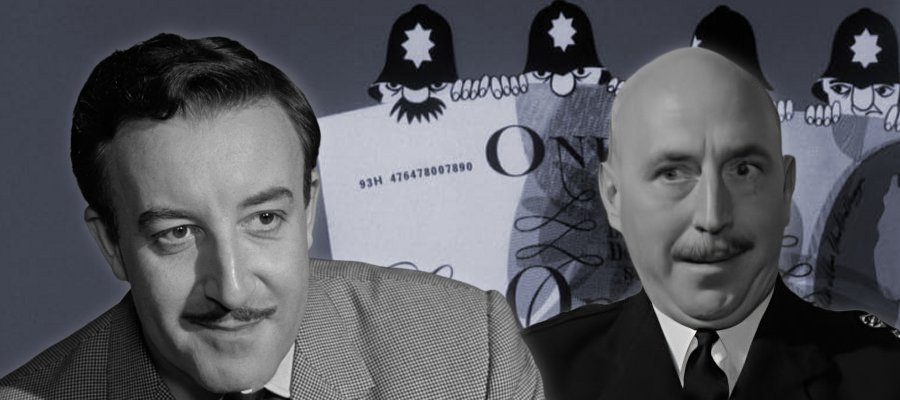
The Wrong Arm of the Law
Distinctively British in its humour, The Wrong Arm of the Law brings together an impressive writing team: Hancock’s Half-Hour creators Ray Galton and Alan Simpson, alongside John Antrobus, John Warren, and Len Heath—who had previously scripted another Peter Sellers vehicle, Two-Way Stretch.
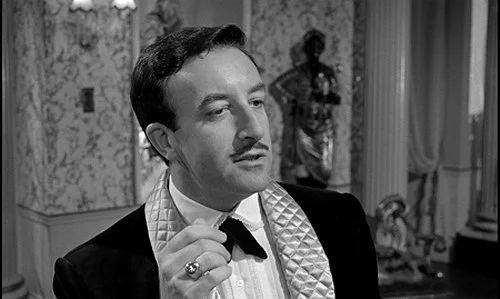
Set in London, the story follows a trio of Australian criminals, led by Bill Kerr, who impersonate police officers in order to rob thieves of their ill-gotten cash and jewels immediately after each crime. Their scheme begins to bite into the profits of local gang leader “Pearly” Gates (Sellers), who operates under the guise of an effete French couturier, Charles Jules, at Maison Jules—a fashionable London house where wealthy clients unwittingly provide valuable intelligence on potential targets. Unbeknownst to Pearly, his girlfriend Valerie (Nanette Newman) is secretly collaborating with the Australians, passing on details of planned robberies.
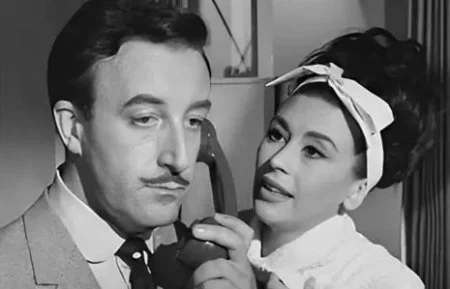
Pearly runs his criminal enterprise with the structure of a benevolent employer, offering perks such as luncheon vouchers and paid holidays on the Costa Brava. He even screens ‘educational films’ for his gang, such as The Day They Robbed the Bank of England (1959), reinforcing the film’s playful satire of organised crime as a kind of corporate institution. So he is aghast that the robbers should become the robbed.
Meanwhile, London’s criminal underworld has formed a syndicate—a closed-shop arrangement designed to divide territories and protect mutual interests. When Pearly’s takings begin to suffer, he initially suspects rival crook “Nervous” O’Toole (Bernard Cribbins – in a relatively small role which he manages to make memorable with his bundle of anxieties and nervous tics). Once it becomes clear that both men are being targeted by the same impostor gang, they join forces.
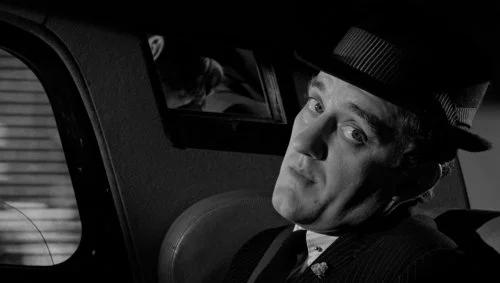
Their uneasy alliance leads to one of the film’s highlights: a general meeting of the crime syndicate staged like a democratic trade union gathering, complete with cameos from Dennis Price and Marianne Stone. Here, it is agreed that the criminals will collaborate with the police—via Inspector Fred “Nosy” Parker—to flush out the so-called “I.P.O. Mob” (Impersonating a Police Officer) and bring them to justice.
Lionel Jeffries excels as the eager-to-please yet bumbling Inspector Parker, and his performance provides a perfect counterpoint to Peter Sellers’ turn as Pearly Gates. The two actors clearly relish trying to outdo one another, resulting in sparkling comic interplay. Sellers—who reportedly vacillated between playing Pearly or the Inspector (a role he would later inhabit and take to legendary status beginning with The Pink Panther)—ultimately delivers one of his finest (certainly since I’m Alright Jack) and last performances in an all-British film. His effortless switch between the sophistication of his French accented 'posh frocks' selling alter-ego, and Pearly's cockney persona offers an early glimpse of his extraordinary versatility. He also arguably lands the film’s best line, declaring to Valerie, while tapping his head, “I’ve got things going round in ’ere that’d make Maigret drop his pipe!”
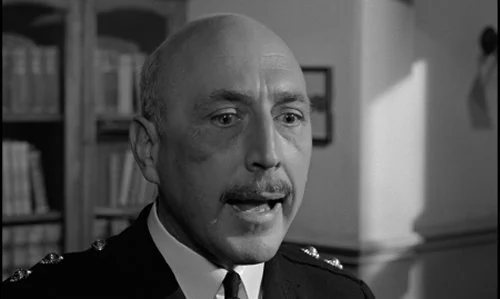
The underworld declares a 24-hour moratorium on crime to aid the search, but the I.P.O. Mob still manage to evade capture. In response, Parker persuades the Assistant Commissioner at Scotland Yard (John Le Mesurier) to sanction a major robbery as bait. To safeguard the stolen bullion, Parker is instructed to join Pearly’s gang. However, once the heist is complete, Pearly proves reluctant to surrender the proceeds, setting up the film’s comic climax.
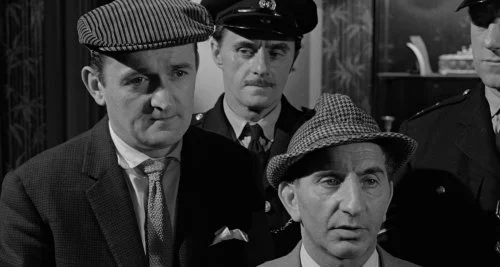
The Wrong Arm of the Law is one of the last films to carry the spirit of the classic Ealing comedies, even if it isn’t formally one of them. It doesn’t simply mark the end of a tradition associated with the British film industry; rather, it represents a point of transition. While it retains the tightly constructed plotting, institutional satire, and affection for criminality seen in classics like The Lavender Hill Mob, it also embraces a broader, more frenetic comic energy driven by performers such as Sellers and Jeffries and a cast of memorable faces that also include Davy Kaye, Graham Stark, Dermot Kelly, Dick Emery, John Junkin, Deryck Guyler and an uncredited Michael Caine. In doing so, the film bridges two eras—honouring the craftsmanship of Ealing while pointing toward the more exuberant, personality-led comedies that would define British humour in the 1960s and beyond.
Share on...
Published on April 9th, 2026. Written by Laurence Marcus for Television Heaven.