

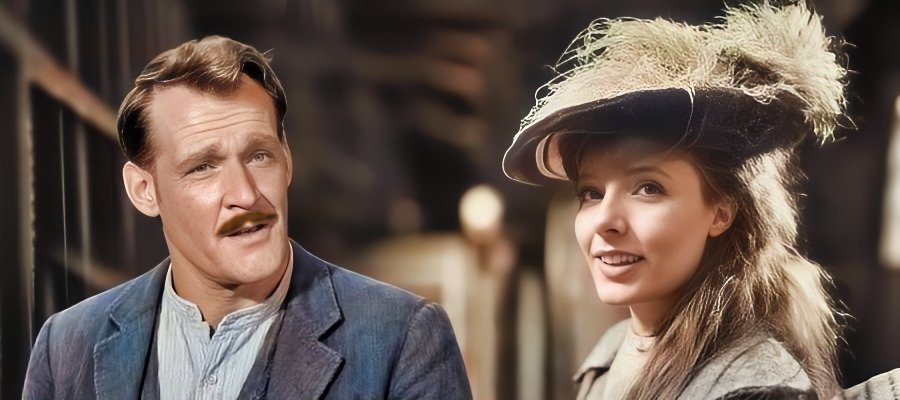
Liza of Lambeth
1965 United KingdomWhen W. Somerset Maugham published Liza of Lambeth in 1897, a stark, naturalistic portrait of a doomed love triangle played out in the slums—it hit Victorian readers like a slap. Its unflinching depiction of Lambeth’s raw, unvarnished lives unsettled an audience accustomed to comfort and cocooned by gentility. Here was a master storyteller laying bare the reality endured by most of the city’s inhabitants, in a world where, as he observed, “suffering did not ennoble: it degraded.”
In doing so, he immediately established himself as a writer willing to confront uncomfortable truths. Drawing on his experiences as a medical student at St. Thomas's Hospital, he portrayed the overcrowded streets of Lambeth with an uncomfortable authenticity. Rather than romanticising poverty, Maugham presented it as an environment where hardship shaped every aspect of daily life, particularly for women whose lives were constrained by social convention, economic necessity and the ever-present consequences of scandal.
The BBC's 1965 adaptation, written by Harry Green and produced by Douglas Allen with direction by Michael Imison, sought to preserve the novel's realism while reshaping it for television. Presented in the relatively unusual format of a two-part original play and produced by BBC Scotland for BBC2, it was initially seen only in those parts of Britain served by the still-expanding BBC2 network.
The drama follows the brief and tragic life of eighteen-year-old Liza Kemp, whose refusal to marry the dependable Tom leads her into a secret relationship with Jim Blakeston, an older married neighbour. Their affair unfolds against the tightly packed terraces of Vere Street, where privacy scarcely exists and gossip spreads with remarkable speed. As the months pass, the excitement of forbidden romance gives way to public disgrace, violence and ultimately tragedy.
Visually, the production recreates late Victorian Lambeth with care, while musical interludes, dancing and popular songs of the period bring a sense of community spirit to the crowded streets. Yet this emphasis on entertainment sometimes softens the novel's uncompromising social realism. Maugham's original work examines the devastating consequences of poverty and limited opportunities. The television version retains the central storyline but often presents the neighbourhood as a place of boisterous vitality rather than relentless deprivation.
Reviewing the first episode in The Stage, critic Bill Edmund offered a thoughtful assessment that recognised both the production's strengths and its shortcomings. He felt the adaptation shifted the balance away from Maugham's bleak naturalism towards something resembling a lively period musical. The inclusion of numerous popular songs and energetic crowd scenes, he argued, gave the impression that the residents of Lambeth were remarkably cheerful despite their circumstances, making the drama feel considerably lighter than its literary source.
Edmund praised Jo Rowbottom's attractive and spirited portrayal of Liza, commenting that she looked entirely at home in the Victorian costumes, although he questioned whether she fully conveyed the hardship of her character's existence. Patrick Allen was considered visually convincing as Jim Blakeston, giving the character an easy confidence that explains his attraction but, in Edmund's opinion, sounded too refined for a man from the Lambeth slums. Leonard Cracknell's restrained and sympathetic performance as the honest and dependable Tom was singled out as one of the production's most believable characterisations.
The reviewer was especially impressed by the female supporting cast. Stella Tanner captured the coarseness and resignation of Liza's mother, Barbara Keogh gave emotional weight to the weary, drink-dependent Delia Blakeston, and Rita Webb's Mrs Hodges embodied the unsentimental practicality demanded by life in the slums. Edmund highlighted Webb's scenes concerning the dying child as moments that most successfully reflected the harsh world Maugham had originally depicted. Brian Wright also received praise for his understated performance as the doctor, whose appearance provided some of the production's most affecting moments.
Despite his reservations about its emphasis on music and spectacle, Edmund ultimately found the adaptation highly enjoyable, describing it as "a good, lusty, fast-moving musical show." His review neatly encapsulated the production's central paradox: as entertainment it succeeded admirably, but as a faithful representation of Maugham's grim portrait of Victorian Lambeth it inevitably lost some of the novel's raw emotional power.
Today, the BBC's Liza of Lambeth occupies an interesting place in television history. It demonstrates the Corporation's willingness during the 1960s to adapt serious literary works while experimenting with dramatic form. Although later interpretations—including the 1976 West End musical adaptation—would take the material in even more overtly theatrical directions, the 1965 production remains a fascinating example of how television sought to balance social realism with popular entertainment. It may not capture every shade of Maugham's uncompromising vision, but it preserves the emotional core of Liza's story and offers an engaging glimpse of a largely forgotten BBC drama.
Seen this show? How do you rate it?
Seen this show? How do you rate it?
Share on...
Published on July 3rd, 2026. Written by Laurence Marcus for Television Heaven.