

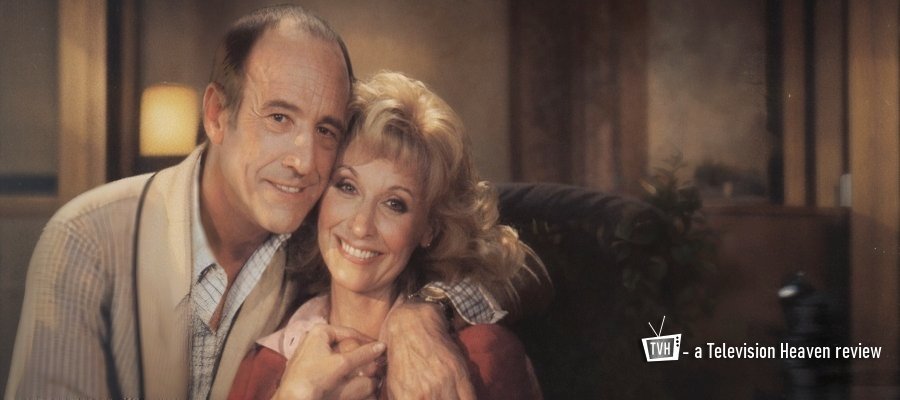
For Maddie with Love
1980 United KingdomDouglas Watkinson’s For Maddie with Love stands as one of the most emotionally courageous and unjustly forgotten British television dramas of the early 1980s. Produced by Associated Television and broadcast as a 48-part live daytime serial between 1980 and 1981, the series tackled terminal illness, grief, euthanasia, and family collapse with a level of candour that was startling for its era — and remains striking even today.
At its centre is Maddie, played with extraordinary depth by Nyree Dawn Porter (The Protectors). Maddie begins to notice that something is wrong with her body. What initially appears as vague instability slowly becomes impossible to ignore until her son witnesses her collapse and insists she seek medical help. The diagnosis — an inoperable brain tumour — transforms the drama from domestic serial into something far more profound: an intimate study of mortality and the emotional shockwaves of impending loss.
What makes For Maddie with Love so exceptional is that it never reduces Maddie to merely a victim. The scripts insist upon her humanity in all its contradictions. She is frightened, brave, jealous, loving, impatient, humorous, exhausted, and fiercely alive all at once. The series constantly reminds us that terminal illness does not simplify personality; if anything, it intensifies it. Maddie fights to retain her dignity and identity while simultaneously watching her role within the family slowly erode.
Nyree Dawn Porter’s performance is remarkable precisely because it refuses sentimentality. Her Maddie is vibrant and warm, often funny, still capable of irritation and sharpness even as her condition worsens. Porter clearly understood that the tragedy lies not simply in death, but in the gradual dismantling of ordinary life. Her own personal experiences with grief and loss seem to lend the performance an almost painful authenticity. Having endured the death of her first husband and periods of professional uncertainty, Porter brings a lived emotional intelligence to the role that elevates the material far beyond conventional “soap opera” melodrama.
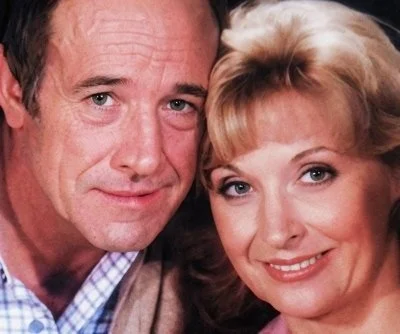
Equally compelling is Ian Hendry (Police Surgeon) as Malcolm, Maddie’s husband. The drama’s emotional core lies in the shifting, elusive dynamic between them. Their relationship is portrayed with an almost theatrical surrealism at times — intimate one moment, emotionally disconnected the next. Malcolm’s inability to accept Maddie’s approaching death becomes one of the series’ most devastating themes. He is not portrayed as cruel or uncaring, merely psychologically incapable of imagining a world without her. The eventual image of the family gathered around the dining table after Maddie’s death, with her absence finally undeniable, is profoundly moving precisely because the series has spent so long making her presence feel central to every corner of the household.
The supporting cast contributes enormously to the realism of the family environment. Sheridan Fitzgerald (Number 10) brings quiet emotional force to Gilly, Maddie’s pregnant daughter still traumatised by miscarriage, while Maddie’s sons represent the different forms male vulnerability can take — the composed professionalism of Gordon (Jeffrey Daunton – A Perfect Hero) contrasted against the uncertainty of university-aged Neil (Robert Duncan – Drop the Dead Donkey). Around them swirls the chaos of ordinary family life: pregnancies, emotional misunderstandings, practical pressures, financial concerns, and unresolved tensions. The brilliance of the writing lies in its insistence that catastrophe does not pause everyday existence. Even as Maddie is dying, life continues making demands.
The production style is also unusually distinctive. Because the series was performed live, there is a rawness and immediacy often absent from heavily edited television drama. Mistakes, hesitations, and emotional silences become part of the texture. The minimalist partial sets — cane chairs suggesting a conservatory, sparse dividers indicating domestic space, Malcolm’s portrait of Maddie looming symbolically in the background — create an atmosphere closer to intimate theatre than conventional television realism. This stripped-down visual approach focuses attention firmly on performance and dialogue.
Thematically, the series was remarkably ahead of its time. Dennis Vance and the writers approached euthanasia and the right to die with seriousness and empathy rather than sensationalism. In 1980, British television rarely addressed such issues openly, particularly in daytime broadcasting. Yet For Maddie with Love treated terminal illness neither as taboo nor moral spectacle. Instead, it explored the psychological and ethical realities faced by families confronting prolonged suffering. Nearly fifty years later, debates around assisted dying remain unresolved, making the series feel unexpectedly contemporary.
Nyree Dawn Porter herself spoke openly about wanting to expose the myths and silences surrounding terminal illness. That honesty permeates the drama. Maddie deteriorates gradually; relationships strain under pressure; family members fail one another and then attempt reconciliation. The emotional truthfulness is what gives the series its enduring power.
It is unfortunate that For Maddie with Love has largely vanished from public memory. Broadcast outside peak hours and never repeated or remade, it never achieved the cultural recognition afforded to more famous British serial dramas. Yet in many respects it was bolder and more emotionally intelligent than many prestige productions of its time. The Stage newspaper’s description of Porter’s work as “powerful and moving” scarcely does justice to the achievement. Above all, it remains a compassionate work — one unafraid to confront death directly while still celebrating the stubborn vitality of life.
Seen this show? How do you rate it?
Seen this show? How do you rate it?
Share on...
Published on May 19th, 2026. Written by Laurence Marcus for Television Heaven.