

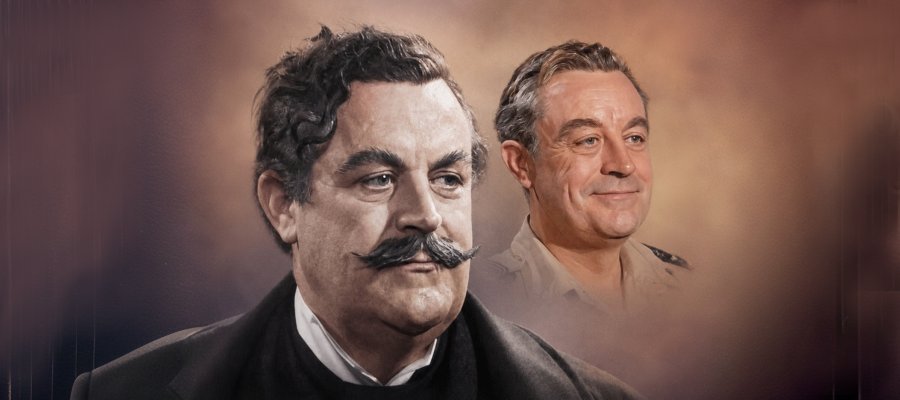
John Barrie
Best remembered as Sergeant Cork, the television detective often described as "the British Maigret", actor John Barrie was born in New Brighton, Cheshire, on 6 May 1917. He made his screen debut in an uncredited role in the 1954 film Yankee Pasha.
Before achieving fame in film and television, Barrie established himself as a respected stage actor within British theatre. During the late 1940s and early 1950s, he performed with a number of repertory companies, including the Old Vic Theatre Company and the Birmingham Repertory Theatre. One of his earliest notable stage appearances came in 1949, when he played Horatio in a production of Hamlet at the Old Vic. His commanding stage presence and clear delivery earned praise from critics, and the experience helped refine his craft while paving the way for his transition to screen acting.
In 1952, Barrie joined the Royal Shakespeare Company (RSC), appearing as Antonio in The Merchant of Venice and Banquo in Macbeth. His work with the RSC demonstrated his versatility, allowing him to excel in both classical and contemporary roles. Theatre critics commended his ability to bring depth and nuance to supporting characters, a quality that would later serve him equally well in television and film. Although he concentrated increasingly on screen work from the mid-1950s onwards, Barrie continued to make occasional stage appearances. His final recorded theatre performance came in a 1965 York production of The Crucible, in which he played Deputy Governor Danforth.
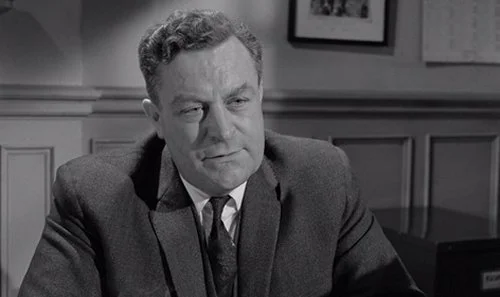
Barrie's first starring television role was as the head of the household in the now-lost BBC serial The Thompson Family, which premiered on Saturday, 23 November 1957, in the Children's Television slot. In 1959, he moved to ATV to star in The Wright People, a Midlands-based drama that the company hoped would replicate the success of Emergency-Ward 10. The series centred on a middle-class family, with Barrie playing John Thompson, a manager at a motor car component manufacturer in Birhampton. Although The Wright People was not fully networked and lasted for only 18 episodes, Barrie was to join the cast of Emergency-Ward 10 later that same year, portraying a Resident Surgical Officer (R.S.O.). It was, however, his portrayal of the Victorian police investigator Sergeant Cork that made him a household name.
Sergeant Cork ran for 66 episodes between 1963 and 1966. At the height of the programme's popularity in 1964, Barrie gave an interview to Today magazine for its 23 May edition, offering a rare and revealing glimpse into his personal life. That interview is reproduced here in full under its original title, I'm Far Too Squeamish To Be A Bobby.
“What does he mean to me, this Sergeant Cork who, on so many Saturday nights, plods his way through the fog and gaslight of Sherlock Holmes’s late - Victorian England?
When people come up to me and ask me to discuss this fictional policeman my reply sometimes shocks them. I tell them he means very little to me. “To me,”’ I say, “‘Cork is just another means of earning a living.”’
I’m not an expert on the things which are meat and drink to Sergeant Cork. I know little about police procedure and the idea of becoming a detective appals me. But as an actor I’m interested. It is, after all, my job to tackle many kinds of roles. Professionally, I don’t care whether I’m asked to play the skipper of a Grimsby trawler or a Roman centurion. It’s all the same to me just as long as the part—and the pay—is good.
Not that I would play any part today unless I was interested in the character.
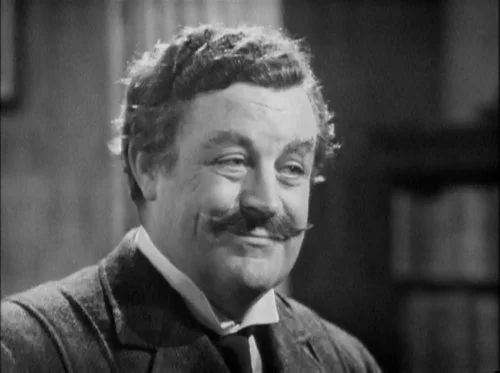
In the case of Cork I was sure the series would have considerable merit since it was the brainchild of Ted Willis. Lord Willis is one of Britain’s leading film and television writers and is an authority on police work. He wrote The Blue Lamp and created Dixon of Dock Green.
He knows the police details and that meant I could create a recognizable character just by studying his lines. I was glad of that as I’d make an awful policeman. I have far too much sympathy for those who find themselves on the wrong side of the law. I would hate to have to book a man or a woman for parking their car in the wrong spot, and I enjoy life too much to spend my time rounding up petty thieves.
And the really ugly side of crime—murder, rape, doesn’t fascinate me. It takes a special kind of make-up, I think, to become a surgeon, a tycoon or a criminal investigator. Just as it takes a certain kind of human being to become an actor, a performer capable of assuming a hundred different faces. In the long run I’m more interested in a man’s character than in his job. And even in my role of Sergeant Cork, I’ve often been very sorry for the people I’ve had to arrest.
Still, it was my business to make something out of this part and here my army experiences have been useful.
I was a sergeant during the war—a Company Sergeant Major in the Physical Training Corps—and, like Sergeant Cork, I had responsibilities that frequently went beyond my actual rank.
One thing I like about Cork is that he’s a man who started out as probationer constable on the beat and has a natural sympathy with the underdog. He does not suffer fools gladly, whether above or below him in rank. His outspokenness has probably cost him promotion, yet his skill at his job has prevented any attempt to remove him from office.
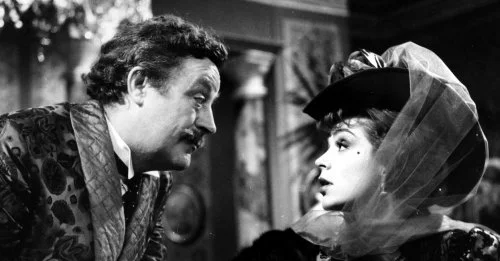
Cork often appears careless in his dress as he gets worked up over a case. But this is because he is not worried about personal comfort and food at these times. He will, if need be, spend the night on a chair in his office and he will be as happy with cheese and pickles as with an elaborate meal. There’s quite a lot of me in that type of man. During the war I learned how to sleep rough and while, today, I enjoy the comforts of life I am not dependent on them. I’d rather have one of each from the fish and chip shop than dine out with chianti and candlelight.
For instance, I’ve been working at Elstree Studios continuously for thirteen months. Weekends I drive up to my home near York as soon as I’m free. During the working week I stay at a country club near the studios. At Elstree I’m only fifteen miles from Mayfair, the night spots and the smart restaurants. Yet in all these thirteen months I’ve only been into London twice. I’m just not interested in London or the South. And this is where I differ from Sergeant Cork. He’s very much a Southerner—a Londoner maybe. Me, I’m North Country through and through. And I come down to the South simply because so much of the work’s down there.
And I think it’s wrong for people to be forced to move South, to get a job. I’m lucky. These days, I can afford the luxury of getting home as much as possible. But, if I had to be uprooted from Yorkshire, to go on playing Sergeant Cork or anyone else on television, I'd pack it in. Another point where Cork and I differ—he’s a bachelor. I’m not. My wife and two sons love the North as much as I do. John, twenty-two, is a BBC engineer. Michael is a farmer. It was quite by chance that we settled in York, though.
I am a village lad with a touch of Scouse, having been born across the Mersey from Liverpool. And I’m proud of it. I like Liverpudlians for being down to earth. I was born on May 6, 1917, and spent my childhood in a fishing village, Park Gate, in the Wirral peninsula of Cheshire. My mother was a schoolteacher, my father a quantity surveyor in the building trade, and I attended the local secondary school. When I left school I worked in a builder's office, sold oil, clerked in a transport office and in the sales department of a famous firm of tinned food manufacturers.
Even as a child I’d always been keen on amateur theatricals and, when I heard of a big festival at Chester, I got in as an actor. The festival lasted two weeks and I was spotted by a manager. At the time, I was getting £2 10s a week as a sales clerk, This manager offered me £4 10s to become an actor. Naturally, I jumped at the chance to make all that extra money.
My first job was at the Royalty, Chester, and my first producer was Arthur Leslie, now famous as Jack Walker of the Rover's Return in Coronation Street. I worked for about a year in repertory. Then the war broke out and I spent over six years in uniform. Back in civvy street I joined Arthur Leslie again and, after touring for a time, I was offered a job with the York Repertory Company. This was in 1952 and I stayed with the company for five years.
My sons reached the important schooling years then and my wife decided it was time we settled down in one place.
I first met my wife in amateur dramatics at Park Gate when we were both in our teens. My first impression of her was that she was stuck up and a bit above me. But I wore her down and she became more human. It was only then that I realized the real cause of her apparent arrogance. Ursula had lost both of her parents very suddenly. This had made her insecure and edgy. What I took for being toffee-nosed was actually a sense of deep loss and loneliness. The moment I realized this I knew that she had nothing against me as a person.
When the war started and I joined up, we both realized that the one thing we wanted was to get married, no matter how black the future seemed. Now Ursula and I are looking forward to our twenty-fifth wedding anniversary next year. And she says of my commuting between London and Yorkshire: "If you must go South for your job, then you must. But I don’t have to worry because in all the years you’ve been doing it, you have always hurried back home just as soon as you possibly can — if not sooner.” She’s dead right. Let Londoners live in London, if they want. But there’s so much doing in the North that I don’t care if I never see the West End again.
I haven’t got any unfulfilled ambitions. In 1957 I was brought down to London to play a part in a BBC television programme about the Luddites called The Machine Breakers. More parts followed and, since then, I’ve been busy in films as well as television. I’ve co-starred in the West End and even appeared at the Palladium.
All I want from the future is to have a cottage with a few pigs and chickens in the back and do about six television plays a year. This would mean I’d be at home for at least half of the year. Of course, the cottage would be in my real home—the North. If you paid me a million I wouldn’t live permanently in the South."
Although Sergeant Cork remained the role for which he was best remembered, John Barrie continued to enjoy a successful television career, going on to play another police officer in Z Cars before joining the cast of The Doctors, a long-running drama set around a north London general practice. He remained with the series until 1972, bringing to a close a television career that had spanned some of the medium's most formative years.
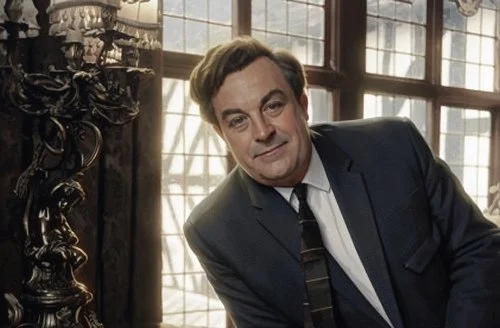
John Barrie retired from acting in 1973 and settled in York, where he devoted himself to family life and the management of a small chain of grocery shops. Away from the spotlight, he became an active member of the local community, supporting charitable causes and veterans' organisations in recognition of his own wartime service with the Royal Artillery. Known for his modest and unassuming nature, he spent his later years enjoying the company of his children and grandchildren until his death on 24 March 1980, following a brief illness attributed to a heart condition. He was 62.
While his screen career encompassed a wide variety of roles, it is as the thoughtful and determined Victorian detective Sergeant Cork that John Barrie remains best remembered by television audiences. Yet his later years also reflected the values he had often expressed: a desire for home, family and independence rather than celebrity. In retiring to York and stepping away from public attention, Barrie lived much as he had wished to live — quietly, purposefully and on his own terms, out of the spotlight that had once made him a familiar face in millions of homes.
Share on...
Published on July 16th, 2026. Written by Laurence Marcus for Television Heaven.