

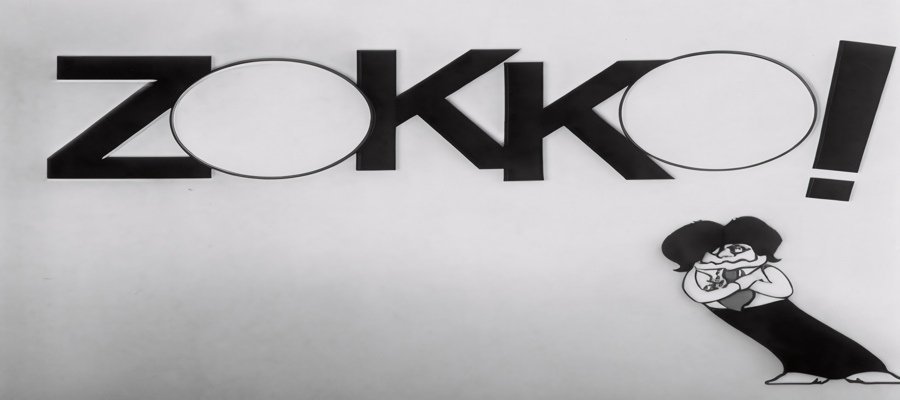
Zokko!
1968 United KingdomBefore Saturday morning television became a battleground of cartoons, celebrity presenters, swaps, and relentless pie-flinging, the BBC briefly decided that what children really needed was a talking pinball machine. Sensible? Not remotely. Memorable? Absolutely.
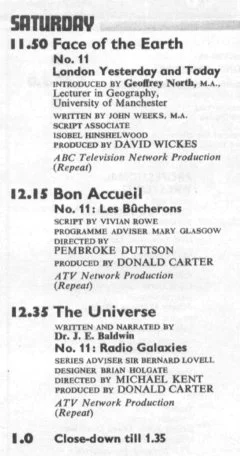
First broadcast in 1968, Zokko! a 20-minute presentation that began on 2nd November at 12.25 in the run-up to the BBC’s flagship sports show Grandstand, arrived with the ambitious claim of being "a weekly comic for children – electronic style," and for once the publicity wasn't exaggerating. Rather than following the format of conventional children's programmes, it mimicked the experience of flicking through a comic, darting from one feature to another with barely enough time to catch your breath.
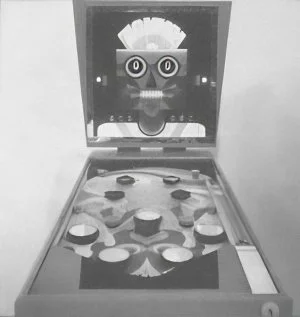
Instead of a presenter, viewers were guided by Zokko itself – a pinball machine (built by BBC Visual Effects designer Mike Ellis--father of later Blue Peter presenter Janet) that spoke in an electronic monotone, announcing each segment according to the score it had just achieved. Adding commentary from the sidelines was a tiny cartoon character called Mr. Zokko, whose wisecracks ensured there was never much chance of taking any of it too seriously.
The concept grew out of the BBC's earlier experimental Saturday morning show Whoosh!, a surreal magazine programme featuring Rick Jones, Dawn Macdonald and Jonathan Collins wandering around an eccentric set solving puzzles. Prior to this, neither the BBC nor ITV had really paid much attention to Saturday mornings, the Beeb filling it with an old black and white film or simply a blank screen or test card transmission, whilst the independent channels mostly presented repeated lectures or a foreign language instructional.
While Whoosh! proved there was an audience for Saturday morning children's television, producer Paul Ciani and Molly Cox decided to go one step further by removing human presenters almost entirely. It was a bold gamble, and in retrospect one that feels remarkably ahead of its time – or maybe it was just very much of its time.
The programme itself was an energetic scrapbook of short films such as stock motor racing footage, cartoons, pop records, magic (courtesy of Ali Bongo), live variety acts and serials, stitched together by a barrage of Radiophonic bleeps and electronic effects. Some inserts were admittedly filler—imported Disney clips (e.g. Fantasia highlights) made appearances—but most of the material was specially produced by Ted Lewis and Malcom Draper, giving Zokko! an identity unlike anything else on television.
Its main cartoon feature was undoubtedly Skayn, the science fiction serial following an astronaut battling strange threats in space. The first adventure saw him attempting to rescue the Moon People from the sinister menace of the Far Side, while the second series returned him to investigate sabotage on a lunar colony. These episodes were oddly calm and hypnotic, a curious contrast to the frantic pace surrounding them. One minute you were bombarded with psychedelic graphics and electronic squawks; the next you were floating serenely through space. It really shouldn't have worked, but somehow it did.
Visually, Zokko! embraced the Swinging Sixties with almost reckless enthusiasm. The flashing geometric patterns, surreal animations and bold graphics must have looked astonishing in 1968, even in black and white. Whether the average child found it exciting or quietly wondered if the television had developed a fault is impossible to know. Either way, it certainly stood out. Watching it today can feel less like children's television and more like stumbling into an art installation after taking a wrong turn. Even Monty Python’s Flying Circus adopted it for a sketch!
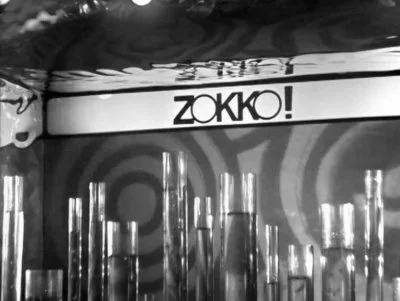
When the programme returned in late 1969 for a second series, the production wisely toned down some of the more aggressively psychedelic design. The talking pinball machine disappeared, replaced by a mysterious new music machine, but the overall spirit remained intact. Alongside the return of Skayn came Susan Starr of the Circus, a crime serial with voice performances from Jennifer Hill, Alan Devereux and Stanley Page, continuing the programme's habit of mixing wildly different genres together.
Sadly, very little of Zokko! survives. Like so much British television of the era, most of it fell victim to tape wiping, leaving only two episodes including the the final one of the second series and a compilation edition rescued by a private collector. That scarcity has only enhanced its reputation as one of the BBC's strangest forgotten experiments.
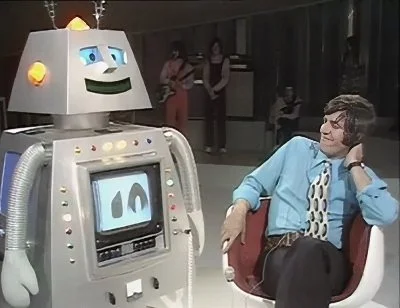
Far from being put off by Zokko!'s delightful eccentricity, the BBC continued to give Paul Ciani free rein to experiment with new ideas for Saturday morning television. Later in 1970 came EdandZed!, a short-lived series that teamed Radio 1 DJ Ed Stewart with a robot sidekick called Zed, voiced by Anthony Jackson. It carried forward many of the ideas explored in Zokko!, before Ciani returned in 1973 with the equally imaginative Outa Space!
Looking back, Zokko! feels like a programme from an alternate universe where children's television took a sharp left turn into psychedelic science fiction before anyone had a chance to object. It wasn't always polished, it probably wasn't always coherent, and at times it seems powered entirely by enthusiasm and electronic sound effects. But its willingness to experiment paved the way for later Saturday morning off-the-wall shows such as TISWAS, proving that children's television didn't have to follow established rules. It could be loud, weird, inventive and just a little bit bonkers. And sometimes, apparently, all you needed to hold the whole thing together was a chatty pinball machine.
Seen this show? How do you rate it?
Seen this show? How do you rate it?
Share on...
Published on July 28th, 2026. Written by Laurence Marcus for Television Heaven.