
Downtime
Review by Daniel Tessier
Between 1989 and 2005, there was no ongoing series of Doctor Who. There was the TV Movie starring Paul McGann in 1996, and a couple of charity skits – one very good, one certainly not. There were books, of course, and audioplays and webcasts and comics, but that wasn't the same. For many fans, these “Wilderness Years” were unacceptably lacking in new Doctor Who. So, a select few decided to do it themselves.
There have been fan films of popular series since camcorders were invented, but certain Doctor Who fans wanted to be more than just that. They wanted to continue the legacy of the programme in as close to an official and legitimate way as they could. Some were professional and semi-professional actors, writers, directors and producers, and were in a position to create something more sophisticated than the usual fan production.
Perhaps the most skilled and experienced group was Reeltime Pictures, an independent production company founded in 1984 and still going strong today. While Reeltime's main income is from corporate and information videos, the company also produces documentary programmes and the occasional drama. Reeltime's Myth Makers series features interviews with dozens of contributors to Doctor Who's long history, but it was the move into original drama production that was most significant to Doctor Who fans. Reeltime produced the very first BBC-sanctioned Doctor Who spin-off, Wartime, in 1988, while the programme itself was still on the air. Starring John Levene reprising his 1960s/70s role as UNIT officer Benton, Wartime was a modest affair but proved that Doctor Who related films could work and sell, at least to the hungry fan community.
The BBC weren't about to give a small company the rights to make actual Doctor Who or use the Doctor, but they were willing to licence certain characters from the series. Complicating the matter of licensing is that, due to the nature of freelance writing contracts in the twentieth century, a number of characters and concepts belong to the original writers of the scripts, in whole or in part, as opposed to the BBC. Mervyn Haisman and Henry Lincoln, who together wrote three 1960s Doctor Who serials – The Abominable Snowmen, The Web of Fear and The Dominators – therefore had ownership of some of the series' major characters, including partial ownership of fan favourite Brigadier Lethbridge-Stewart.
Downtime, a direct-to-video release originally intended for Doctor Who's thirtieth anniversary in 1993, had a slow start to production and was eventually released in 1995. It was produced by Reeltime founder Keith Barnfather; written by Marc Platt (writer of 1989 serial Ghost Light); and directed, in quite a coup, by Christopher Barry, who had worked on the programme since its very first season and had directed serials for the first four Doctors. A sequel to both The Abominable Snowmen and The Web of Fear, Downtime became the final part of a Yeti trilogy. As well as bringing back these memorable monsters, the film featured no fewer than three actors returning to play major, regular characters: Nicholas Courtney as the Brigadier, Deborah Watling as Victoria Waterfield, and Elisabeth Sladen as Sarah Jane Smith. While Courtney had appeared in Doctor Who's last season in 1989, Watling hadn’t appeared since her exit story in 1968 (not counting a repeat showing of The Evil of the Daleks), and Sladen hadn't appeared since the twentieth anniversary special The Five Doctors in 1983.
With all this professional talent on board and ready to make this new chapter of almost-Doctor Who, surely it had to be something pretty special? Well...
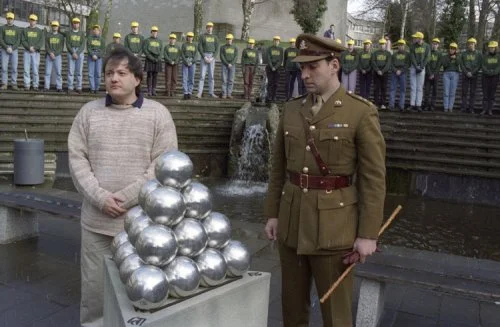
In spite of the talented and experienced people in front of and behind the camera, Downtime is still a very amateurish production, very obviously the work of a company with limited drama experience. Even at its ropiest, actual Doctor Who never looked quite so shoddy as this. Of course, this was made on a budget of next to nothing, and the little it had, mostly went to the cast and director. So some extremely cheap effects work and some guerilla-style location filming is forgivable. The script is quite good; Marc Platt had written the dense and sinister Ghost Light for Doctor Who's final season, and he brings some of that complexity and creepiness to Downtime. The story is very much for die-hard Doctor Who fans – after all, who else would be buying this? – serving as a sequel to the Patrick Troughon serial The Web of Fear as well as following up on characters and plot threads from various stories of the sixties, seventies and eighties. On the other hand, in many ways it is incredibly nineties, not least in the way that the Great Intelligence – the villainous entity that twice faced the Doctor in the 1967-8 season – tries to take over the world by brainwashing students with computers.
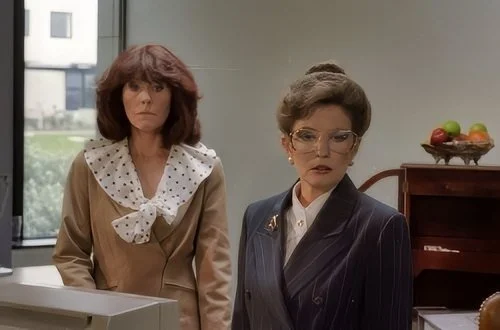
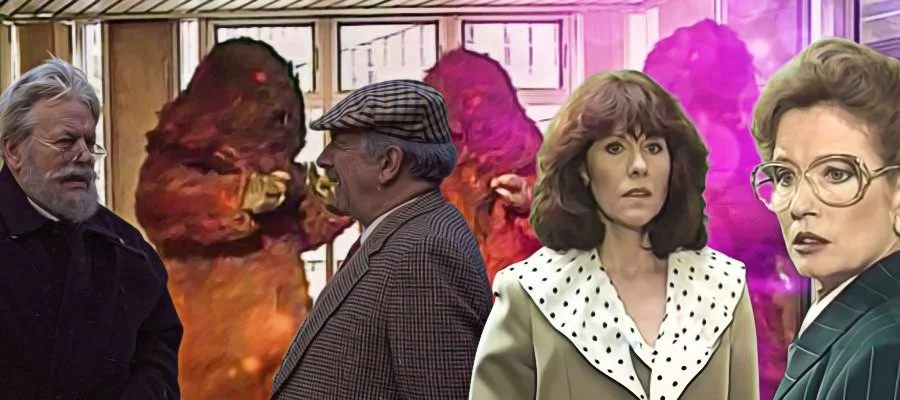
The performances of the returning Doctor Who cast are mixed. Elisabeth Sladen is as good as ever, but she's hardly in it, basically bookending the story and acting as a way to bring the Brigadier into things. In fairness, the character wasn't originally written as being Sarah Jane, simply another journalist, but director Chris Barry suggested she ask for the role. Sarah is contacted by Victoria, who is still living in the twentieth century following her exit in Fury from the Deep. Once a posh girl from the 19th century, Victoria is now a rather ruthless middle-aged woman running a university. Victoria tries to get information on UNIT from Sarah, who wisely then informs the Brigadier.
Victoria's story is central and works well. She has been trying to contact her long-dead father by tracking down a mystical locus that can reach other planes of existence, but is being manipulated by the Intelligence. With Deborah Watling on board, her father Jack Watling was keen to return too. Having played explorer Edward Travers in both The Abominable Snowmen and The Web of Fear, he returns to the role as very elderly Travers, written into the script as the unwilling host of the Intelligence. Having both Watlings in the cast was another boon that made the film even more exciting for fans, but pushed the casting budget up beyond its limit. To be honest, the money wasn't well spent. Neither Jack nor Deborah are particularly good in Downtime and struggle to carry their important roles in the story.
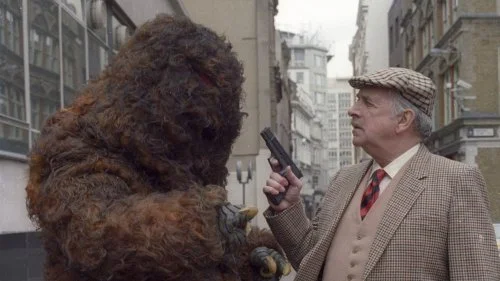
Nicholas Courtney, on the other hand, is excellent. He's the real star of the show, the Brigadier being the hero of the hour, drawn into a plot by his old enemy that spreads to risk his own family. Courtney is spot-on as the older, more tired but still resolute and courageous soldier. He is targeted by Victoria, the Intelligence and their minions because they believe he is in possession of the locus from his previous encounter with the entity. The Intelligence also fancies a bit of good old-fashioned revenge against the man who once helped defeat him. However, the locus is actually in the possession of the Brigadier's estranged daughter, Kate.
It will probably be a surprise to most viewers, but Kate Lethbridge-Stewart, the popular and important recurring character played by Jemma Redgrave on the revived Doctor Who and The War Between the Land and the Sea has her origins in a cheap video spin-off from the nineties. The revelation of a daughter for the Brigadier was a major addition to Doctor Who's growing mythology and gave Courtney a new way to play the character he'd owned for almost thirty years.
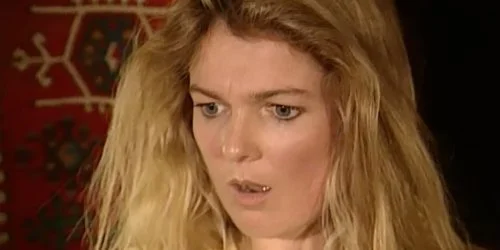
Now, there's nothing official to say that the Kate from Downtime and the Kate from Doctor Who proper are one and the same, but they clearly are. Still, the Kate we meet here is a pale shadow of the woman she becomes later. She and her father are estranged, so that he doesn't even know that he's a grandfather to a five-year-old boy, Gordy. Kate, living on a narrowboat for whatever reason, is an unassuming type and certainly not the powerful head of UNIT. Feasibly, though, her encounter with the Great Intelligence is what sets her on her new path. It has to be said, though, that Beverley Cressman is nowhere near as impressive as her eventual successor in the role, giving a fairly one-note performance as Kate.
The remaining cast are just as mixed. Geoffrey Beevers, known to fans as the “interim” incarnation of the Master who appeared in 1981's The Keeper of Traken, gives a characterful and spirited performance as Harrods, a washed-out former officer who becomes an important ally. John Leeson, best known as the voice of K-9, portrays the university DJ, and he's pretty good in a very limited, somewhat annoying role. Shakespearean actor Miles Richardson – son of Ian Richardson and, at the time, married to Beverley Cressman – gives a strong performance as compromised UNIT leader Captain Cavendish.
Much of the rest of the cast is made up of amateurs, presumably fans, and frankly, some of the extras can't even play zombified students convincingly. Baby-faced Mark Trotman, as the Brigadier's former student and now ally Daniel Hinton, is frankly dreadful. It's something of a relief when he gets transformed into a Yeti. Peter Silverleaf – here at the beginning of a career that went on to include roles in Casualty and The Bill – is pretty good as oily university marketing manager and Intelligence pawn Christopher Rice.
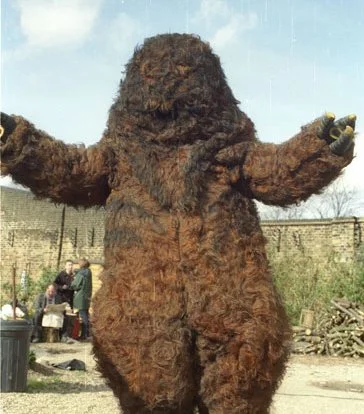
In the end, Downtime is a fun diversion, so long as you don't expect too much from it. It would no doubt have helped bridge the gap between Doctor Who's last season and the airing of the TV Movie for hungry fans, but it would be hard to recommend it to anyone other than a died-in-the-wool Whovian. Its reception at the time was mixed, although it's fair to call it one of the best such productions of its type. It was popular enough to get a belated sequel, the 2004 DVD release Daemos Rising, a follow-up to the popular 1971 serial The Daemons, starring Cressman and Richardson as Kate and Cavendish. Downtime itself had the privilege of being novelised as an official Doctor Who story. Marc Platt adapted his own script as an entry in Virgin Books' Doctor Who Missing Adventures range; a cameo from the Doctor in the prologue and epilogue helped make it fit more comfortably into the range. Downtime was eventually released on DVD in 2015 and surprisingly, appeared for streaming on Amazon Prime in late 2025.
Share on...
Published on March 27th, 2026. Written by Daniel Tessier for Television Heaven.