
The Wheel in Space
Review by Daniel Tessier
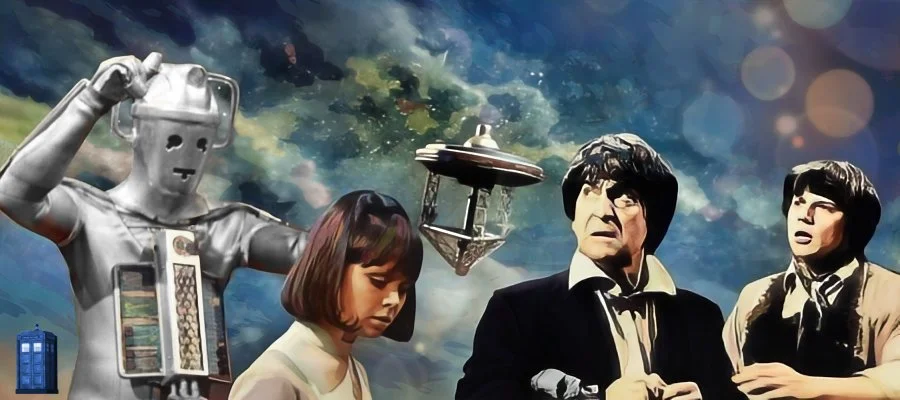
Doctor Who's fifth season ended in a similar fashion to its fourth: introducing a new companion to star in the following season, with a popular and arguably overused monster making a return. The Wheel in Space is the fourth appearance of the Cybermen in less than two years, but this time their presence is not the focus of the story. While the machine creatures are the central threat and are behind all the troubles that befall the space station of the story's title, The Wheel in Space is really about the tense culture on the station itself and the society of the distant 21st century.
Doctor Who made several visits to the 21st century during Patrick Troughon's time as the star, but there was no attempt to make a consistent vision of the future. Each writer created and explored their own ideas of what the future might hold. The Wheel in Space was drawn up by Cybermen co-creator Kit Pedler, and it's full of his trademarks: an isolated base, an international crew of scientists, and, of course, the Cybermen themselves. Pedler would normally work with Gerry Davis to turn his outlines into full scripts, but Davis was committed to the BBC series The First Lady at the time this serial was being put together. Instead, David Whitaker, the series' original script editor, was hired to write the scripts, and it's full of his own telltale story elements. The story features professionals with compromising personal and romantic histories together, giving this future world a human reality many such stories are missing. It's also chock-full of Whitaker's baffling brand of pseudoscience, right down to his obsession with the element mercury.
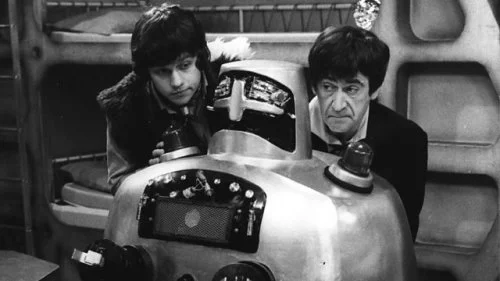
A brief summary just so you can get your heads round this particular plot: the TARDIS once again malfunctions, with the Doctor making it worse by fiddling with the console and causing the mercury in the fluid links to evaporate. Anyone who watched the heavily Whitaker-ised first season story The Daleks will know that the TARDIS can't run without mercury, and the Doctor still hasn't thought to keep a back-up supply. The Doctor and Jamie find themselves marooned with a non-functional time machine aboard an abandoned spacecraft. The one functioning robot on board causes a sudden course change, causing the Doctor to wang his head and suffer a concussion. The ship drifts close to Space Station W3 – the eponymous Wheel in Space – and is brought onboard. Frazer Hines gets to carry episode two while Patrick Troughon has a week off, the unconscious Doctor portrayed by a stand-in under a blanket.
No one is aware that the ship also contained a bunch of Cybermen. They send a bunch of Cybermats, the little mechanical critters introduced in The Tomb of the Cybermen at the other end of the season, onto the station. The Cybermen's plan is.. hang on, I think I've got this right: The Cybermen have caused a star several thousand light years away to go nova, which has diverted a meteor shower towards the station. They've sent the Cybermats on board to eat up all the station's supply of special metal, bernalium, which is needed to power the lasers that can blast away the meteorites. This means some of the crew have to nip over to the ship and get some of the bernalium handily stored there. Except the bernalium crates actually contain Cybermen, snoozing away in big plastic eggs. When the crew – hypnotised for good measure – bring the supplies on board, these Kinder Surprises hatch into Cybermen, who will take over the station and use it as a beacon for their invasion of the solar system.
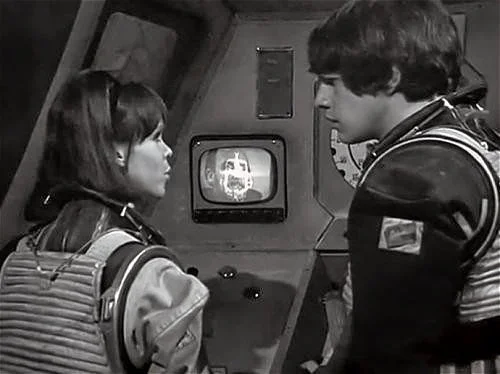
Now, it's just possible I've got the odd little detail wrong there, but believe me, the plot really is that ridiculous. Which is a pity, really, because plot aside, there's a lot here that works. The entire cast is doing exceptional work with what they've been given. Troughton is less in his usual gremlin mode here, laying on the charm and ingratiating himself with the station crew, but shifting to cold resolution as soon as the time comes to deal with the Cybermen. Frazer Hines may be even better than Troughton in this serial. With Troughton away for an episode, he takes the lead in a way he doesn't usually get, as Jamie does the usual Doctorish things. Trying to account for their presence on the spaceship, Jamie comes out with quick-thinking excuses, false identities and occasional honesty for good measure, to ensure that his presence, and an attempted act of sabotage (for the best possible reasons), don't land him in a brig or out the airlock. He also gets to be the one who first meets the new companion character, getting her on side and intriguing her as a strange man out of time. Maybe there's potential in a version of Doctor Who led by a handsome young man in a kilt?
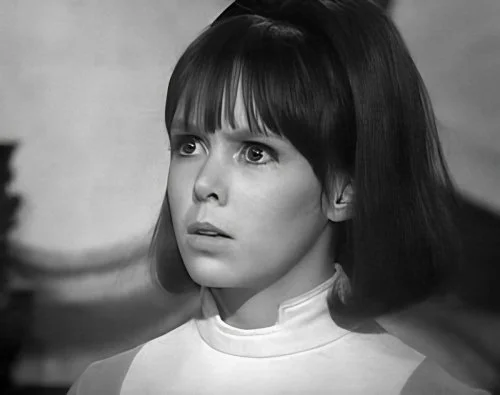
However, the new companion is the big deal here. Zoe is a fantastic addition to the show. Wendy Padbury, off a long stint on Crossroads and later to star in Freewheelers and guest on Emmerdale Farm (the latter opposite Frazer Hines, of course), makes her Doctor Who debut. She immediately impresses as Zoe Heriot, a character who is both adorable and mercilessly intellectual. Padbury had not long turned twenty, but Zoe was described as being anywhere from fifteen to only twelve in behind-the-scenes material. Whatever her age, she's a child prodigy, hyper-intelligent and faultlessly logical. Acting as the station's astrophysicist, librarian and mathematician, Zoe has been trained to think in pure logic and reason, and the crew even get her to check the computer's results to make sure it's working OK. She's eager to please and happy to help, yet much of the crew resent her, put off by her apparently emotionless nature, something that even Zoe is beginning to feel is holding her back. This Spock-type character, the “walking computer,” isn't exactly an original concept for a sci-fi series but it offers a fascinating glimpse at how the writers were envisioning the future.
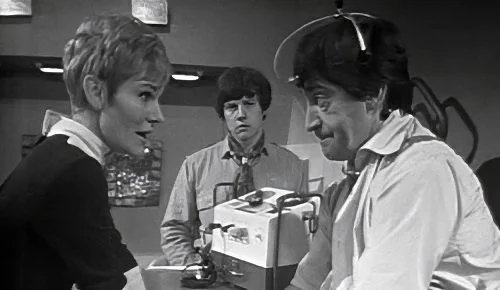
Among the guest cast, Anne Riddler (Wyatt's Watchdogs, Terrahawks) stands out as Dr. Gemma Corwyn, the chief medical officer and second-in-command of the Wheel. She's also a psychiatric counsellor – and you thought Star Trek: The Next Generation was the first sci-fi to put a counsellor on the bridge. Undoubtedly the most level-headed among the crew (save for Zoe, naturally), Gemma develops a mildly flirtatious relationship with the Doctor. He certainly seems to take it unusually hard when she is killed by the Cybermen. Not long after, Troughton delivers a fluff that William Hartnell could only dream of, when he mentions the “sexual air supply.” He probably meant to say “sectional,” but I guess Gemma really was on his mind.
Michael Turner (Crossroads, Mr. Pye) gives a suitably neurotic performance as the overwhelmed station controller, Jarvis Bennett, while Eric Flynn (Ivanhoe, The Black Arrow) puts on a raucous Australian accent as the heroic officer Leo Ryan. The beautiful Clare Jenkins (also known for Ivanhoe) previously played Nanina in The Savages; here, she plays Russian “Astrogator” Tanya Lernov, constantly flirting with Leo when she's not taking on his duties in the middle of an emergency. Also of note is a 25-year-old Donald Sumpter in the first of several Doctor Who roles as young Italian officer Enrico Casali.
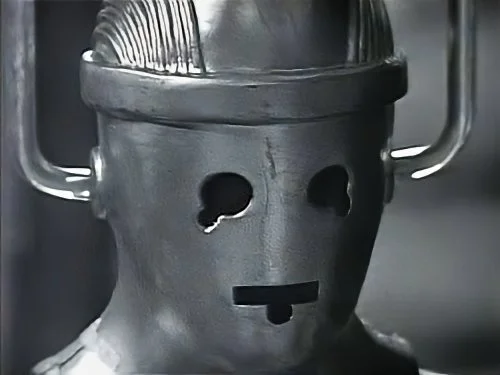
Much of the serial's runtime is devoted to fleshing out the characters' relationships and exploring the tension among the crew, making it all the more powerful when characters are compromised or killed. Meanwhile, the twin threats of the meteor storm and the encroaching Cybermen provide increasing tension from outside. When the Cybermen do finally arrive in force, they're suitably intimidating. They've had another redesign, making them sleeker than before, and adding the now iconic “teardrop” design to their eyeholes. The redesign goes a long way towards making the Cybermen creepy again, something they've not managed to be since their first appearance. The addition of the Cyber-Planner – a sort of disembodied brain wired into the Cybermen's commandeered ship – is another nice edition.
Like most of the serials in season five, The Wheel in Space is today incomplete; only the third and last episodes of this six-part story remain in the archives. Like all 1960s Doctor Who, the soundtrack survives thanks to some low-tech but enthusiastic piracy, while telesnaps also exist for its full run (the last such serial to enjoy this treatment for all episodes). The Wheel in Space has not been lucky enough to be recreated through animation, save for a condensed version of the first episode created for the 2018 Missing, Believed Wiped event. (This is included on the DVD and Blu-Ray releases of The Macra Terror, for some reason.)
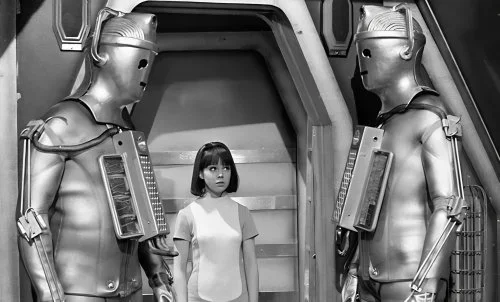
The Wheel in Space does not have a stellar reputation among the series' fans, although much of this may simply be down to coming in at the end of a run of very popular serials. It's a creepy, slow-burn story where the danger gradually mounts until the threat is right there within the pressurised walls of the station. Unfortunately, it's compromised by the absurdity of the plot, from the Cybermen's ludicrous plans to the idiotic actions by some of the crew.
It does, however, give us one of the all-time great TARDIS teams. When Zoe sneaks on board the TARDIS in the serial's final moments, the stage is set for season six and one final triumphant run for black-and-white Doctor Who. Before the season break, though, the show's producers had one more treat up their sleeves: Doctor Who's first full repeat serial. The previous season's finale, The Evil of the Daleks, was lined up for a repeat, and this was built into the ongoing story of the programme. Now that Zoe's onboard, the Doctor decides to show her what to expect out there in the universe... so he plugs himself into the TARDIS and brings up his recent adventure on the scanner. So this sort of thing didn't start with Tales of the TARDIS after all...
Share on...
Published on March 29th, 2026. Written by Laurence Marcus for Television Heaven.