

Ike: The War Years
1979 United StatesReview: John Winterson Richards
It is easy to underestimate Ike. Many of his contemporaries did, and he is not a favourite among academic historians for whatever that might be worth. His fellow professional soldiers tended to look down on him as too much of a politician while actual politicians tended to write him off as too much the simple soldier. He was neither. As both soldier and statesman he flourished in the grey area between the two roles that modern geostrategy has made increasingly important, a politically savvy commander-in-chief when that was most needed. As such, he made some big mistakes, both military and political, but no one ever doubted his integrity, which is why most really did "like Ike." The more one studies and reflects on him the more one realises he deserves more respect than he has generally been given, the opposite of what usually happens when one begins to explore major historical figures in greater depth.
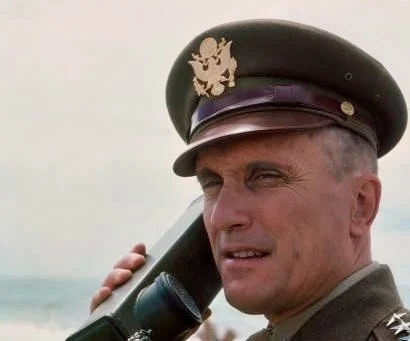
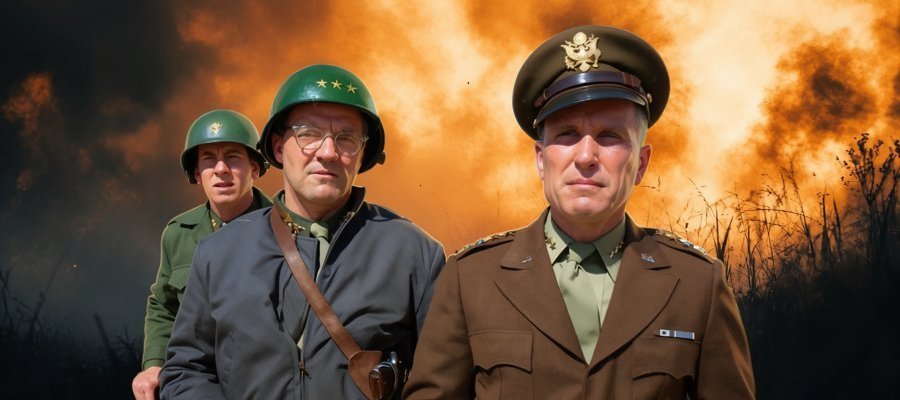
It has been particularly interesting to compare the two biggest television biographies of Ike, both of which are confined to his service in World War Two. Both say as much about the different periods in which they were made as they do about Eisenhower. The relatively low key Ike: Countdown to D-Day, with Tom Selleck in the title role, is also reviewed on Television Heaven. This is a review of Ike: The War Years, sometimes marketed simply as Ike, a wide-ranging miniseries starring Robert Duvall as the eponymous hero, made near the peak of what might be termed the "Golden Age of the Hollywood Miniseries" a full twenty-five years before.
There is a definite change in tone. Where Countdown to D-Day is an intense, fairly realistic drama, in spite of some inaccuracies, The War Years is a sprawling epic. It relies a great deal on colourised documentary footage shot during the War, some of it very familiar, combined with reused material from Post-War dramatisations, most notably the Oscar winning feature film Patton a few years before. Since Patton, for all its undoubted greatness as drama, tends to be mocked by military historians for its use of anachronistic tanks, this rather undermines its authenticity from the start.
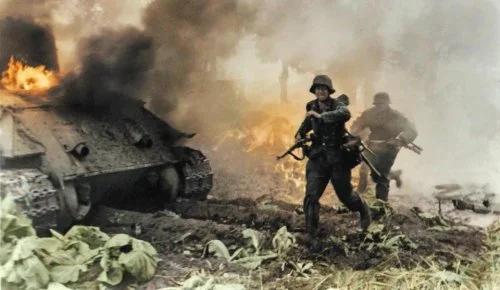
Indeed, it is a frustrating business to try to sort the facts from the inaccuracies. As is often the case, someone has obviously gone to some trouble to get a lot of minor details right, this giving a false impression of integrity, only for the final draft of the soapy script to abandon all concern for historical truth in pursuit of squeezing every possible drop of drama out of situations in which history offered more than enough without the need for embellishment. Even where there is some essence of truth in the melodrama, events are exaggerated or telescoped, and scant respect is shown for the historical timeline. It also must be noted that all is presented very much from the American point of view, the British being stuffy and obstructive as usual in Hollywood productions - but history proved the British right on most of the main points of contention.
The greatest inaccuracy is almost certainly the reliance on the memoirs of Ike's driver, Kay Summersby, in which she claimed they had an affair. Most reputable historians doubt this, and it is significant that she published her book several years after Ike's death when the laws of libel could no longer be applied and most of the other people in a position to refute her were also gone. While it is true that some high ranking officers, away from their wives and children, may have taken advantage of the young women in uniform around them - Red Army generals often had unofficial "campaign wives" - most of the memoirs and diaries we have suggest that those in active command positions would have neither the time nor the privacy to carry on clandestine liaisons. Moreover, it goes against everything we know about Eisenhower: he was a deeply religious man who chose to be baptised privately after he became President despite the fact that it would have been greatly to his political advantage to make a big show of it before he was elected - a complete contrast with the overt displays of religiosity by candidates of both American parties in recent years. It may well be that having an outgoing feminine presence in his almost exclusively male inner circle cheered him up under extreme stress, and he did become close to his driver, as many did, but more than this seems unlikely.
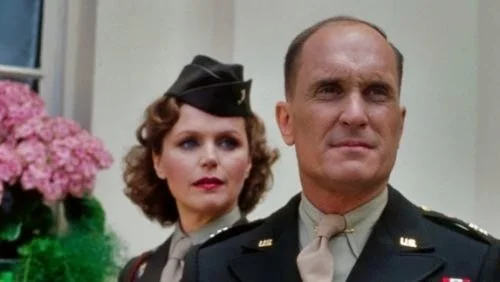
The lovely Lee Remick plays Summersby with her usual charm, probably making her far more attractive that she really was, or any woman could be who was not Lee Remick. Nevertheless, one still gets the impression that this was the sort of woman who would be great fun at a party, but might get a bit wearing if one was constantly in her company. Whether or not this was a deliberate acting choice is impossible to say with certainty.
Unlike Tom Selleck, Robert Duvall starts with the advantage of a basic physical resemblance to Eisenhower. He is a lot less reverential than Selleck and he does not hold back when he loses his temper - something Duvall always did particularly well. Although Eisenhower's ability to work easily with all sorts of different people was the key to his success, when he got angry, he got really angry. Overall it is another memorable Duvall performance, further proof of the versatility that made him one of the greatest film actors of his generation, possibly of all time (see our reviews of Lonesome Dove, The Godfather Saga, and Stalin for further illustrations).
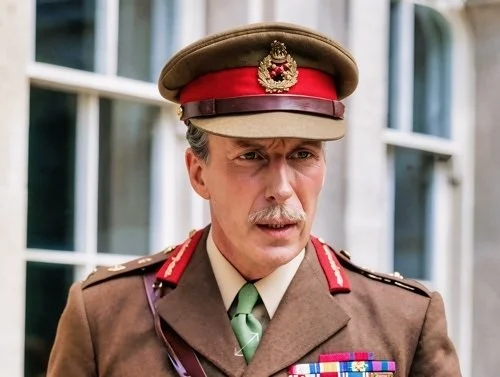
Yet even he is sometimes upstaged by Ian Richardson as Sir Bernard Law Montgomery in their scenes together. Curiously Richardson played Montgomery twice that year - the two performances are in fact listed as consecutive credits on IMDb. The other was in Churchill and the Generals, a much better written BBC television film. Unlike most who have played the Victor of El Alamein, Richardson seems to have understood that the famous arrogance was not brittle bravado - Monty's self-confidence was so complete that he could not understand why others did not simply acknowledge his superiority. This comes across very well in a scene in which he does not even attempt to hide the fact that he wants Ike's job because he is certain he could do it better. He seems to be inviting Ike to agree.
Wensley Pithey, best known on British television as Superintendent Charlesworth in several series in the late Fifties, is an ebullient Churchill. The ubiquitous Vernon Dobtcheff may well be the definitive Charles de Gaulle. Dana Andrews is a domineering George Marshall but is given no opportunity to show the courtesy and consideration that impressed everyone who met the original. The reliable Bonnie Bartlett is likewise given little to do as Mamie Eisenhower beyond the usual supportive wife stuff. Paul Gleason (The Breakfast Club) is given leave from his usual disagreeable authority figures to play Kay's too agreeable to be true fiancé. JD Cannon is kind to Walter Bedell Smith, Ike's efficient but awkward Chief of Staff. Don Fellows, who later played Bedell Smith in The Last Days of Patton appears here as Carl Spaatz. Other familiar faces include Martin Jarvis as King George VI, David De Keyser as Sir Alan Brooke, and Terence Alexander as Sir Arthur Tedder, here listed as "General" Tedder rather than Air Chief Marshal.
That niggle rather sums up Ike: The War Years. For all the skill and presence of its very distinguished cast, it lacks the greater sophistication, authenticity, and dramatic tension of Countdown to D-Day a quarter of a century later. The general standard of television writing improved enormously in the Eighties and Nineties, prompting the thought that in this regard at least the Golden Age of the Hollywood Miniseries was not quite so golden after all.
Seen this show? How do you rate it?
Seen this show? How do you rate it?
Share on...
Published on July 24th, 2026. Written by Laurence Marcus for Television Heaven.