

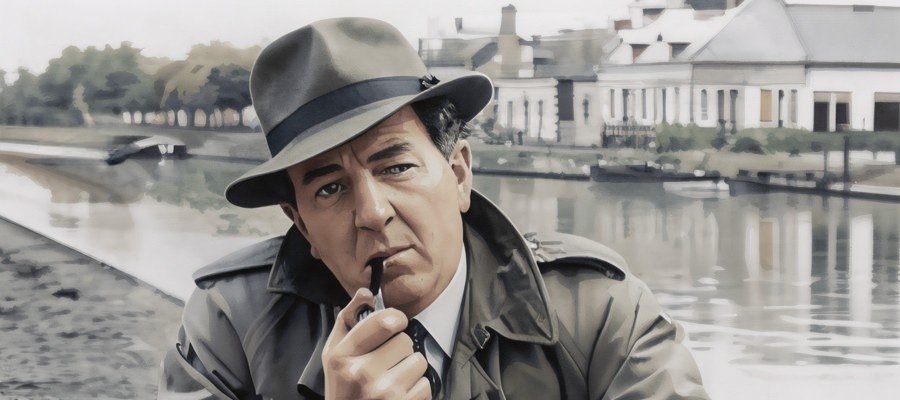
Rupert Davies
(1916–1976): The Actor Behind Maigret
There are actors who become inseparable from a single role, and there are those whose careers extend far beyond the part for which they are best remembered. Rupert Davies belonged to both camps. To millions of viewers in Britain and abroad, he was forever Inspector Jules Maigret, the thoughtful, pipe-smoking French detective who walked the streets of Paris in the BBC's celebrated adaptations of Georges Simenon's novels between 1960 and 1963. Yet Davies himself always regarded Maigret as simply another stage in a much longer journey. He had no desire to become a permanent television detective; he wanted only to continue working as an actor.
That determination had been forged long before fame arrived. His life encompassed the Merchant Navy, aerial warfare, imprisonment in one of Germany's most notorious prisoner-of-war camps, and years of theatrical apprenticeship before success finally came in middle age. His experiences gave him a depth and humanity that audiences instinctively recognised, even if they never knew why.
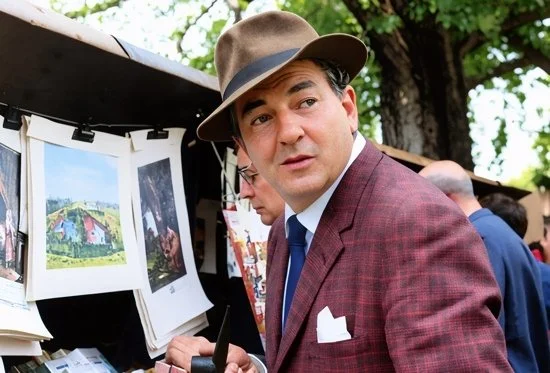
Born Rupert Lisburn Gwynne Davies on 22 May 1916 in Liverpool, his father, Howard Davies, and mother, Louie Lloyd Thomas, were both Welsh by birth. Howard came from Llannon in Carmarthenshire, where his father, Evan Henry Davies, had been a Congregationalist minister. Louie was born in Cardigan.
Howard initially worked as a schoolteacher before moving to Liverpool and entering banking. By 1911 he was employed as a clerk at the London and Provincial Bank, living above the premises at 145 Walton Road. Promotion followed quickly, and by the time Rupert was born he had become manager of another branch nearby. The family home, Bank House, 189 Walton Road, stood directly above the bank itself, a common arrangement at the time.
Little is known of Rupert's schooldays. At sixteen, with his parents by then living in London, he was sent to a training ship with the intention of making a career in the Merchant Navy. It proved an adventurous beginning. He later recalled, with characteristic understatement, that he had sailed "seven times to Australia" before deciding that his future lay elsewhere.
As Europe drifted towards war, Davies transferred to the Royal Navy Reserve, driven by one ambition: he wanted to fly.
He trained as an Observer in the Fleet Air Arm and served as a Sub-Lieutenant aboard HMS Glorious in the Indian Ocean before returning to Britain for operational service. Flying in the elderly but dependable Fairey Swordfish, he took part in mine-laying sorties from Lincolnshire airfields, navigating while his pilot flew low over hostile waters.
His war changed dramatically in 1940.
During one mission the Swordfish was forced down into the North Sea off the Dutch coast. Davies and his pilot spent hours drifting in a dinghy before being picked up by German forces. The remainder of the war was spent as a prisoner, much of it in Stalag Luft III, the camp that would later become famous through The Wooden Horse and The Great Escape.
Davies attempted escape three times, each ending in recapture. He was also involved, though without fully appreciating it at the time, in preparations for what would become the Great Escape. Only after the war did he realise why fellow prisoners had seemed obsessed with gymnastics, vaulting horses and apparently pointless physical exercises.
More profoundly, imprisonment confronted him with both humanity at its finest and its darkest.
Years later he recalled one of the bleakest moments of his life. Following the execution by the Gestapo of fifty officers recaptured after the Great Escape, Davies found himself conducting an auction of the murdered men's possessions.
In a frank and revealing article that he penned himself for Odhams’ weekly magazine Today in February 1964, he wrote:
'I stood up there on a soap box in Stalag Luft III, conducting an auction of the dead men’s possessions. And the terrible thing was that to jolly the money out of the men there, and to hide our anger and grief, I had to make them laugh.
“What am I offered for this jacket, for this toothbrush?’’ I said. I joked about each item, each pathetic reminder of all those comrades, who had been murdered. People paid fantastic prices for these things—because they were more than a pair of shoes, more than a toothbrush or jacket. They were symbols of our defiance and contempt and anger which could be expressed in no other way.
And so, joke by joke, I mined £11,000 out of my fellow prisoners of war for the families of the men who had died.'
Reflecting on the incident twenty years later, he admitted that, for a brief moment after hearing of the executions, he had wanted to kill any German he encountered. The feeling passed, replaced by the practical need to do something useful. That episode remained central to his understanding of human nature and later informed his approach to acting. To portray evil convincingly, he believed, an actor had to acknowledge the capacity for darkness within himself.
Stalag Luft III changed Davies's life in another, happier way.
Like many prisoner-of-war camps, it developed an active theatrical tradition. Davies became involved in performances staged for fellow prisoners, discovering talents and ambitions that had previously lain dormant.
The experience convinced him that acting—not the sea, nor the Navy—would be his future.
Upon his release in 1945 he scarcely paused before pursuing that ambition. Almost immediately he joined Back Home, a stage production featuring former prisoners of war at London's Stoll Theatre. The following year he made his first appearance on BBC Television and began what would become nearly fifteen years of steady work in repertory theatre, television drama and occasional films.
Like countless actors of his generation, Davies learned his profession through constant work rather than overnight success.
Throughout the late 1940s and 1950s Davies became one of British television's reliable character actors.
His stage work included the premiere of Alun Owen's The Rough and Ready Lot in 1959 before reprising the role in the BBC adaptation later that year. Television producers increasingly recognised his authority, intelligence and understated screen presence.
He appeared in productions such as Quatermass II, Ivanhoe, Emergency-Ward 10, Danger Man, Armchair Theatre, and numerous television plays.
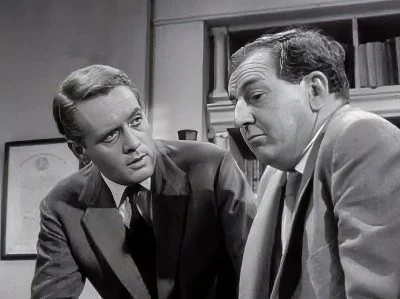
Success, however, remained gradual rather than spectacular.
Everything changed on Good Friday 1960.
Producer Andrew Osborn offered Davies the role of Inspector Jules Maigret in a new BBC adaptation of Georges Simenon's novels. Davies knew almost nothing about the character. Instead of reading all sixty-odd novels, he proposed something far more direct. He wanted to meet Simenon himself.
Osborn agreed, and together they flew to Switzerland to visit the novelist at his home in Echandens. Davies had managed to read only ten pages of a Maigret novel before arriving. According to his recollection, Simenon's reaction was immediate.
"C'est Maigret! C'est Maigret! You are the flesh and bones of Maigret."
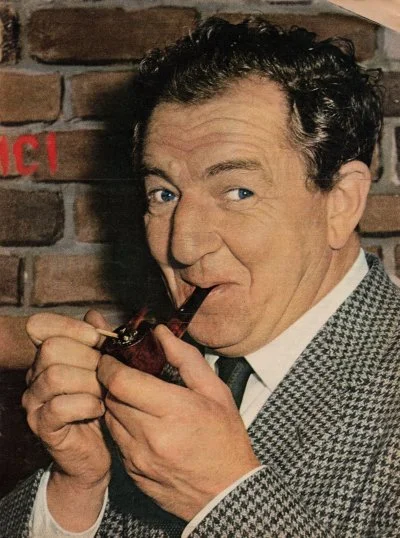
The meeting proved invaluable. Rather than discussing plot or detective technique, Simenon described Maigret as though he were a living person. Davies later recalled that whenever he casually lit his pipe or scratched his neck, Simenon would exclaim, "That's Maigret!"
The instinctive understanding between author and actor endured. After the first series had been completed, Davies returned to Switzerland with films of the programmes. Simenon and his family welcomed him warmly, even greeting him with Ron Grainer's Maigret theme. Both author and wife declared themselves delighted with the portrayal.
For Davies, there could have been no greater endorsement.
Between 1960 and 1963 Davies portrayed Maigret in fifty-two televised adventures, a performance that became one of British television's defining detective portrayals.
Yet the success came at considerable personal cost.
He later admitted that every one-hour programme required around one hundred hours of preparation. Scripts dominated his life. He often worked until two or three o'clock in the morning while his wife Jessica patiently stayed awake beside him.
"I lived, breathed and slept Maigret," he wrote.
His sons, Timothy and Hoagan, were growing up fast during those years, and Davies realised how much of their childhood he had missed.
Although audiences saw only the effortless performance, Davies increasingly felt that Maigret had begun to consume his own identity.
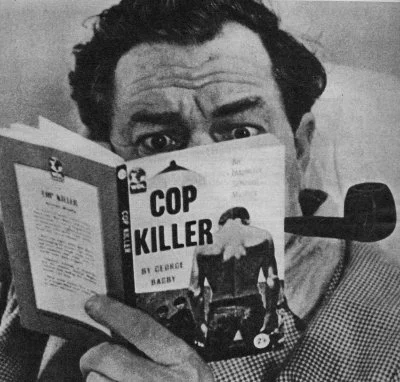
In Today, he wrote: “I was not sorry to part company with Maigret a few weeks ago. The parting came at 10.15 one Tuesday evening in the B.B.C. recording studio TC.4. There was the last jaunty snatch of the ‘‘Maigret theme.’’ I heard voices saying: ‘‘All right.” ‘‘Okay.’’ “‘No retakes.””
And I thought: so that’s it, then.
The big studio lights faded, and I picked my way over the heavy camera cables and took the lift to the sixth floor where there was to be a small celebration. I hung up the slouched hat I had worn in fifty-two Maigret episodes, and someone handed me a whisky. There is always something sad about the ending of a show and this was no different. But I also felt a sense of relief. I raised my glass to a toast: “Maigret is dead. Vive Rupert Davies.”
It was not rejection of the detective.
Indeed, he continued to admire the character deeply, describing him as "more than a detective... an observer of life."
But he desperately wanted audiences and producers to remember that he was an actor, not merely a detective in a heavy overcoat.
Mindful of the dangers of typecasting, Davies had insisted when accepting the role that the BBC guarantee him three entirely different dramatic productions once Maigret finished. It was, he explained, "a form of insurance" against losing his own artistic identity.
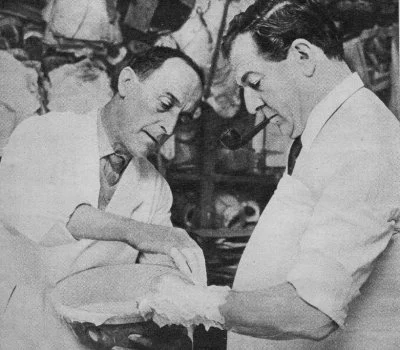
Despite widespread assumptions, Davies never became wealthy through Maigret.
He explained candidly that the financial success of the series had depended largely upon selling it to the American market. Canada bought it; the United States did not.
American broadcasters considered the series morally too relaxed. They disliked Maigret's sympathetic treatment of prostitutes and his straightforward discussions of sexual relationships. Davies found this faintly absurd, but accepted it with good humour.
Free from the detective's overcoat, Davies eagerly embraced varied work.
Television audiences saw him in Man in a Suitcase, The Champions, Doctor at Large, Arthur of the Britons, and as Count Rostov in the BBC's epic adaptation of War and Peace. Younger viewers knew him as the voice of Professor Ian "Mac" McClaine in Gerry Anderson's Joe 90.
His film career also flourished.
He made a memorable appearance as George Smiley in The Spy Who Came in from the Cold (1965), appeared alongside Vincent Price in Witchfinder General, played Father Sandor in Hammer's Dracula Has Risen from the Grave, and later featured in the large-scale productions Waterloo and Zeppelin. In all he appeared in more than thirty films.
Like Maigret, Davies enjoyed smoking a pipe, a coincidence that delighted audiences.
Capitalising on the detective's popularity, he recorded the novelty single Smoking My Pipe in 1963, based upon Ron Grainer's instantly recognisable television theme. The following year he became the inaugural recipient of the Pipe Smoker of the Year award.
His popularity also brought him to This Is Your Life in October 1962, when Eamonn Andrews surprised him in central London.
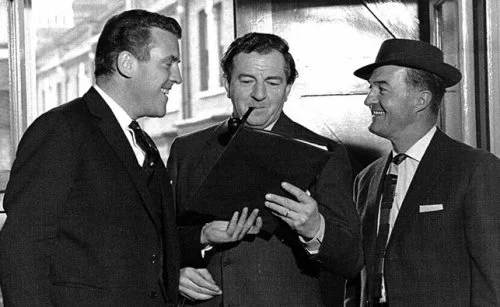
Away from the spotlight, Davies's greatest pleasure was family life.
He and Jessica raised their sons Timothy and Hoagan while maintaining a holiday home on the Llŷn Peninsula in North Wales, a place that remained particularly dear to them.
Davies continued working steadily throughout the 1970s. In one of his most revealing reflections, written shortly after leaving Maigret, he observed: "An actor is a man who never believes he eats until the food is on the fork." It was an expression of both humility and realism. Acting, to Davies, was not glamour but employment. He hoped to be working into old age, remarking that at forty-seven he intended still to be acting when he was eighty-seven.
That ambition was never fulfilled.
Rupert Davies died of cancer in London on 22 November 1976 at the age of sixty.
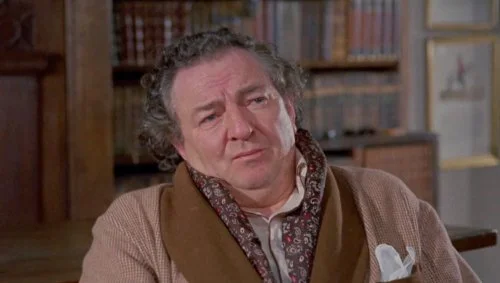
He was buried at Pistyll Cemetery near Nefyn on the Llŷn Peninsula, where he and Jessica had long enjoyed spending time. Jessica was later laid to rest beside him.
Rupert Davies never regarded himself as a star. Even after the extraordinary success of Maigret, he saw himself simply as an actor earning his living, always looking for the next part and hoping audiences would forget the previous one within the first minute of a performance. Yet that modesty was part of his appeal. He brought intelligence, warmth and absolute professionalism to every role, whether leading a major BBC drama or appearing briefly in a supporting part. Like so many of Britain's finest "jobbing actors", he became woven into the fabric of post-war television and cinema. His career was built not on celebrity but on craft, and it is for that quiet excellence that Rupert Davies continues to be remembered.
Share on...
Published on July 14th, 2026. Written by Laurence Marcus for Television Heaven.