

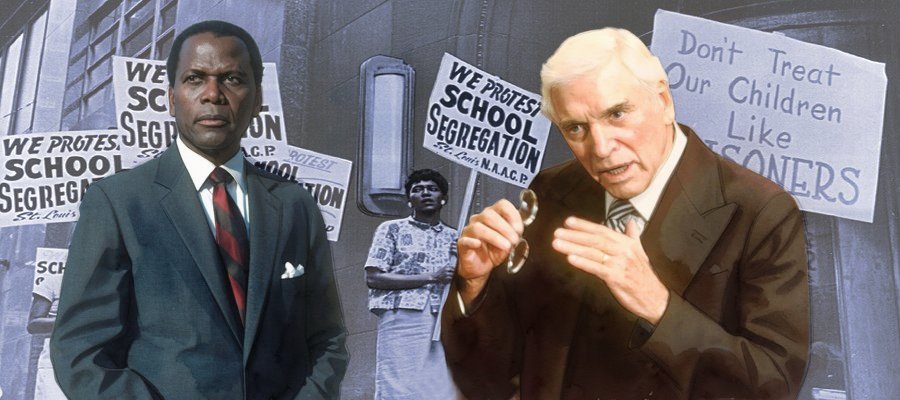
Separate But Equal
1991 United StatesReview: John Winterson Richards
The court room drama is a staple of television, but it is almost invariably the facts of a case that provide the dramatic tension. Separate But Equal, a miniseries shown in two parts on ABC, is therefore unusual in that the facts of the case were never in serious dispute and that the real drama comes in the form of an intelligent discussion of the nature of law.
The case in question concerned the racial segregation of State schools in a number of United States in the late 1940s, the litigation continuing into the early 1950s. By that point, segregation was already viewed widely, certainly in Washington, as something of a national embarrassment, contrary to the high ideals for which Americans, black and white, were supposed to have fought and died in World War Two, and which America was supposed to be defending in the Cold War. Separate But Equal refers to this subtly in passing references to the Korean War and to black American UN official Dr Ralph Bunche receiving the Nobel Prize. Reference could also have been made to US Supreme Court Justice Jackson's moralising as Chief US Prosecutor at the Nuremburg Trials - see our review of Nuremberg - except Jackson appears in Separate But Equal in a far less flattering light.
A legal prohibition of segregation ought to have been straightforward. The Fourteenth Amendment to the US Constitution, passed in the immediate aftermath of the American Civil War and the abolition of slavery by the Thirteenth Amendment, had established the principle of equality before the law very clearly. That should have ended the matter right there. However, in the 1890s, in the case of Plessy v Ferguson, the US Supreme Court had endorsed a legal loophole in a statute passed by a racist Louisiana State Legislature that allowed racial segregation so long as the rights accorded to the segregated races were "equal."
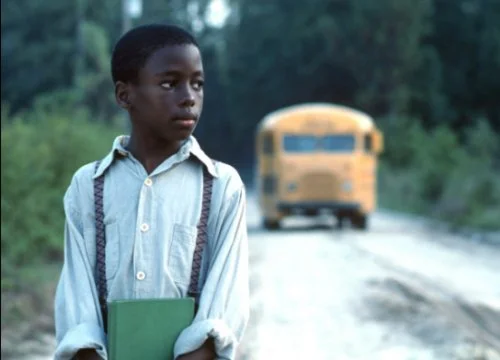
This "equality" was a legal fiction from the start. Black people were invariably restricted to second class everything. The argument was made that this was because they paid less taxes, ignoring the fact they were paying less because they were earning less due to those same restrictions. This was particularly true in education, in which early disadvantage leads to lifelong disadvantage. In Clarendon County, South Carolina, the local School Superintendent spent more than three times as much on each white child as on each black child. His further refusal to assign just one of his 30 school buses to a black school, or even provide fuel for one the black parents finally bought themselves, prompted a brave band, led by their Pastor, to start a court case. They suffered threats and harassment. Some lost their jobs. Even after his eventual victory, the Pastor was forced to flee the State after having the temerity to defend his family when thugs shot at his home. If anything Separate But Equal plays down this aspect.
With the help of the NAACP, the "National Association for the Advancement of Colored People," sic, they still won in their case because it was beyond dispute that they had been treated unequally, and the State agreed to a massive investment in schools for black children. However, by that point the argument had moved on. The Clarendon County parents' case, known as Briggs v Elliott, after the first named plaintiffs and the defendant Superintendent respectively, developed into a full front attack on the very principle of "separate but equal" on the grounds that racial segregation was in and of itself inherently unequal. As such it was heard by the US Supreme Court together with several other cases, including the much better known Brown v Board of Education, to which the dialogue in Separate But Equal refers as "the Kansas case."
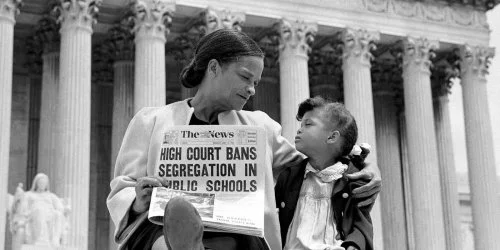
It is hardly a spoiler to say that the good guys won and the Supreme Court struck segregation down because it was obviously the right thing to do. However, the way the Court did it widened a dangerous crevasse in American jurisprudence, or legal philosophy, and may have caused as many problems as it solved. It effectively ignored both its own previous decision in the Plessy case and the nominal will of the people in South Carolina (admittedly not of the whole people since black people were effectively excluded from the political process, but that was not the issue in the Briggs case). In doing so it put a low priority on the legal doctrines of stare decisis, which requires judicial decisions to be consistent with each other, and States' Rights, which are supposed to be guaranteed under the Tenth Amendment to the US Constitution.
More importantly, it also went to the root of the question of what is the law? Is it just the words on the page of a printed statute, interpreted literally? Or should the judge try to look into the minds of the original legislators? Or should the interpretation of the law reflect changes in public attitudes? That was the basis of the decision of the Supreme Court in the Brown, Briggs, and related cases, but it raises a lot of even more difficult questions. First and foremost, what does that make of the rule of law, which is by definition supposed to be a constant standard? Even if there should be flexibility built into the system, who has the right to say they speak on behalf of changing public attitudes? Is that not the function of elected legislators rather than unelected judges? Apart from anything else, was this not the sort of biased judicial intervention which had produced the Plessy decision that caused all the trouble in the first place?
These big questions are explored in the second part of Separate But Equal to a depth that would be unimaginable in a television drama today. The script is necessarily simplified and biased, but still sufficiently honest to make it clear that the more serious opposition to the final decision was not racist but rather was based on legitimate issues in Constitutional philosophy. Indeed, one is left feeling that Justice Reed, who is portrayed, wrongly, as a stubborn reactionary, was right in his concerns about "Krytocracy," rule by judges, subverting Democracy, rule by the people. The basis of the decision in Brown, rather than the decision itself, has a controversial legacy in cases such as Roe v Wade and Dobbs v Jackson that endures to this day.
The first part is less compelling, despite having the greater human interest, because it has a tendency to lapse into cliche, even if it is substantially accurate. Indeed, it rather beats the viewer over the head with a lot of "As you know..." type speeches. That said, it also leaves a lot out, such as the fact that all the antagonistic characters belonged to the party Hollywood supports, and most considered themselves "progressives," while a couple of more sympathetic characters were associated with the other party. The script is particularly unfair to Governor Byrnes, never mentioning that he was no hick politician but a respected statesman who had served on the US Supreme Court himself under FDR and as US Secretary of State under Truman.
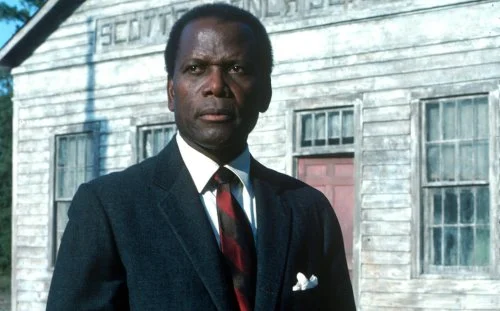
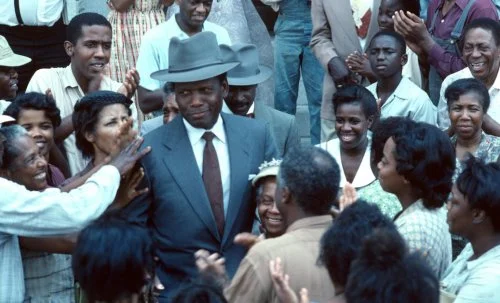
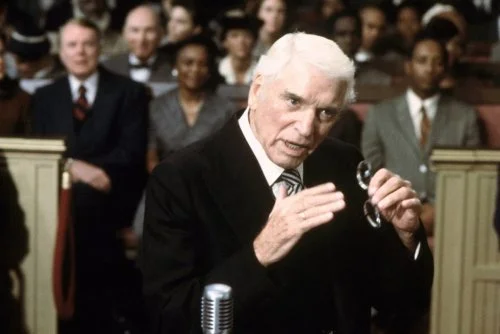
The drama is sustained throughout by a real powerhouse cast. Sidney Poitier has one of his best later roles as Thurgood Marshall, Counsel to the NAACP, destined to be the first black Justice of the US Supreme Court, and no one else could really have played it. His eventual opponent is John W Davis, who had been the unsuccessful Democratic candidate for President in 1924. He is played by Burt Lancaster who, despite being on the Left even by Hollywood standards, portrays him with sympathy and integrity, so that he definitely gets the better of Marshall in their first encounter. It turned out to be Lancaster's last performance and a good one with which to leave the stage.
Richard Kiley, who had originated the role of Don Quixote in Man of La Mancha before becoming something of a miniseries specialist in his later career, plays newly appointed Chief Justice Earl Warren as the smooth political operator he seems to have been. Mike Nussbaum practically steals the second part as Justice Felix Frankfurter, the hyper-intellectual jurist's jurist, who was nevertheless possibly wrong on this one. Cleavon Little (Blazing Saddles), also in what tragically turned out to be one of his last roles, and a precocious young Jeffrey Wright play two members of Marshall's close knit NAACP legal team who both went on to higher things. The production values are good, even if the camerawork and the stirring score by Carl Davis - presumably no relation to the antagonist - make it rather too obvious what the viewer is supposed to be feeling at any point in time. As so often, the actual story told straight, without the emotional manipulation, would have had greater punch.
Seen this show? How do you rate it?
Seen this show? How do you rate it?
Share on...
Published on April 13th, 2026. Written by John Winterson Richards for Television Heaven.